


The Terafab Manifesto: Inside Musk’s Ambitious Plan to Control the Silicon Supply Chain

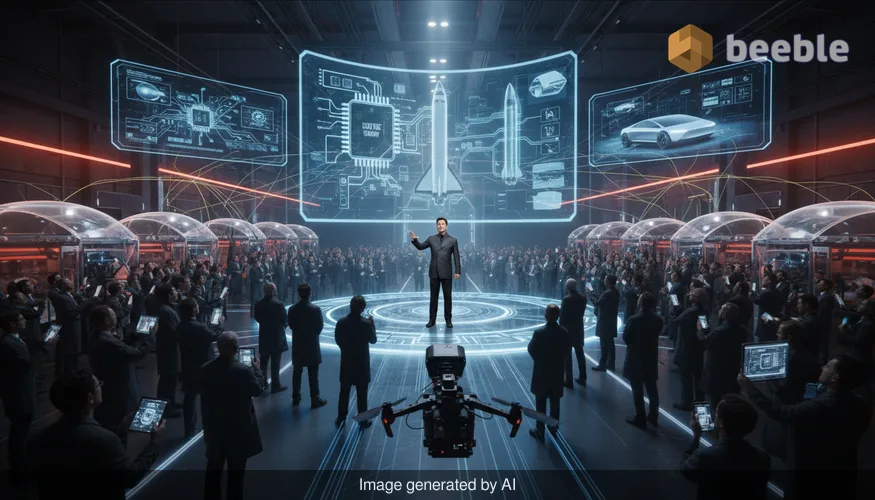
What happens when the world’s most ambitious supply chain hits a wall made of silicon? For Elon Musk, the answer isn’t to wait for a vendor to fix the problem; it is to build the solution from the ground up. This past Saturday night in downtown Austin, Musk unveiled his latest disruptive venture: the “Terafab.” This facility, a collaborative effort between Tesla and SpaceX, represents a paradigm-shifting move toward total vertical integration in the semiconductor space.
Located near Tesla’s existing Austin headquarters and Giga Texas, the Terafab is designed to address a friction-heavy reality that Musk’s companies face daily. According to Musk, traditional semiconductor manufacturers simply aren’t moving fast enough to satisfy the hunger of his AI and robotics divisions. “We either build the Terafab or we don’t have the chips,” Musk stated with characteristic bluntness. Essentially, he is treating the global chip shortage not as a temporary market fluctuation, but as a permanent bottleneck that requires an unprecedented infrastructure response.
The Scale of the Terafab: Earth and Beyond
To understand the magnitude of this project, one has to look at the numbers. Musk is targeting a production capacity capable of supporting 100 to 200 gigawatts of computing power per year for terrestrial applications. Even more remarkable is the goal for space: a full terawatt of computing power. To put it another way, Musk isn’t just building a factory; he is constructing a utility grid for the next generation of intelligence.
In practice, these figures are staggering. If we view the cloud as a utility grid, Musk is effectively trying to build his own power plants rather than buying electricity from the established providers. This scalable approach is necessary because Tesla’s Optimus robot and FSD (Full Self-Driving) suites are essentially sophisticated computers on wheels and legs. They require massive amounts of local processing power to navigate the unpredictable physical world. Meanwhile, SpaceX’s needs are even more specialized. Operating in the volatile environment of orbit requires chips that are not only powerful but also hardened against radiation and extreme thermal cycles.
Training the AI Apprentice
Musk often speaks of training AI as raising an apprentice. You cannot expect a student to learn if they don’t have the right tools or enough time in the classroom. In this metaphor, the chips produced by the Terafab are the classrooms. Without them, the development of Tesla’s neural networks slows to a crawl. By bringing chip manufacturing in-house, Musk aims to create a seamless feedback loop between hardware design and software implementation.
I recall a similar, albeit smaller-scale, challenge during my years working in tech startups. We were dealing with a legacy system—what we called “Software Archaeology”—where every new feature felt like adding a brick to a precarious tower. We suffered through the engineering vs. product tug-of-war, where our ambitions were constantly throttled by infrastructure constraints. We eventually had to build our own internal tooling because the off-the-shelf solutions were too bloated. Musk is doing this on a global, perhaps even interplanetary, scale. He is bypassing the “PR review bottleneck” of the global semiconductor industry to ensure his companies can iterate at the speed of thought.
The Space Frontier and Technical Debt
SpaceX’s involvement in the Terafab is perhaps the most nuanced part of the announcement. Why does a rocket company need a terawatt of computing in space? The answer lies in the future of Starlink and Mars colonization. As the network grows, the need for sophisticated, low-latency edge computing in orbit becomes critical. Relying on Earth-bound manufacturers for these specialized components creates a vulnerable supply chain.
Curiously, Musk’s move also addresses the concept of technical debt. Most modern chips are designed for general-purpose use, which often leads to inefficiencies when applied to specific tasks like real-time robotic vision or orbital telemetry. By designing bespoke silicon, Tesla and SpaceX can avoid the “monolith” of generic hardware. This allows them to strip away the obsolete features found in standard chips, resulting in a sleek, highly optimized architecture tailored specifically for their ecosystems.
Risks of the Silicon Gambit
Nevertheless, building a semiconductor fabrication plant—let alone a “Terafab”—is an intricate and multifaceted undertaking. The industry is notoriously volatile, and the capital expenditures required are enough to make even the most robust balance sheets look thin. There is also the risk of scope creep. We’ve seen this before in massive tech projects where the initial vision is so grand that the execution becomes a friction-heavy slog.
Oddly enough, Musk did not provide a concrete timeline for when the Terafab would be operational. This lack of a schedule suggests that even he recognizes the complexity of the task. Building a fab isn’t just about pouring concrete and buying machines; it’s about mastering the physics of the microscopic. It’s an environment where a single speck of dust can be as catastrophic as a 3 AM production incident in a data center. Consequently, the success of the Terafab will depend on whether Musk can attract the specialized talent needed to run such a sophisticated operation.
A New Paradigm for Tech Giants
Is the Terafab a sign of things to come for the rest of the industry? We are seeing a trend where organizations are increasingly viewed as living organisms that must produce their own “nutrients” to survive. Apple has already moved toward its own silicon, and Amazon and Google are following suit with their own AI chips. Musk’s plan, however, is more aggressive because it includes the actual manufacturing, not just the design.
Because of this, the Terafab could represent the end of the era where tech companies are beholden to a handful of massive foundries. If Musk succeeds, he will have turned his companies into a self-sustaining ecosystem, immune to the whims of global trade disputes or shipping delays. It is a bold, perhaps even precarious, bet on the future of autonomy and space exploration.
What to Watch Next
As we wait for more details on the Terafab, tech leaders and investors should keep a close eye on several key indicators:
- Talent Acquisition: Watch for high-level poaching from established players like TSMC, Intel, or Samsung.
- Permitting and Construction: Keep an eye on Austin’s local government filings for updates on the facility’s footprint.
- Hardware Benchmarks: Look for mentions of “Dojo 2” or new Starlink hardware that might hint at early Terafab prototypes.
Sources:
- Bloomberg News: Musk Announces Terafab Plans in Austin.
- Tesla Investor Relations: AI and Robotics Update.
- SpaceX Mission Briefings: Future of Starlink Infrastructure.
- Semiconductor Industry Association: Global Fab Capacity Reports.



See you on the other side.
Our end-to-end encrypted email and cloud storage solution provides the most powerful means of secure data exchange, ensuring the safety and privacy of your data.
/ Create a free account
