


The Transparency Trap: Why Europe is Reining in Mass Data Disclosures

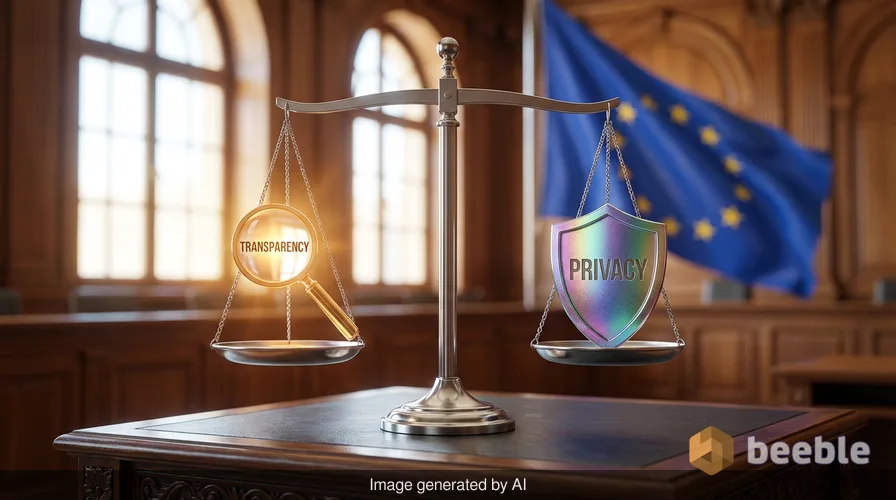
Have you ever wondered why a government’s quest for 'transparency' often ends up feeling like an invasion of your living room? It is a tension I encounter frequently in my work as a digital detective. We are told that sunlight is the best disinfectant, yet when that light is focused too intensely on the private lives of individuals, it doesn't just disinfect—it burns.
In the regulatory landscape of the European Union, we are currently witnessing a sophisticated pushback against the 'more is better' approach to data collection. Two recent legal battles—one involving NGO donors in Slovakia and another concerning company owners across the EU—have sent a clear message to lawmakers: transparency is not a blank check to ignore privacy.
The Slovakian Standoff: When Donors Become Targets
Imagine you are a private citizen who feels passionately about a local environmental cause. You donate your hard-earned savings to an NGO to help protect a forest. Suddenly, a new law demands that your name, address, and the exact amount you gave be published on a public website for anyone to see.
This was the reality in Slovakia until the Constitutional Court stepped in. The government argued that publishing the details of everyone donating over 5,000 euros was necessary to fight the shadow economy and stop 'undue influence.' On the surface, it sounds noble. In practice, it was a systemic overreach.
The Court ruled that this blanket obligation was disproportionate. From a compliance standpoint, the government failed to prove that such a broad intrusion was the only way to achieve their goals. Essentially, they were using a sledgehammer to crack a nut, and in doing so, they threatened the very foundation of civil society by potentially exposing donors to harassment or political retaliation.
The UBO Registry: A Lesson in Proportionality
This isn't just a Slovakian quirk; it’s a pan-European shift. For years, the EU pushed for 'Ultimate Beneficial Owner' (UBO) registries. These are databases designed to reveal who actually pulls the strings behind a company, a vital tool in the fight against money laundering.
Initially, the Fifth Anti-Money Laundering Directive mandated that these registries be open to the general public. Anyone with an internet connection could browse the personal data of business owners. However, the Court of Justice of the European Union (CJEU) recently struck this down.
The court’s reasoning was nuanced but firm: while fighting financial crime is a legitimate interest, granting the entire world access to personal data without a specific reason is a serious interference with the right to privacy. Now, access must be limited to those who can demonstrate a 'legitimate interest,' such as investigative journalists or NGOs fighting corruption. Privacy, in this context, acts as a filter rather than a wall.
Privacy as a Foundation, Not a Checkbox
When I analyze these cases, I often think of privacy by design as the foundation of a house. If you build a house without a foundation, it doesn't matter how beautiful the windows are; the structure will eventually collapse. Similarly, a law designed for transparency will fail if it isn't built on a foundation of data minimization.
Data minimization is the principle that you should only collect and share what is strictly necessary. In my own editorial work, I apply this meticulously. If I’m reporting on a data breach, I don’t need to show a screenshot with a victim's phone number to tell the story. I redact, I anonymize, and I protect. Lawmakers are finally being forced to do the same. They are learning that information is not just an asset; it is a toxic asset. If you collect it without a robust reason, you are creating a liability for everyone involved.
Navigating the Regulatory Maze
For organizations and individuals alike, these rulings serve as a compass. They remind us that the 'right to be forgotten' and the right to a private life are not just academic concepts—they are actionable legal protections.
Curiously, the trend is moving toward granular control. Instead of a 'one size fits all' disclosure, we are seeing a shift toward 'need to know' access. This makes the role of a Data Protection Officer (DPO) more like a translator, bridging the gap between the government’s demand for data and the individual’s right to be left alone.
Practical Takeaways for the Digital Age
Whether you are running an organization or simply managing your own digital footprint, here is how to stay on the right side of this evolving landscape:
- Audit your disclosures: If your organization publishes data, ask: "Is this specific detail necessary to achieve our goal?" If you can achieve transparency with pseudonymous data, do it.
- Question 'Public Interest' claims: Just because a government or company claims a public interest doesn't mean they have a right to your entire digital identity. Look for the legal basis.
- Practice Digital Hygiene: Use encrypted channels for sensitive communications. Treat your personal data like a valuable currency—don't spend it where you don't have to.
- Demand Proportionality: In any data-sharing agreement, ensure the scope of data is limited to the specific purpose of the processing.
Ultimately, these court rulings are a victory for the individual. They prove that even in an era of 'Big Data,' the law still values the quiet dignity of a private life. Transparency and privacy are not enemies; they are two sides of the same coin, and we are finally learning how to balance them.
Sources
- Court of Justice of the European Union, Joined Cases C-37/20 and C-601/20 (Luxembourg, 2022).
- Constitutional Court of the Slovak Republic, Ruling on the Amendment to the Act on Non-Profit Organizations (2024/2025).
- EU Charter of Fundamental Rights, Articles 7 (Respect for private and family life) and 8 (Protection of personal data).
- General Data Protection Regulation (GDPR), Article 5 (Principles relating to processing of personal data).
- Directive (EU) 2018/843 (Fifth Anti-Money Laundering Directive).
Disclaimer: This article is for informational and journalistic purposes only. It provides an analysis of legal trends and court rulings but does not constitute formal legal advice. For specific legal concerns, please consult with a qualified legal professional.



See you on the other side.
Our end-to-end encrypted email and cloud storage solution provides the most powerful means of secure data exchange, ensuring the safety and privacy of your data.
/ Create a free account
