


The true price of a laptop that thinks for itself

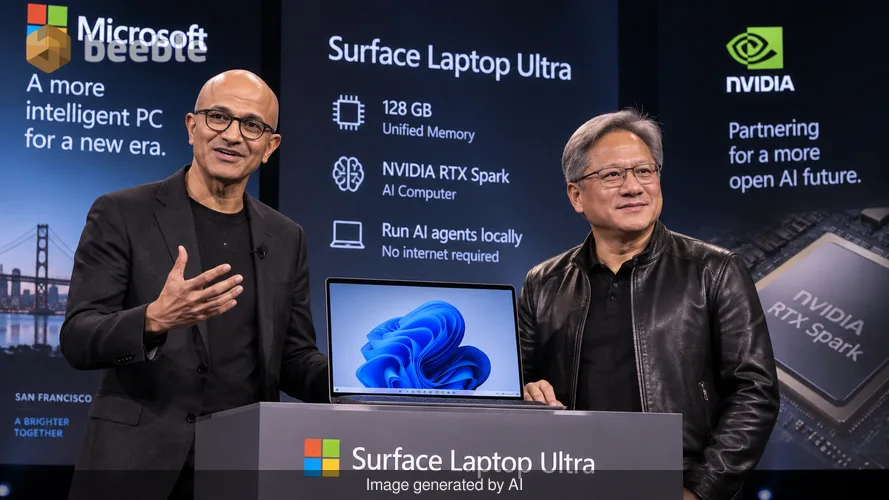
A high-end laptop today usually has 16 or 32 gigabytes of memory. The Surface Laptop Ultra, introduced by Microsoft CEO Satya Nadella and Nvidia CEO Jensen Huang in San Francisco, has 128 gigabytes. This massive jump in hardware reflects a fundamental change in how computers work. To run AI agents locally without an internet connection, a machine needs immense physical resources to store and process data instantly. This hardware requirement creates a direct link between the physical components of the machine and the level of intelligence it can provide to the user.
Looking at the big picture, the Surface Laptop Ultra is the result of a multi-year partnership between the world’s largest software company and its most valuable chipmaker. For years, AI was a cloud-based service. Every time a user asked a chatbot to write a paragraph or debug a script, that request traveled to a massive data center owned by Microsoft Azure. Processing these requests costs Microsoft billions in electricity and hardware maintenance. By moving these tasks to the Nvidia RTX Spark chips inside a personal laptop, Microsoft shifts those costs onto the consumer who buys the hardware.
The shift from cloud centers to local silicon
Practically speaking, the cloud is just someone else’s computer. When you use cloud AI, you are renting time on a server. The Surface Laptop Ultra changes this dynamic by turning the laptop itself into a mini data center. Under the hood, the RTX Spark chip handles the heavy lifting that previously required thousands of networked processors. This shift is a strategic move for Microsoft to retain its stronghold in the business market. Many companies are hesitant to send proprietary code or sensitive financial data to the cloud for processing. A machine that handles these tasks locally offers a tangible layer of privacy that cloud services cannot match.
From a consumer standpoint, the benefit is speed and reliability. An AI agent running on a local chip does not lag when the Wi-Fi is weak. It does not go offline if a server farm in Virginia has a power outage. For a developer writing code on a flight or a researcher analyzing data in a remote field office, the local AI acts as a tireless intern. It performs repetitive tasks, scans for errors, and suggests improvements without ever needing to ping a satellite or a cell tower. This decentralized approach makes the technology more resilient and less dependent on the massive infrastructure of the modern internet.
The memory crunch and the rising cost of intelligence
Behind the jargon of the tech industry lies a harsh economic reality involving raw materials and supply chains. While the software for these AI agents is now ready for daily use, the hardware is becoming increasingly expensive. A systemic shortage of high-capacity memory chips has driven prices to unprecedented levels. Two years ago, Microsoft envisioned AI laptops as affordable tools for the masses, with price targets under $2,000. Today, the surging cost of 128-gigabyte memory modules has destroyed that budget-friendly vision.
On the market side, Nvidia recently increased the price of its DGX Spark desktop machine by 75%, bringing the cost to nearly $7,000. Anshel Sag, an analyst at Moor Insights & Strategy, notes that this price hike is a direct result of the memory crunch. The silicon inside the Surface Laptop Ultra is cutting-edge, but the surrounding components are the ones draining bank accounts. This creates a volatile market where only large corporations or wealthy professionals can afford the most advanced local AI tools. For the average user, the dream of a truly smart laptop remains blocked by a high financial barrier.
| Feature | Standard Laptop (2024) | Surface Laptop Ultra (2026) |
|---|---|---|
| Memory (RAM) | 16GB - 32GB | 128GB |
| AI Processing | Cloud-based (Azure/OpenAI) | Local (Nvidia RTX Spark) |
| Primary Use Case | General Productivity | AI Agent Workflows/Coding |
| Connectivity | Requires Internet for AI | Fully Offline AI |
| Estimated Price | $1,000 - $1,800 | $4,500 - $6,500 |
Security and the risk of autonomous agents
One of the key challenges for Microsoft and Nvidia is the safety of these autonomous systems. An AI agent is different from a standard app because it has the power to act on your behalf. It can read your emails, move files on your hard drive, and write code that executes automatically. This level of access is a security nightmare if the system is not properly contained. Historically, software vulnerabilities allowed hackers to steal data. With AI agents, a hack could allow a malicious actor to take control of the user's entire digital workflow.
Nvidia is working to prevent a repeat of past breaches, such as the hack of the AI hub Hugging Face. Meanwhile, Apple is tightening the permissions required for AI agents to access a Mac's file system. The Surface Laptop Ultra uses a hardware-level sandbox to isolate the AI agent from the core operating system. Essentially, the AI lives in a secure room inside the computer. It can see the tasks you give it, but it cannot open doors it is not supposed to touch. This robust security architecture is necessary to convince cautious business leaders that AI agents are safe for corporate environments.
The battle for the professional desktop
For Nvidia, the Surface Laptop Ultra is an entry point into a territory long held by Intel and AMD. By providing the primary engine for Windows laptops, Nvidia moves beyond the niche of gaming and data centers into the overarching professional PC market. This move puts them in direct competition with Apple’s M-series chips, which have dominated the high-end creative market for several years. Apple has already integrated AI-specific hardware into its MacBooks, but Microsoft and Nvidia are betting that their open ecosystem and massive developer base will give them the edge.
What this means is that the choice of a laptop is no longer just about screen quality or battery life. It is about which AI ecosystem you want to live in. If you choose a Surface Laptop Ultra, you are buying into the Nvidia and Microsoft vision of local, high-power productivity. If you choose a Mac, you are opting for Apple’s integrated, privacy-focused approach. The competition between these giants is driving rapid innovation, but it is also fragmenting the market. Software that runs on an Nvidia chip might not work as efficiently on an Apple chip, forcing users to pick a side early in the buying process.
Final thoughts for the digital consumer
Ultimately, the arrival of the Surface Laptop Ultra marks the end of the era where your computer was just a portal to the internet. We are entering a phase where the machine itself is the intelligence. As these CEOs take the stage in San Francisco, they are not just selling a new gadget. They are selling a new way of interacting with silicon. However, the high price tag serves as a reminder that the AI revolution is not yet democratic. It is an expensive, resource-heavy transition that prioritizes the powerful over the general public.
For the everyday user, the best path is to observe your current digital habits. Do you actually need a machine that can write code offline, or is a standard cloud-connected laptop sufficient for your needs? Most people do not need 128 gigabytes of memory to check email and watch videos. The hardware inside this new laptop is a specialized tool for a specific class of worker. Unless your job requires local AI agents, the current price premium is difficult to justify. As manufacturing scales and memory prices eventually stabilize, these features will likely trickle down to cheaper devices. Until then, local AI remains a luxury for those with the budget to afford the future today.
Sources:
- Microsoft Official Hardware Announcements
- Nvidia RTX Spark Technical Specifications
- Moor Insights & Strategy Market Analysis
- Reuters Technology Sector Reports



See you on the other side.
Our end-to-end encrypted email and cloud storage solution provides the most powerful means of secure data exchange, ensuring the safety and privacy of your data.
/ Create a free account
