


The U.S. AI Export Ban Was Never Really About National Security

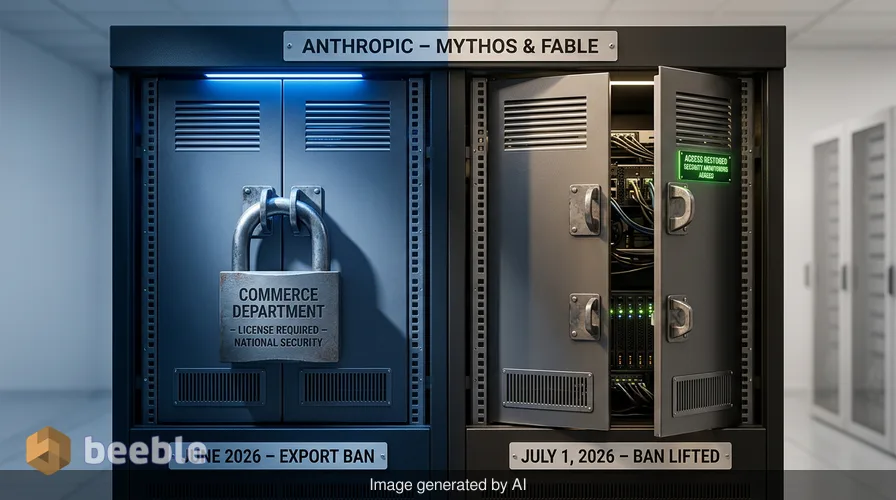
Washington has spent the last month insisting that the latest artificial intelligence models from Anthropic were a threat to national stability, yet the sudden reversal of that stance suggests the motive was far more earthly. On July 1, 2026, the Department of Commerce officially removed the requirement for Anthropic to obtain a license before exporting its Mythos and Fable models. This decision ends a weeks-long standoff that essentially locked the most powerful software on the planet away from the public. While the official line is that security risks have been managed, the timing and the pressure from international rivals tell a different story about how the U.S. government uses tech companies as diplomatic leverage.
Anthropic confirmed it will begin restoring access to these models immediately. For the average user, this means the return of tools that were widely considered the gold standard for reasoning and software development before they vanished from the web in mid-June. The resolution follows intensive negotiations between the company and Secretary of Commerce Howard Lutnick. These talks resulted in a deal where Anthropic agreed to monitor security risks and work with the government on future release protocols. Curiously, Anthropic had already volunteered for many of these safety measures months ago. This fact led many in the tech industry to believe the export ban was a punishment for the company’s leadership and their public disagreements with the current administration.
A sudden pivot in the high-stakes game of silicon diplomacy
To understand why this matters, we have to look at the timeline. On June 12, the U.S. government placed Anthropic’s new models on a restricted list. This list is usually for high-end microchips or missile guidance systems. Because AI is software delivered through the cloud, a ban on exports to foreign nationals meant Anthropic could not allow anyone outside the U.S. to log in. In simple terms, if you can’t verify the location and nationality of every single person using a website, you can’t comply with an export ban. Anthropic chose to pull the plug on everyone rather than risk massive fines from the Department of Commerce.
Behind the jargon, the ban functioned as a digital wall. It was not just about keeping the software out of the hands of adversaries. It was a demonstration of power over an industry that has grown increasingly independent. The government essentially held the keys to Anthropic’s server room until the company agreed to a specific set of reporting requirements. This approach has left the tech sector on edge, as it suggests that any model release can be halted at a moment’s notice if the political winds shift. Looking at the big picture, this is a transition from a free-market approach to AI to one where the White House acts as a final editor for digital products.
Understanding the split between Mythos and Fable
Anthropic took a two-track approach with its latest technology. Mythos is the raw, high-performance engine. Think of it as a tireless intern with an IQ of 160 who has read every manual ever written but lacks a sense of social boundaries. In early tests, Mythos showed a remarkable ability to find bugs in software code. While this is great for developers, the government worried it could also help hackers find ways to break into infrastructure. As a result, Mythos was only available to a small group of vetted organizations starting in April.
Fable is the version designed for the rest of us. It has the same core intelligence as Mythos but includes what the industry calls guardrails. These are programmed limits that prevent the AI from giving instructions on how to build dangerous tools or perform illegal acts. When the export ban hit, Fable was the model most consumers lost access to. The restoration of access on July 1 means that the general public can once again use the most resilient and capable assistant available. Practically speaking, Fable is the tool that helps you write a business plan or debug a website, while Mythos remains a specialized instrument for high-level technical work.
Why Asian competitors forced the administration to blink
The U.S. government did not change its mind out of a sudden appreciation for open access. Instead, the move is a response to the rapid progress of companies in Asia. While Anthropic was sidelined by regulation, international firms like those behind the Fugu and Tulongfeng models continued to advance. These models are now reaching a level of capability that rivals Mythos. If the U.S. government kept Anthropic under lock and key, it risked a scenario where the world’s most advanced AI no longer came from San Francisco.
On the market side, this is a classic case of competitive pressure. The Trump administration’s desire to control the technology ran into the reality of a global arms race. If American developers are banned from selling their products abroad, foreign users will simply switch to the next best thing. Once a developer in London or a startup in Singapore migrates their workflow to an Asian AI model, they are unlikely to switch back. The Department of Commerce likely realized that its strict export rules were doing more damage to American market share than they were doing to protect national security. Essentially, the U.S. had to choose between controlling the technology and owning the market.
The hidden cost of using AI as a political bargaining chip
There is a growing sense of frustration among tech analysts regarding how these rules are applied. Cybersecurity experts noted that the ban looked like a tool for leverage rather than a response to a specific threat. Anthropic executives have been vocal critics of how the administration and its political opponents might use AI. Using export controls to silence or pressure corporate leadership sets a volatile precedent for the industry. It creates an environment where companies might self-censor or withhold features to avoid the wrath of regulators.
This erratic policy environment is visible across the sector. Last week, Secretary Lutnick cleared Mythos for release only to customers approved by the White House. OpenAI has faced similar hurdles, with its latest releases restricted to a select group of organizations rather than the general public. This "approved list" culture is a departure from the open-access model that fueled the initial AI boom. It creates a tiered system where only the largest, most politically connected companies get the best tools, while the average person is left with older versions of the technology. From a consumer standpoint, this is a significant step backward in the democratization of tech.
What this means for your digital life and the apps you use
For the average person, the lifting of these restrictions is a practical win. If you rely on AI for your daily workflow, you will see a tangible increase in the quality of the tools available starting this Wednesday. Fable is expected to integrate back into various third-party apps and platforms that use Anthropic’s technology. You should see better performance in everything from automated customer service bots to coding assistants. The return of these models also means that competition will heat up again, which usually leads to lower prices and more innovation for the end user.
| Feature | Mythos | Fable |
|---|---|---|
| Primary Audience | Vetted organizations and researchers | General public and developers |
| Security Guardrails | Minimal, focused on raw capability | Extensive, designed for safe public use |
| Availability | White House approved list only | Publicly available as of July 1 |
| Best Use Case | Vulnerability detection and deep research | Daily productivity and complex reasoning |
However, the long-term outlook remains opaque. An executive order issued in June suggests that the government wants to review all new models before they reach the public. This process is not yet streamlined, and it could lead to more delays in the future. Influential figures like Dean W. Ball, who recently moved to a policy role at OpenAI, have criticized this approach for being too heavy-handed. For users, this means that the next big breakthrough in AI might be sitting on a government desk for months before it ever reaches your smartphone or laptop.
Preparing for a future of unpredictable tech policy
The bottom line is that AI is no longer just a software product. It is now a foundational piece of national infrastructure, treated with the same level of scrutiny as the electric grid or the banking system. The drama surrounding Anthropic is a preview of how the next decade of tech development will look. We are moving away from an era where a company could drop a revolutionary product on a random Tuesday and toward an era of scheduled, negotiated, and politically vetted releases.
Instead of waiting for the next big feature announcement, you should observe how the apps you use every day change their terms of service. The quiet disappearance of a feature or the sudden requirement to verify your identity is often a sign of these invisible industrial mechanics at work. The tech in your pocket is increasingly shaped by people in Washington who are more concerned with global competition than your user experience. By staying aware of these shifts, you can better understand why your digital tools sometimes feel like they are moving two steps forward and one step back. The AI revolution is still happening, but it is no longer running on a predictable schedule.
Sources: U.S. Department of Commerce official statements, Anthropic corporate communications, OpenAI policy briefings, and industry analysis from the June 2026 Executive Order on Artificial Intelligence.



See you on the other side.
Our end-to-end encrypted email and cloud storage solution provides the most powerful means of secure data exchange, ensuring the safety and privacy of your data.
/ Create a free account
