


The US AI export ban is backfiring as Asian startups launch their own frontier models

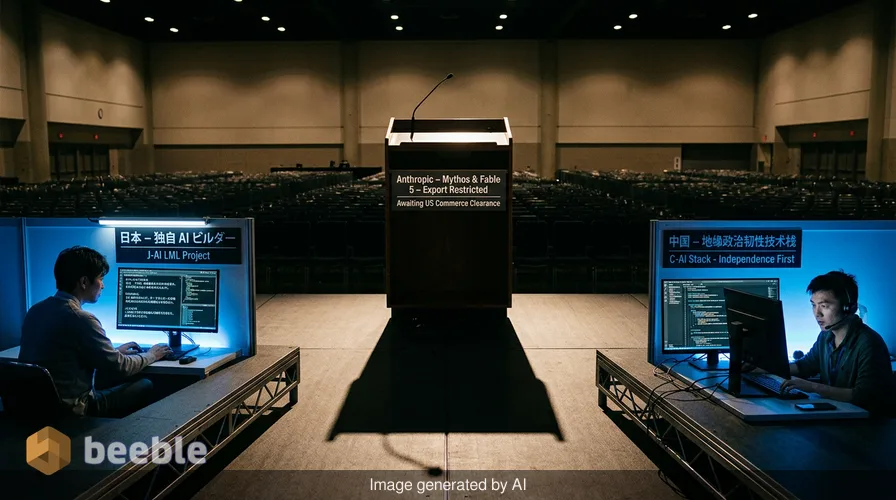
While many believe that keeping the most advanced AI models inside US borders preserves a technological edge, this policy is creating a Darwinian pressure on international markets. Export controls are intended to safeguard secret sauce, but in the fast-moving world of software, they often act as a massive subsidy for foreign competitors. When the US government restricted Anthropic from exporting its Mythos and Fable 5 models to non-Americans earlier this month, it did not stop the demand for high-end AI in Asia. It simply removed the biggest American player from the room.
Looking at the big picture, the vacuum created by these bans is already being filled by local companies in Japan and China. These startups are not just copying what exists. They are building tools that are more resilient to geopolitical shifts and better suited to local languages. For the average user, this means the next wave of clever apps and secure software might not come from Silicon Valley, but from firms that the US government is inadvertently helping to grow.
The blowfish in the room
Sakana AI is a Tokyo-based startup founded by former Google researchers who understand the plumbing of modern AI. Last week, the company released Fugu, a model named after the Japanese blowfish. The name is a direct reference to the idea of a product that is powerful and requires careful handling but is essential to the local ecosystem. Sakana claims this model matches the capabilities of Anthropic’s Fable 5 and Mythos Preview.
Behind the jargon, Fugu is an orchestration model. This means it does not just answer questions; it acts as a manager that coordinates other AI models through their APIs. This design is a practical response to the risk of export bans. If a business relies on a single provider like Anthropic or OpenAI, its operations can stop overnight if a government official signs a new order. Fugu allows a company to spread its work across many different models. If one is blocked, the system moves the task to another. David Ha, the CEO of Sakana, describes this as a hedge against the concentration of power. This approach turns a single point of failure into a resilient web.
China turns security into a strategic asset
While Sakana positions itself as a practical alternative for allies, the reaction in China is more confrontational. The cybersecurity firm 360 recently launched two tools: Tulongfeng and Yitianzhen. These are not general-purpose chatbots for writing poetry or planning vacations. They are industrial-grade tools for finding software bugs and defending networks against hackers.
Zhou Hongyi, the founder of 360, argues that high-end AI for finding vulnerabilities is a national strategic asset. He describes the current situation as one-way transparency. This is a scenario where one country has the AI tools to find and exploit weaknesses in software, while other countries are banned from using those same tools for defense. By launching Tulongfeng, 360 aims to end this imbalance. These models are designed to go head-to-head with Mythos, the very model the US government currently keeps under lock and key. This development shows that export bans do not prevent the creation of powerful technology. They change who owns it and where the profits go.
The economic cost of the digital wall
On the market side, the numbers suggest that US companies have a lot to lose. In May 2026, Anthropic reported a revenue run rate of $47 billion. This is a massive sum for a company that was a small lab just a few years ago. A significant portion of that growth comes from enterprise customers in Asia who want to automate their businesses. When the US government blocks access to Mythos, it hands those customers to Sakana and 360.
Practically speaking, businesses prefer stability over raw performance. A Japanese bank or a Chinese manufacturer will choose a local model that is slightly less capable but 100% available over a US model that might disappear due to a change in trade policy. This shift is tangible in the way Sakana is marketing Fugu. The company specifically highlights that its product is free from the risk of export controls. This is a powerful selling point in a volatile global economy.
| Model Name | Origin | Primary Use Case | Market Strategy |
|---|---|---|---|
| Mythos | USA (Anthropic) | High-end reasoning & security | Banned for non-US users |
| Fugu | Japan (Sakana AI) | Agent orchestration | Hedge against export risk |
| Tulongfeng | China (360) | Vulnerability discovery | Strategic national defense |
| Yitianzhen | China (360) | Incident response | Automated cyber defense |
Why local nuance beats raw power
Beyond politics, there is a technical reason why these Asian models are gaining ground. US models are often trained on massive amounts of English-language data. While they are impressive, they frequently miss the nuance of local languages and business cultures. Sakana AI has spent the last year optimizing its models for the Japanese language. These models work well even with smaller datasets, which makes them more affordable to run.
Under the hood, these local models are like a car designed for the narrow streets of Tokyo rather than the wide highways of Texas. They are efficient and fit the environment perfectly. For a Japanese government agency, a model that understands the specific etiquette of local bureaucracy is more useful than a massive US model that understands every language but masters none. This specialization makes it harder for US companies to win back customers even if the export bans end. Once a company builds its infrastructure around a local provider, the cost of switching back is often too high.
The shifting global power map
Historically, the US has dominated the tech industry by being the open platform for the world. By moving toward a more closed system, it is forcing other nations to develop their own backbone for the digital age. This is not a temporary trend. It is a fundamental change in how the world develops technology. AI is the digital crude oil of the 21st century. No country wants to depend on a foreign power for its fuel.
Essentially, the export ban on Anthropic’s models has acted as a starting gun for a new arms race. Instead of one global leader, we are seeing the emergence of regional champions. These companies are building robust, decentralized systems that do not rely on a single government’s permission to operate. This makes the global tech ecosystem more complex, but it also makes it more resilient to the whims of any single politician.
What this means for your digital life
From a consumer standpoint, the rise of regional AI models will change the products you use. You might soon find that your smartphone or laptop uses different AI engines depending on where you are in the world. This is not necessarily a bad thing. Competition drives down prices and forces companies to innovate faster.
To put it another way, the era of the one-size-fits-all global AI is ending. In its place, we are getting a more fragmented but diverse set of tools. You should observe how your favorite apps handle your data and which models they use under the hood. Diversification is the best way to ensure that your digital life does not go dark because of a trade dispute.
Ultimately, the takeaway for the everyday user is to stop viewing AI as a single, monolithic entity owned by a few US giants. The technology is becoming a foundational part of global infrastructure, much like electricity or the internet. As it spreads, it becomes harder for any one country to control. You should look for services that offer choice and transparency rather than those that lock you into a single, potentially volatile provider. The future of tech is not about who has the biggest model, but who can keep the lights on when the political winds change.
Sources: Sakana AI official product release, Reuters report on 360 cybersecurity tools, TechCrunch interview with Ren Ito, Anthropic financial performance disclosure.



See you on the other side.
Our end-to-end encrypted email and cloud storage solution provides the most powerful means of secure data exchange, ensuring the safety and privacy of your data.
/ Create a free account
