


The US Government Just Got the Keys to the AI Kingdom—and It Might Be the Best Thing for Your Digital Security

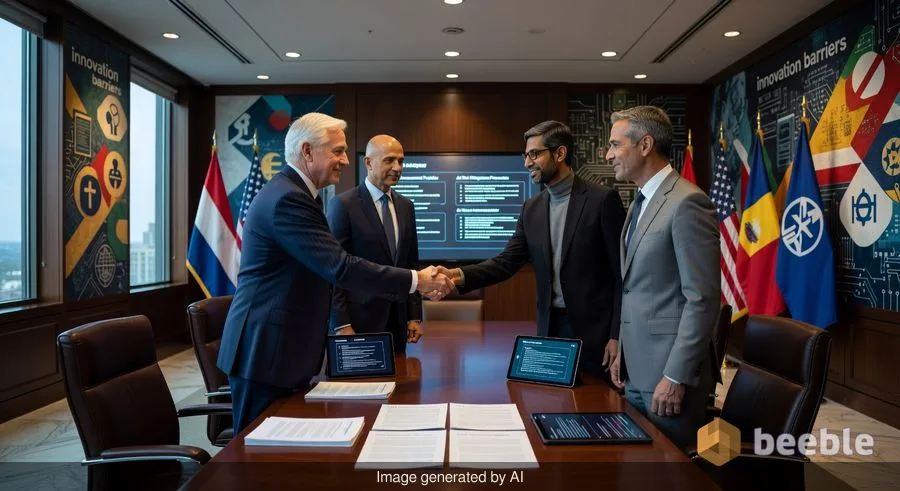
For years, the conversation around Artificial Intelligence has been polarized between two extremes: a regulatory 'wild west' that risks global catastrophe, or a bureaucratic chokehold that kills innovation. We’ve been told that you can either have lightning-fast progress or rigorous safety, but never both. However, the recent agreement between the US Department of Commerce and tech giants Google, Microsoft, and xAI suggests a third path is emerging—one that challenges the popular narrative that deregulation means a total lack of oversight.
Looking at the big picture, we are witnessing a systemic shift in how the world’s most powerful tools are vetted before they ever reach your smartphone or office computer. By agreeing to let the Center for AI Standards and Innovation (CAISI) evaluate their models for cybersecurity and biosecurity risks, these companies are essentially allowing a digital safety inspector to check the foundations of their buildings before the tenants move in. While the current administration’s rhetoric focuses heavily on removing 'barriers to innovation,' this move proves that national security remains a foundational concern that transcends partisan politics.
The New Digital Inspection Pit
Under the hood, this agreement isn't about creating a new 'AI Police' with the power to shut down companies. Instead, it utilizes CAISI—a branch of the Department of Commerce—as a collaborative testing ground. Think of it like a crash-test facility for cars. Before a new model hits the road, it’s slammed into walls to see if the airbags deploy. In this case, the 'walls' are sophisticated simulations designed to see if an AI can be tricked into writing malicious code, designing chemical weapons, or bypassing banking security protocols.
Until now, this kind of pre-release testing was largely voluntary or handled internally by the companies themselves. By formalizing this with CAISI, Google, Microsoft, and Elon Musk’s xAI are moving toward a more transparent, albeit controlled, environment. Curiously, this includes xAI, a company led by a man who has frequently sparred with regulatory bodies. The fact that xAI is at the table suggests that even the most disruptive players recognize that a single catastrophic AI failure could lead to a volatile public backlash that would stunt the entire industry.
Why the Tech Giants are Playing Ball
From a consumer standpoint, it might seem strange that companies would voluntarily hand over their 'digital crude oil'—the proprietary algorithms that cost billions to develop—to government scientists. However, the motivation is deeply practical. For a company like Microsoft, the goal is protecting its flagship AI, Copilot. Microsoft explicitly stated that these evaluations help them stay ahead of AI-driven cyber attacks.
Essentially, these companies are outsourcing a portion of their risk management. If CAISI finds a vulnerability in a model like Google’s Gemini or Microsoft’s Copilot before it goes live, the company saves itself from a potential PR nightmare and multi-billion dollar liability. For the average user, this means the AI tools you interact with are less likely to be 'poisoned' by hackers or used as a weapon against your own personal data.
The GPT-5.5 Factor and the Cybersecurity Frontier
Perhaps the most tangible example of this collaboration involves OpenAI. While they signed their initial agreement back in 2024, their recent activities offer a roadmap for what Google and xAI will likely experience. Chris Lehane, OpenAI’s chief global affairs officer, recently noted that the company provided the government with ChatGPT 5.5—the version released just this week—well ahead of its public debut.
| Model Variant | Access Level | Primary Focus |
|---|---|---|
| ChatGPT 5.5 (Public) | General Public | General productivity, creativity, and search. |
| GPT-5.5-Cyber | Limited First Users / CAISI | Advanced coding, vulnerability detection, and network defense. |
| GPT-5.5-Bio | Internal / CAISI Only | Screening for chemical and biological weapon synthesis risks. |
What this means is that we are moving toward a tiered system of AI. There is the 'civilian' version you use to summarize emails or plan a vacation, and then there are the 'hardened' versions designed for national defense. OpenAI is even working on a 'playbook' to distribute these cybersecurity-focused models throughout the public service. This suggests that AI is no longer just a consumer gadget; it is becoming a resilient layer of our national infrastructure.
Innovation Without the Red Tape?
One of the most interesting aspects of this development is how it aligns with the current administration’s 'National Policy Framework.' The goal is to 'accelerate' AI deployment while avoiding the creation of 'few federal rulemaking bodies.' To put it another way, the government is betting that specialized experts in existing agencies can handle AI oversight better than a single, massive regulatory agency.
This approach seeks to maintain a streamlined path to market. By using CAISI—a body focused on 'measurement science' rather than 'lawmaking'—the government is trying to provide a seal of approval that says a model is safe without dictating exactly how that model must be built. It’s a nuanced distinction, but a vital one for the tech sector. It allows the US to maintain its lead over global competitors like China by keeping the 'innovation engine' running hot, while still keeping a finger on the emergency stop button.
What This Means for You: The 'So What?' Filter
Practically speaking, how does this affect your daily digital life? For most of us, AI has become a tireless intern—handling the mundane tasks of sorting data, drafting text, and organizing our schedules. This agreement ensures that your 'intern' hasn't been secretly trained by bad actors to steal your identity or crash your company’s server.
- Increased Trust in Updates: When your favorite AI assistant gets a major version jump (like the move to 5.5), you can have more confidence that it has undergone external stress testing.
- Better Cybersecurity Tools: As models like GPT-5.5-Cyber are vetted and deployed, the 'good guys' (your bank’s security team, your email provider’s spam filter) will have access to the same high-level intelligence as the 'bad guys.'
- Privacy Safeguards: Part of CAISI’s evaluation includes looking at how models handle sensitive data. This adds an extra layer of scrutiny to how these models 'remember' or 'forget' user information.
Conversely, we should remain mildly skeptical. These evaluations are 'collaborative,' and CAISI has been opaque about which specific models it has already tested. Transparency is the currency of trust, and while these agreements are a great first step, the public will eventually need more than just a press release to feel entirely secure.
Looking Ahead: The Shifting AI Landscape
Ultimately, the agreement between Google, Microsoft, xAI, and the US government signals that we are leaving the 'experimental' phase of AI and entering the 'industrial' phase. We are treating AI less like a magic trick and more like a utility—something that must be reliable, safe, and standardized.
As a consumer, you should observe how your tools change over the next six months. You may notice more frequent 'safety' updates or new features specifically designed to protect your digital identity. This is the tangible result of these high-level negotiations.
Instead of worrying about a 'Terminator' scenario or a total lack of oversight, we should focus on the quality of these tests. The real victory isn't just that the government is testing AI, but that they are doing so in a way that respects the pace of technology. We are building a future where the digital backbone of our society is tested with the same rigor as the steel in our bridges and the medicine in our cabinets. That is a shift worth watching.
Sources:
- US Department of Commerce: Center for AI Standards and Innovation (CAISI) Official Briefing.
- Microsoft Public Statement: AI Safety and National Security Collaboration.
- OpenAI Global Affairs Report: GPT-5.5 Deployment Strategy.
- US National AI Policy Framework (March 2026 Edition).



See you on the other side.
Our end-to-end encrypted email and cloud storage solution provides the most powerful means of secure data exchange, ensuring the safety and privacy of your data.
/ Create a free account
