


The US is building a fence around advanced AI and Europe wants to lure Anthropic across it

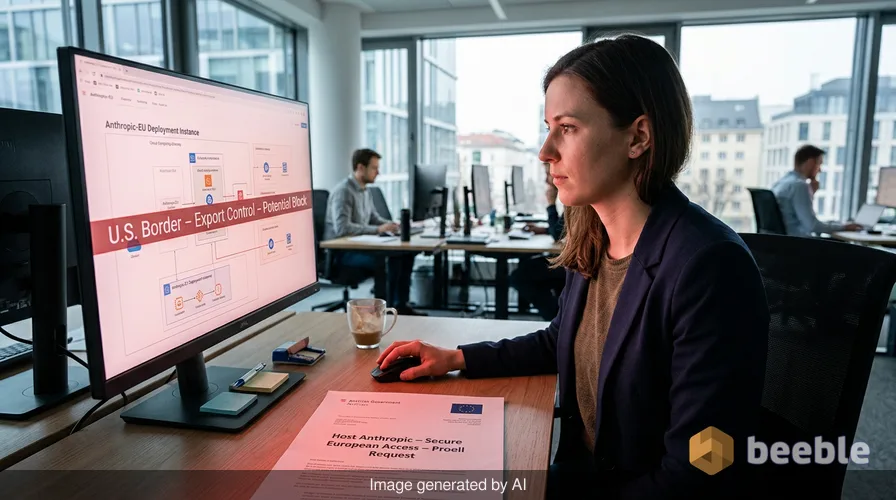
While most people treat AI as an infinite resource available through any web browser, the reality is that it is a physical asset tied to specific borders. The common narrative suggests that software has no home, yet the hardware that runs these programs is very much stationary. Recent moves by the United States government show a desire to keep the most advanced versions of this technology within its own territory. This shift has sparked a diplomatic scramble in Europe. Austria is now leading a charge to convince the European Union to host Anthropic, one of the primary competitors to OpenAI, to ensure that European businesses do not lose their access to the next generation of digital tools.
Austria's State Secretary for Digitalization, Alexander Proell, recently sent a formal request to the EU Technology Commissioner, Henna Virkkunen. The message was clear. Proell argues that Europe cannot afford to be a spectator as the US considers new rules that might block foreigners from using the highest tier of AI models. For the average user in London, Paris, or Vienna, this is not just a high-level political spat. It is a debate about whether the digital tools you use for your job every day will suddenly require a US passport to operate.
Why your favorite AI chatbot is suddenly a matter of national security
For the past two years, AI has been a tireless intern for millions of people. It helps write emails, debug code, and summarize long reports. But to a government, this same technology is a strategic asset. The US Department of Commerce has been exploring ways to limit the export of the massive amounts of computing power required to train these models. More recently, the focus has shifted to the models themselves. There is a growing fear in Washington that advanced AI could assist in cyberattacks or biological weapons development if it falls into the wrong hands.
Looking at the big picture, these restrictions are not just about security. They are about economic leverage. If a country controls the fastest, smartest AI, its companies have a massive head start. Austria sees the writing on the wall. If the US decides that the most advanced versions of Anthropic's Claude or OpenAI's GPT-5 are too dangerous or too valuable to share, European industries will be stuck with the digital leftovers. Essentially, the US is treating AI like a restricted military technology rather than a consumer product.
The Austrian plan to turn the EU into a safe harbor for tech giants
Austria’s proposal is a gamble on the idea of tech sovereignty. Proell suggests that the EU should offer Anthropic a reason to set up its primary operations inside the bloc. This would ideally put the company under European jurisdiction, protecting its services from sudden US export bans. In everyday life, this is similar to a city offering tax breaks to a grocery store so that the neighborhood doesn't become a food desert. Austria wants to make sure Europe does not become a digital desert.
Under the hood, this move would require massive investment. Hosting a company like Anthropic is not just about giving them an office in Brussels. It requires vast data centers, massive amounts of electricity, and a legal framework that makes the company feel safe from both US interference and overly restrictive European regulations. The EU already has the AI Act, which is the first major set of laws governing the technology. Austria is betting that a combination of legal clarity and physical presence will be enough to lure one of the big players away from Silicon Valley.
How export controls turn digital tools into guarded assets
To put it another way, the US is considering a "know your customer" policy for AI. This would force companies like Amazon and Microsoft—which provide the cloud servers where AI lives—to verify the identity of anyone training a large model. It could also lead to restrictions on who can access the "weights" or the core intelligence of the model. For a developer in Austria using Anthropic to build a new medical app, a change in US policy could mean their access is cut off overnight.
This creates a volatile environment for businesses that rely on these tools. Historically, software has been the most globalized industry in the world. You could start a company in a garage in Estonia and use the same tools as a startup in San Francisco. Now, we see a fragmentation. If the US restricts access, the world splits into digital zones. Austria’s push to host Anthropic is an attempt to keep the EU in the top-tier zone. Without a major AI firm on European soil, the continent is at the mercy of decisions made in a different time zone by a different government.
What this means for the small business owner in Berlin or Paris
From a consumer standpoint, the location of an AI company matters for three main reasons: speed, privacy, and availability. When a company is based in your region, your data usually stays closer to home. This makes it easier to comply with local privacy laws like the GDPR. Furthermore, it ensures that the service is built with your local context in mind. An AI trained and managed entirely in the US might not understand the specific industrial standards or legal nuances of the European market.
Practically speaking, if the US curbs access, a small marketing firm in Germany might find that its AI tools are suddenly slower or less capable than those used by a competitor in New York. The US versions might get the newest features six months earlier, or the European versions might be restricted to "safe" topics that don't reflect the needs of a global business. Austria’s goal is to prevent this digital divide from becoming a permanent handicap for European workers.
The logistical nightmare of moving a digital brain across the Atlantic
Zooming out, the idea of moving Anthropic to Europe is a massive undertaking. Anthropic is deeply tied to the US tech ecosystem. It has received billions of dollars in investment from Google and Amazon. These American giants provide the specialized microchips—the digital crude oil—that Anthropic needs to function. Moving the company's brain to Europe would not just be a legal shift; it would be a physical one. Europe currently lacks the same density of high-end AI chips that the US possesses.
Curiously, this might be the biggest hurdle for the Austrian plan. Even if Anthropic wanted to move to avoid US regulations, it might find that the hardware it needs is still under the control of the US government. The microchips are made by companies like Nvidia, which must also follow US export laws. Simply moving the headquarters to Vienna does not magically solve the supply chain problem. The EU would need to build its own chip-making capacity or secure its own reliable supply to truly host a sovereign AI giant.
Why sovereign AI is the new digital crude oil
Ultimately, the debate started by Austria shows that AI is no longer just a cool app on your phone. It is foundational infrastructure. Just as countries worry about where their oil, gas, and electricity come from, they now worry about where their intelligence comes from. Austria is signaling that the era of global, borderless tech is ending. In its place is an era where your location determines your level of digital capability.
For the average user, the takeaway is that the tools you rely on are more fragile than they appear. They are subject to the whims of international trade and national security. While we have grown used to the idea that any software is available to anyone with an internet connection, that era is shifting. The push to bring Anthropic to Europe is a sign that the digital world is becoming a map of walled gardens. For now, the best path is to stay informed about where your tools are hosted and who actually controls the switch that keeps them running.
Sources:
Federal Chancellery of the Republic of Austria, Office of the State Secretary for Digitalization.
European Commission, Directorate-General for Communications Networks, Content and Technology.
U.S. Department of Commerce, Bureau of Industry and Security, 2024-2026 AI Policy Briefings.
Anthropic Public Corporate Disclosures and Governance Reports.



See you on the other side.
Our end-to-end encrypted email and cloud storage solution provides the most powerful means of secure data exchange, ensuring the safety and privacy of your data.
/ Create a free account
