


The World’s Most Important Science Site is Now Fighting a War Against Its Own Biggest Trend

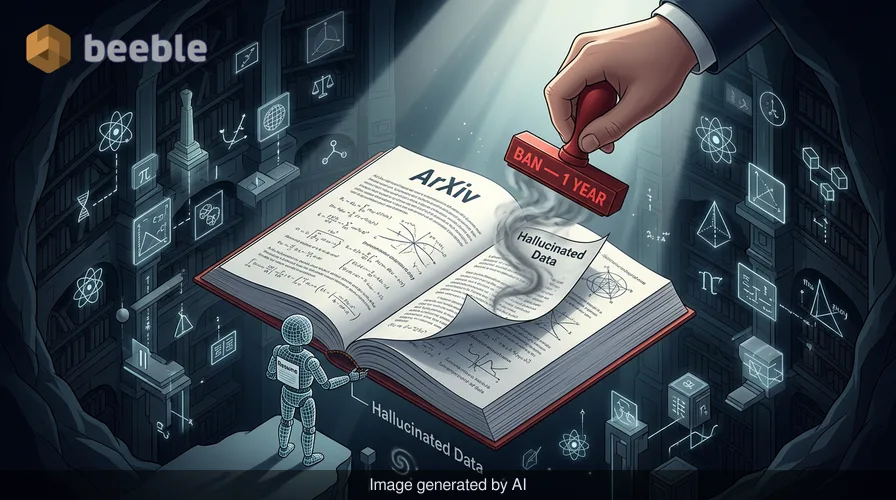
While the prevailing narrative suggests that artificial intelligence is an unalloyed engine of scientific acceleration, the reality on the ground is becoming increasingly messy. We have been told that Large Language Models (LLMs) would act as a tireless intern, summarizing vast datasets and drafting complex papers in seconds to help humans solve cancer or crack fusion. But in the halls of the world’s most critical research repositories, that intern has started lying on their resume—and the managers are finally showing them the door.
ArXiv, the venerable open-access repository that has hosted groundbreaking research in physics, math, and computer science for decades, recently announced a strict new policy. If an author submits a paper containing "incontrovertible evidence" that they let an AI do the work without checking the results, they face a mandatory one-year ban. For the average user, this might seem like an internal academic squabble. In reality, it is a foundational battle over the integrity of the information that eventually powers everything from your smartphone’s battery life to the medical advice you find on Google.
The Myth of the Automated Genius
To understand why this move is so disruptive, we first have to look at what ArXiv actually is. It isn’t a traditional journal with a slow, grinding peer-review process. Instead, it is a preprint server—a place where researchers post their work immediately so the global community can see it. It is the digital crude oil of the scientific world; it’s where ideas are refined before they become the products we buy. If the source material in ArXiv becomes tainted with "AI slop," the entire downstream supply chain of knowledge begins to fail.
For years, the tech world has hailed LLMs as the ultimate productivity hack. However, looking at the big picture, we are seeing a systemic shift where the ease of generation is outstripping our capacity for verification. Researchers, under immense pressure to "publish or perish," have begun using AI not just as a proofreader, but as a ghostwriter. The problem? These AI models are essentially sophisticated pattern-matchers. They don't "know" facts; they predict the next likely word in a sentence. When they don't have a fact, they often invent one that sounds plausible—a phenomenon known as hallucination.
When the Intern Starts Making Things Up
Thomas Dietterich, the chair of ArXiv’s computer science section, recently clarified that the repository is not banning AI usage entirely. Instead, they are banning the careless use of it. Behind the jargon, the "incontrovertible evidence" Dietterich refers to is often embarrassingly obvious.
In everyday life, we’ve all seen the tells of an AI-written email: the overly polite tone, the generic structure, or the occasional "As an AI language model, I cannot..." phrase left in by a lazy sender. In the world of high-stakes research, these red flags take more dangerous forms:
- Hallucinated References: The AI cites a paper that sounds real, written by a real professor, but the paper simply does not exist.
- Internal Prompts: Authors accidentally leaving their instructions to the AI (e.g., "Write a conclusion for this data") inside the final PDF.
- Biased Data Synthesis: AI models repeating outdated or incorrect scientific dogmas because they were trained on older internet data.
Historically, scientific fraud required effort. You had to forge data or manipulate images in Photoshop. Now, producing a plausible-looking (but entirely fake) scientific paper takes less time than ordering a pizza. This is why ArXiv is moving toward a "one-strike" rule. If the moderators find clear evidence that you didn't even bother to read your own AI-generated submission, you’re out.
The One-Year Penalty Box
Under the new rules, the consequences are robust. A one-year ban from ArXiv is a significant blow to a researcher’s career, especially in fast-moving fields like AI research where being first to post is everything. But the punishment doesn't end after twelve months. Once the ban is lifted, any subsequent submissions from those authors must first be accepted by a reputable, peer-reviewed venue before they can appear on ArXiv.
Essentially, ArXiv is saying: If we can't trust you to be your own editor, we’re going to outsource that trust to someone else.
| Feature | Human-Led Research | Unchecked AI Generation |
|---|---|---|
| Accuracy | High (subject to human error) | Variable (prone to hallucinations) |
| References | Real and verifiable | Often fabricated or misattributed |
| Tone | Specific and technical | Generic and repetitive |
| Accountability | Author takes full responsibility | Responsibility is often opaque |
| Review Speed | Slow and methodical | Instantaneous |
Decoupling from the Ivory Tower
Curiously, this crackdown coincides with a major structural change for the repository. After being hosted by Cornell University for over 20 years, ArXiv is transitioning into an independent nonprofit. On the market side, this is a strategic play for resilience. As an independent entity, ArXiv can raise more diverse funding to build the automated tools and hire the human moderators needed to fight the rising tide of AI-generated misinformation.
From a consumer standpoint, we should view this as a necessary infrastructure upgrade. If ArXiv were to be overrun by low-quality content, it would become a volatile environment for investors and tech companies who rely on its data to build the next generation of gadgets. By cleaning up its act, ArXiv is protecting the foundational layer of the tech industry.
Why Your News Feed Depends on a Math Site
To put it another way, why should the average person—someone who isn't writing papers on quantum topology—care about this? Because science doesn't stay in the lab.
When a "breakthrough" paper is posted to ArXiv, it often triggers a wave of news articles. If that paper was hallucinated by an AI and never checked by the human author, that misinformation travels through the news cycle and eventually lands in your social media feed. We have already seen cases in biomedical research where fabricated citations are on the rise. If a doctor or a policy maker relies on a summary of research that was never actually conducted, the real-world consequences are tangible and dangerous.
Ultimately, ArXiv’s move is a reminder that in a world of decentralized information, the human element remains the most important filter. AI is a powerful tool for scaling output, but it cannot scale truth. Truth requires the slow, methodical work of human verification.
Filtering the Signal from the Noise
As we look at the shifting landscape of digital information, ArXiv’s new policy offers several lessons for our own digital habits. We are moving into an era where the cost of creating content is zero, which means the value of that content is also trending toward zero—unless it is backed by a credible human or institution.
Practically speaking, we should all start applying the "ArXiv Filter" to the information we consume. If a piece of news feels too perfectly structured, uses overly generic language, or cites "studies" that you can't find with a quick search, treat it with the same skepticism that ArXiv moderators treat a suspicious preprint.
Looking at the big picture, the "one-strike" rule isn't just about punishing lazy scientists. It’s about preserving a space where ideas can be exchanged without the fear of being drowned out by digital noise. As AI continues to flood the internet with content, the most valuable resource in the world won't be data or processing power—it will be trust.
Sources:
- ArXiv official governance and policy updates (2024-2026)
- 404 Media interview with Thomas Dietterich
- Cornell University Library administrative reports
- Peer-reviewed studies on LLM-generated citation hallucinations



See you on the other side.
Our end-to-end encrypted email and cloud storage solution provides the most powerful means of secure data exchange, ensuring the safety and privacy of your data.
/ Create a free account
