


The World’s Power Grid Just Got Its First Hydrogen Heartbeat

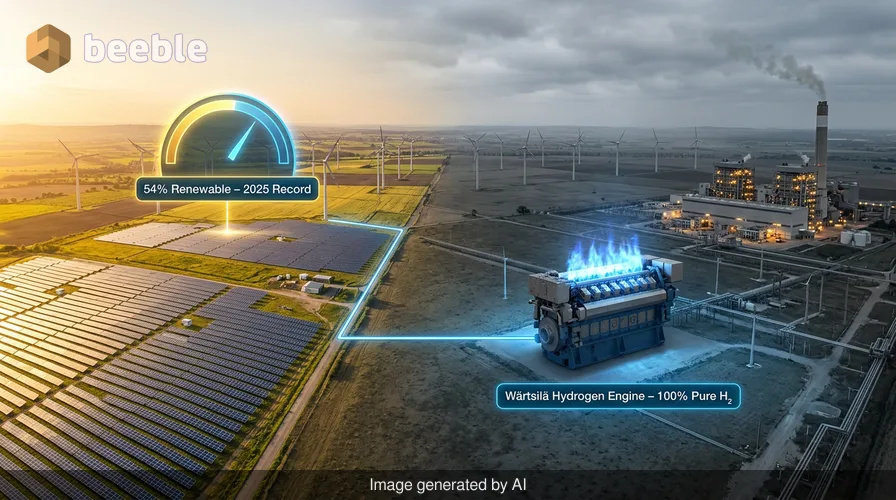
Spain reached a record 54% renewable energy share in its power mix during 2025, but that victory came with a technical catch. On calm, cloudy days, the national grid still calls on fossil fuels to fill the gap. This dependency is why the successful connection of a large-scale hydrogen engine to the Spanish grid is a significant shift in how we manage energy. Developed by the Finnish technology group Wärtsilä, this engine is the first of its kind to generate utility-scale electricity using 100% pure hydrogen.
Behind the jargon, this is a massive internal combustion engine. It is not a silent, futuristic box like a fuel cell. It is a piece of heavy industry, the invisible backbone of modern life, adapted to burn the most abundant element in the universe. While the world has talked about the hydrogen economy for decades, this test in northern Spain moves the concept from a laboratory experiment to a functional part of the public infrastructure.
The math behind the hydrogen transition
To understand why a hydrogen engine matters, we have to look at the math of grid stability. Solar and wind power are volatile. On a sunny afternoon in Spain, the country often produces more electricity than it can use. Conversely, when the sun sets, the grid needs a massive injection of power within minutes. Currently, most countries use lithium-ion batteries for short bursts of four hours or less. For anything longer, they rely on natural gas turbines.
Hydrogen acts as a long-term energy buffer. When there is excess wind power, we can use that electricity to split water into hydrogen and oxygen through electrolysis. We then store that hydrogen in tanks or underground salt caverns. When the wind stops, the Wärtsilä engine burns that stored hydrogen to put electricity back onto the grid. This creates a closed loop where renewable energy is captured, stored, and released without a single molecule of carbon dioxide entering the atmosphere.
Converting old school combustion for a new era
Under the hood, the Wärtsilä engine is a marvel of adaptation. Burning hydrogen is much harder than burning natural gas. Hydrogen molecules are tiny and leak through seals that would easily contain methane. More importantly, hydrogen burns much faster and hotter than fossil fuels. If you simply pump hydrogen into a standard gas engine, the fuel will ignite too early, causing a phenomenon called knocking that can shatter the engine block.
Engineers solved this by redesigning the fuel injection systems and the timing of the combustion cycle. The result is a machine that looks like a traditional power plant engine but operates on entirely different physics. This specific engine is part of the Wärtsilä 31 platform, which holds world records for efficiency. By making this platform hydrogen-ready, the company provides a path for existing power plants to switch fuels without tearing down their entire buildings.
| Feature | Hydrogen Combustion Engine | Hydrogen Fuel Cell | Battery Storage |
|---|---|---|---|
| Scale | Multi-megawatt (High) | Small to Medium | Scalable but expensive |
| Response Time | Minutes | Seconds | Milliseconds |
| Durability | High (Industrial grade) | Medium (Membrane wear) | Medium (Chemical degradation) |
| Primary Use | Grid balancing | Transport/Backup | Short-term smoothing |
Breaking the reliance on natural gas
On the market side, the push for hydrogen is a strategy for energy independence. Spain is currently a leader in the H2Med corridor, a massive subsea pipeline project designed to transport green hydrogen across Europe. By proving that hydrogen can run large engines today, Spain is positioning itself as the green powerhouse of the continent.
Historically, the price of electricity in Europe has been tied to the price of natural gas. When gas prices spike due to geopolitical tension, every household's utility bill goes up. Transitioning to hydrogen engines allows a country to decouple its energy prices from the global gas market. Once the infrastructure is built, the fuel is essentially produced at home using local wind and sunshine. This shift is a move toward a more resilient and decentralized energy system.
The infrastructure wall standing in the way
Curiously, the engine itself is no longer the biggest problem. The technology works. The real hurdle is what industry experts call the midstream. To make this engine useful on a national scale, we need thousands of miles of specialized pipelines and massive storage facilities. Hydrogen is less dense than natural gas, meaning we need to move much more of it to get the same amount of energy.
Practically speaking, we also need a massive increase in green hydrogen production. Most hydrogen today is "grey," made from natural gas in a process that still releases carbon. Using grey hydrogen in a green engine defeats the purpose. The industry needs to scale up electrolyzers—the machines that make green hydrogen—to a level that matches the capacity of these new engines. This is a classic chicken-and-egg problem where power plants wait for fuel while fuel producers wait for customers.
What this means for your monthly utility bill
From a consumer standpoint, you will not see a "hydrogen discount" on your bill anytime soon. In the short term, green hydrogen is more expensive than natural gas. The cost of building the electrolyzers, the storage tanks, and the specialized engines is high. However, looking at the big picture, this technology is an insurance policy against energy volatility.
As more of these engines come online, the risk of blackouts during extreme weather events decreases. They provide the "firm" power that solar and wind cannot. For the average user, the primary benefit is a more stable grid and a slower rate of price increases over the next decade. Instead of paying for expensive imported gas during a crisis, your utility company will draw from a local reserve of hydrogen produced during a sunny week in July.
The shift toward a post-carbon reality
Ultimately, the Wärtsilä test in Spain is a proof of concept for a world that no longer burns fossils for reliability. It proves that we do not have to invent entirely new, magical physics to save the planet. We can take the mechanical reliability of the internal combustion engine and swap its carbon-heavy diet for a clean one.
As a result of this successful test, we will likely see more utility companies ordering hydrogen-ready equipment. This is a foundational step. It signals to investors that hydrogen is a tangible asset rather than a speculative tech trend. For those of us watching from the outside, it is a reminder that the transition to clean energy is not just about sleek electric cars and glass solar panels. It is also about the heavy, vibrating machinery in the background that keeps the lights on when the world goes dark.
Shift your perspective the next time you see a wind farm standing still. In the near future, that lack of movement will not mean a lack of power. It will mean the grid is quietly breathing through a hydrogen engine, using the energy it saved for exactly that moment.
Sources: Wärtsilä Energy, Spanish National Grid (REE), International Energy Agency (IEA) Hydrogen Report.



See you on the other side.
Our end-to-end encrypted email and cloud storage solution provides the most powerful means of secure data exchange, ensuring the safety and privacy of your data.
/ Create a free account
