


Trust Issues: Why Italy’s €4 Million Fine Against Trustpilot is a Watershed Moment for the Review Economy

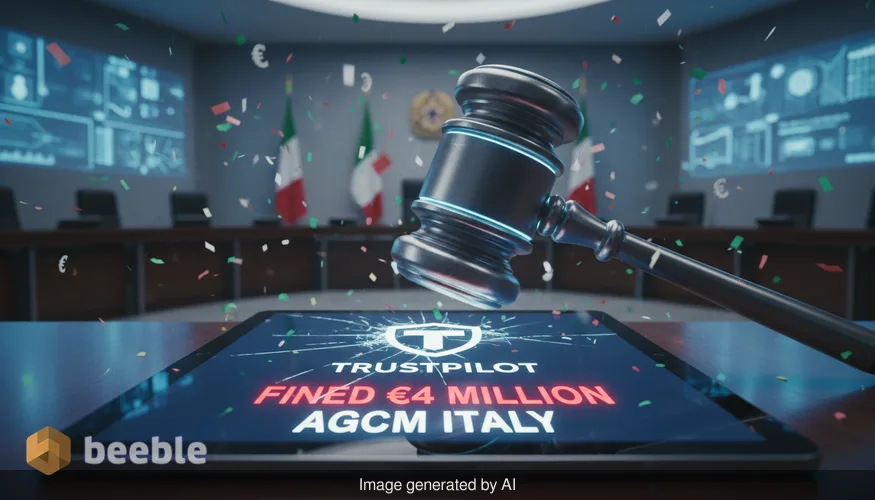
Can you truly trust a “verified” review? For years, the gold star next to a customer testimonial has served as a digital seal of approval, a beacon of authenticity in an ocean of internet noise. But on March 23, 2026, the Italian Competition Authority (AGCM) sent a €4 million shockwave through the platform economy, suggesting that these seals of trust might be more opaque than they appear.
The AGCM announced a significant fine against Trustpilot Group Plc and its subsidiaries for what it termed unfair commercial practices. From a compliance standpoint, this isn't just a slap on the wrist for a single company; it is a systemic warning to every platform that monetizes reputation. The Authority found that Trustpilot’s review ecosystem was not the robust, transparent fortress it claimed to be, but rather a landscape where the lines between genuine feedback and curated marketing were dangerously blurred.
The Illusion of the “Verified” Tag
At the heart of the AGCM’s investigation was a fundamental discrepancy between promise and practice. Trustpilot promoted its platform as a tool to reduce false content and ensure the integrity of the review system. However, the regulator concluded that the platform failed to carry out adequate, stringent checks to ensure that reviews—even those sporting the coveted “verified” label—actually reflected real customer experiences.
In practice, this creates a precarious situation for the average consumer. When we see a verified tag, we assume a certain level of granular due diligence has occurred. We assume the platform has acted as a gatekeeper. Instead, the AGCM found the gate was often left ajar. To put it another way, if the foundation of a house is cracked, it doesn't matter how beautiful the siding looks. Trust is that foundation, and the AGCM has signaled that “verification” must be more than a marketing slogan; it must be a binding commitment to accuracy.
The “Selective Invitation” Trap
Curiously, one of the most sophisticated issues identified by the AGCM involves the tools Trustpilot provided to businesses. Under the guise of “integrity-enhancing” services, these tools essentially allowed companies to cherry-pick which customers received invitations to leave reviews.
I remember a classic “Legal vs. Engineering Tug-of-War” from my early days in the industry. A marketing lead wanted to build a feature that only triggered a review prompt if the user had spent more than five minutes on the app and hadn't encountered a crash. From an engineering perspective, it was a clever way to boost the rating. From a legal and ethical perspective, it was a distortion of reality. We were essentially building a filter that silenced the disgruntled and amplified the satisfied.
Trustpilot’s services, according to the AGCM, functioned in a similar way. By allowing businesses to select their audience, the resulting overall ratings became a curated masterpiece rather than a representative sample. This practice violates the core principle that reviews should be a multifaceted reflection of a company's performance, not a highlight reel bought and paid for through a subscription service.
Dark Patterns and the Transparency Gap
Beyond the reviews themselves, the AGCM took aim at the platform's interface. The regulator found that Trustpilot utilized “dark patterns”—subtle design choices intended to influence user behavior or obscure key information. These included a lack of transparency regarding how the platform actually functions and the specific impact that paid services have on a business’s visibility and rating.
In a regulatory context, dark patterns are increasingly viewed as a toxic asset. Whether it’s an unnecessarily complex “cancel subscription” flow or an opaque explanation of how algorithms rank content, these tactics erode consumer autonomy. The AGCM determined that Trustpilot did not adequately disclose the role of its paid services, leaving consumers in a labyrinth of half-truths where they couldn't make a truly informed choice.
The Legal Anatomy: Articles 20 to 23
The AGCM didn't just express disappointment; they brought the hammer down using the Italian Consumer Code. Specifically, the practices were found to be in breach of Articles 20, 21, 22, and 23(1)(bb-ter).
| Article | Focus Area | Violation Found |
|---|---|---|
| Article 20 | General prohibition of unfair practices | Systemic failure to ensure review genuineness. |
| Article 21 & 22 | Misleading actions and omissions | Lack of transparency regarding paid services and platform mechanics. |
| Article 23(1)(bb-ter) | Specific deceptive practices | Promoting tools as “integrity-focused” while allowing rating distortion. |
This statutory framework is part of a broader European effort to clean up the digital marketplace. Much like the GDPR transformed how we handle data, the Italian Consumer Code (and the overarching EU Omnibus Directive) is transforming how we handle “trust.” Compliance is no longer a checkbox; it is a compass that must guide every design decision a platform makes.
Practical Takeaways for Digital Platforms
If you are a DPO or a product manager navigating this patchwork quilt of regulations, the Trustpilot fine offers several actionable lessons:
- Audit Your Verification Logic: If you label something as “verified,” you must be able to prove the methodology behind it. “Self-certification” by the user is rarely enough in the eyes of modern regulators.
- Eliminate Selective Bias: Ensure that review invitation systems are automated and unbiased. If you allow businesses to filter who they ask for feedback, you are inviting a regulatory investigation.
- Transparency by Design: Be explicit about the influence of money. If a business pays for a “premium” profile that changes how reviews are displayed or collected, that fact must be front-and-center, not buried in a Terms of Service labyrinth.
- Kill the Dark Patterns: Conduct a UX audit specifically looking for deceptive design. If your interface “nudges” a user toward a decision that benefits the platform at the expense of the user’s clarity, it’s a liability.
Ultimately, Trust is Not a Product
Ultimately, the AGCM’s decision serves as a reminder that trust is a fragile asset. In the race to scale and monetize, it is easy to treat compliance as an afterthought—a “launch blocker” to be dealt with later. But as Trustpilot has learned, the cost of rebuilding a reputation is far higher than the cost of building a compliant system from the start.
As we move further into 2026, expect more regulators to follow Italy's lead. The era of the “wild west” of online reviews is ending. Platforms must decide now: will they be the transparent windows into consumer experience they claim to be, or will they remain opaque mirrors reflecting only what their paying clients want to see?
Is your platform ready for a transparency audit? Now is the time to review your automated invitation logic before the regulators do it for you.
Sources:
- Italian Competition Authority (AGCM) Official Press Release, March 23, 2026.
- Italian Consumer Code (Legislative Decree No. 206/2005), Articles 20-23.
- EU Directive 2019/2161 (The Omnibus Directive) regarding better enforcement and modernization of Union consumer protection rules.



See you on the other side.
Our end-to-end encrypted email and cloud storage solution provides the most powerful means of secure data exchange, ensuring the safety and privacy of your data.
/ Create a free account
