


Uber’s Real Ambition Isn't Self-Driving Cars—It’s Turning Your City Into a Living Laboratory

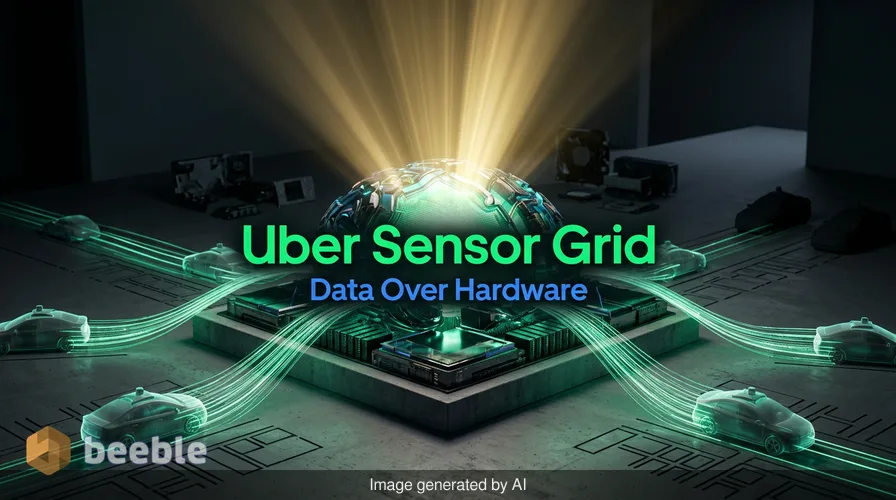
Conventional wisdom says Uber failed at self-driving cars. After burning billions on its Advanced Technologies Group and eventually offloading it to Aurora years ago, the narrative was clear: Uber would be the marketplace, not the maker. While companies like Waymo and Zoox spent years perfecting the expensive hardware needed to replace human drivers, Uber seemed content to simply sit back and wait to host those fleets on its app.
Looking at the big picture, that narrative was incomplete. While it appeared Uber was retreating from the autonomous vehicle (AV) race, it was actually repositioning itself to own the one thing more valuable than the car itself: the data that teaches the car how to think. Uber’s Chief Technology Officer, Praveen Neppalli Naga, recently pulled back the curtain on a strategy that transforms millions of standard passenger vehicles into a high-resolution sensor grid. This isn't just about ride-hailing anymore; it’s about becoming the foundational infrastructure for the entire AI-driven world.
The Data Bottleneck: Why Robots Still Struggle with Left Turns
To understand why Uber’s move is so disruptive, we have to look at the current state of autonomous driving. In simple terms, building a self-driving car is easy; building one that doesn't make a life-threatening mistake once every 50,000 miles is incredibly hard. The industry has reached a point where the underlying algorithms—the brains of the car—are quite robust. The problem is that these brains need to experience every possible scenario before they can be trusted.
Think of an autonomous system as a tireless intern. It can work 24/7 without getting bored, but it has zero common sense. It needs to see a thousand different ways a child might chase a ball into a street, or how a construction worker’s hand signals differ in London versus Los Angeles. Currently, AV companies collect this data by deploying small, specialized fleets of expensive sensor-laden SUVs. It is a slow, capital-intensive process that limits their learning to a few specific neighborhoods.
Uber’s realization is that they already have a fleet of millions of cars traversing every corner of the globe. If even 5% of those vehicles were equipped with a streamlined sensor kit, Uber could collect more real-world driving data in a single afternoon than a traditional AV company could in a year.
From Ride-Hailing to the AV Cloud
Under the hood, this program is an evolution of Uber’s AV Labs. Initially, this was a small project using Uber-owned cars to test sensors. Now, the goal is to decentralize that collection. Uber is building what Naga calls an “AV Cloud”—a massive, searchable library of labeled sensor data.
Imagine you are a startup building a delivery robot. You need to know how people in Mumbai navigate around stray cows or how Boston drivers handle a sudden slushy Nor’easter. Instead of sending your own cars to those cities, you simply query Uber’s library. You pay for the specific scenarios you need, and Uber provides the high-fidelity data gathered by its network of drivers.
Beyond just selling raw data, Uber is offering a service known as “shadow mode.” This allows an AV company to run its software in the background of a real Uber trip. The human driver is in total control, but the AI is “pretending” to drive, comparing its decisions to the human’s actions in real-time. This creates a safe, virtual training ground that uses the physical world as its backdrop.
Why This Strategy is a Financial Masterstroke
On the market side, this pivot is a classic example of moving up the value chain. Building hardware is volatile and expensive; providing the data that powers that hardware is a high-margin, scalable software business. By moving away from the “metal” and toward the “info,” Uber avoids the massive liability and maintenance costs of owning a robotaxi fleet while making themselves indispensable to the companies that do.
Historically, the tech industry has seen this play before. In the early days of the internet, companies fought to build the best desktop computer. Ultimately, the companies that became the most resilient were those that provided the search engines and data protocols that everyone else had to use. Uber is essentially trying to become the Google Search of the physical road.
| Feature | Traditional AV Companies | Uber’s AV Cloud Model |
|---|---|---|
| Fleet Size | Hundreds to thousands of cars | Potential for millions of driver-owned cars |
| Data Variety | Limited to specific test cities | Global, covering diverse climates and cultures |
| Capital Expense | High (Buying/Maintaining fleets) | Low (Software and sensor-kit focus) |
| Primary Asset | The Vehicle | The Data Layer |
| Business Goal | Replace the driver | Power the replacement |
The Impact on the Average User
For the average user, this shift might feel invisible at first, but the long-term implications are systemic. Practically speaking, your next Uber ride might arrive with a slightly more sophisticated camera array mounted near the rearview mirror or on the roof. Uber has signaled that they want this process to be transparent, though the specifics of how drivers will be compensated for turning their cars into mobile data centers remain opaque.
From a consumer standpoint, this could actually accelerate the arrival of autonomous features in your own personal vehicle. As Uber democratizes this training data, smaller car manufacturers who can't afford a massive AV research division can buy into Uber’s cloud to improve their own safety features. This could lead to a future where “self-driving” isn't just a luxury for those who can afford a six-figure EV, but a standard safety feature powered by the collective experience of millions of Uber drivers.
Conversely, there are valid concerns regarding privacy and the “surveillance” of public spaces. If every Uber becomes a rolling 360-degree camera, the amount of data being captured about pedestrians, other drivers, and private property is unprecedented. Uber will need to navigate a complex web of global regulations to ensure this data is anonymized and used ethically.
The “So What?” Filter: What This Means for You
Ultimately, Uber is betting that the most valuable commodity of the 21st century isn't the ability to move people from point A to point B, but the ability to map and understand how that movement happens in real-time. They are turning the world’s roads into digital crude oil, and their drivers are the drills.
What this means is that the “race” for self-driving cars is entering a new phase. It is no longer about who has the coolest-looking robotaxi; it’s about who has the most robust library of human experience to feed the machines.
As a consumer, you should start looking at the gig economy through a different lens. Your driver isn't just providing a service; they are inadvertently building the very system that might one day replace the need for their profession. For now, this means better maps, safer assisted-driving features in your next car, and perhaps a more intuitive understanding of our cities. But it also means we are moving toward a world where every trip we take is a data point in a much larger, interconnected machine-learning experiment.
Instead of watching for the arrival of the first driverless car in your city, start looking at the sensors appearing on the ones that still have a person behind the wheel. That is where the real revolution is happening—not in the labs of Silicon Valley, but in the mundane, everyday traffic of your local morning commute.
Sources:
- TechCrunch: StrictlyVC Event Interview with Praveen Neppalli Naga.
- Uber Technologies, Inc. Investor Relations: AV Strategy Overview.
- Wayve: Collaborative Partnership Announcements.
- National Highway Traffic Safety Administration (NHTSA): Data Collection Guidelines for Autonomous Systems.



See you on the other side.
Our end-to-end encrypted email and cloud storage solution provides the most powerful means of secure data exchange, ensuring the safety and privacy of your data.
/ Create a free account
