


Volkswagen is Betting $5.8 Billion That Your Next Electric Car Needs a Rivian Brain

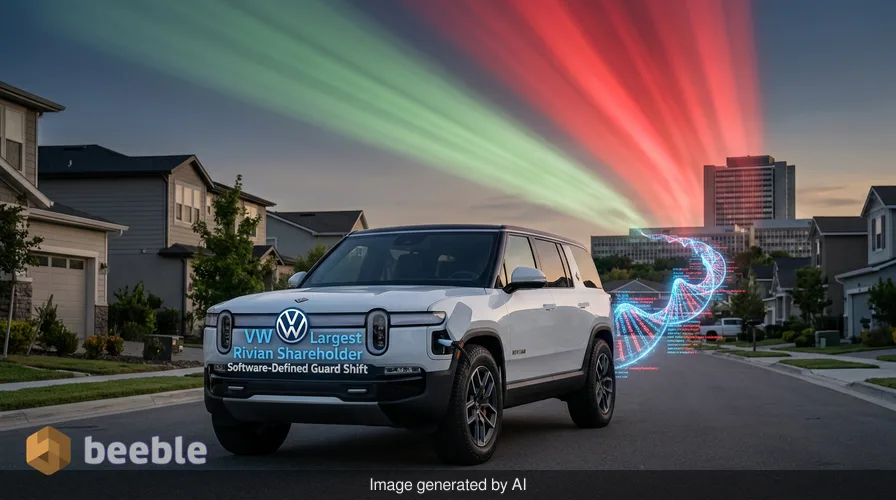
If you happen to see a mid-sized SUV humming quietly down a suburban street later this month, there’s a good chance it’s the new Rivian R2. On the surface, it represents the latest attempt by an American startup to capture the hearts of the outdoor-loving middle class. But if you were to trace the digital DNA of that vehicle—and the billions of dollars flowing behind it—you wouldn’t just end up at a California design studio. You would find yourself in Wolfsburg, Germany, at the headquarters of Volkswagen Group.
In a shift that signals a massive changing of the guard, recent SEC filings reveal that Volkswagen has officially overtaken Amazon to become Rivian’s largest shareholder. The German automotive giant now controls 15.9% of the company, leaving Amazon’s 12.28% stake in the rearview mirror. Looking at the big picture, this isn't just a reshuffling of a cap table; it’s a systemic transformation of how the world’s largest automakers are trying to survive the transition to software-defined vehicles.
The Billion-Dollar Nervous System
To understand why a legacy titan like Volkswagen would hand over nearly $6 billion to a startup that has yet to turn an annual profit, we have to look under the hood. For decades, cars were built as mechanical objects with a few computers slapped on top. Each function—the power windows, the brakes, the infotainment—had its own little computer box. In the industry, we call this distributed architecture. It’s messy, it’s heavy, and it makes over-the-air software updates nearly impossible.
Rivian, conversely, built its vehicles more like a modern server rack. They use what’s known as zonal architecture. In everyday life, think of it like the difference between having 50 different remote controls for every lightbulb in your house versus having one central smart hub that controls everything via a single app. Volkswagen’s own internal software efforts, housed under a division called Cariad, famously struggled with bugs and delays that pushed back major vehicle launches for years. Essentially, VW realized it was cheaper and faster to buy a proven "brain" from Rivian than to keep trying to grow their own in a lab that wasn't producing results.
This partnership bore its first tangible fruit last month when Rivian successfully completed winter testing for the VW ID.EVERY1. This small, four-door hatchback is a foundational moment for the joint venture. While it wears a VW badge, its internal nervous system is pure Rivian. This is why VW was willing to unlock another $1 billion for the startup—because the tech actually works in the freezing cold.
Why Amazon is Stepping Aside
For years, Amazon was the face of Rivian’s success. The retail giant wasn't just an investor; it was the ultimate customer, ordering 100,000 electric delivery vans to green its massive logistics machine. However, Amazon’s role has shifted from an active partner to a legacy supporter. Historically, Amazon held 20% of the company before the 2021 IPO. As Rivian issued more shares to raise capital and VW moved in with its massive cash injections, Amazon’s influence naturally diluted.
From a consumer standpoint, Amazon got what it wanted: a reliable fleet of custom-built electric vans that are now a common sight in neighborhoods across the country. But Amazon is a cloud and retail company, not a car manufacturer. It has little interest in the grueling, low-margin work of building mid-sized SUVs for families. Volkswagen, on the other hand, needs Rivian’s software to ensure its next generation of Audi, Porsche, and VW models don’t feel like fossils compared to a Tesla or a Xiaomi SU7.
The High Price of Innovation
While the influx of German cash is a lifeline, it highlights a transparent reality of the modern EV market: building cars is a resiliently expensive hobby. Rivian poured $1.7 billion into research and development in 2025 alone. Much of that capital is being swallowed by the company’s push into autonomy—training the AI that will eventually allow these cars to navigate city streets with minimal driver input.
Curiously, the joint venture with Volkswagen specifically excludes AI and autonomous driving. This means Rivian is keeping its most disruptive "secret sauce" to itself, perhaps hoping to license it to others later or use it as a competitive edge. This massive R&D spend is the reason the company recently told investors it won't be EBITDA positive—essentially, it won't be making a functional profit—next year.
Looking at the financial mechanics, we can compare the modern EV startup to a high-performance jet. It requires an incredible amount of fuel (capital) just to get off the runway. Once it’s at cruising altitude, it’s remarkably efficient, but the takeoff phase is volatile and full of risk. VW’s $5.8 billion is the high-octane fuel Rivian needs to keep the engines running until the R2 and the upcoming R3 hit mass-market scale.
What This Means for You
For the average user, this corporate maneuvering has very practical implications for your next car purchase. If you’re a current Rivian owner or considering an R2, this news is a massive vote of confidence. It means the company is unlikely to vanish overnight—a common fear with EV startups. With the world’s second-largest automaker as its primary backer, Rivian now has a robust safety net and a partner with a global supply chain.
| Feature | Rivian Focus | VW Benefit |
|---|---|---|
| Software | Zonal Architecture | Reliable, bug-free interfaces |
| Updates | Frequent Over-the-Air (OTA) | Cars that get better over time |
| Hardware | R2/R3 Platform | Scalable tech for mass-market EVs |
| Supply Chain | High-cost, low-volume | Reduced costs through VW’s buying power |
If you are a Volkswagen fan, the bottom line is that your next electric VW will likely be a much better product. You can expect a streamlined user interface that doesn’t lag, better battery management, and a vehicle that feels interconnected with your digital life rather than a collection of separate analog systems.
Ultimately, the VW-Rivian deal is a sign that the era of the "standalone" car company might be ending. To survive a shifting landscape, the old guard provides the factories and the scale, while the new guard provides the code. For those of us behind the wheel, that partnership might finally deliver the seamless, tech-forward experience we’ve been promised for a decade.
As we look ahead to 2027, the success of this venture won't be measured in SEC filings or share percentages, but in how many ID.EVERY1 hatchbacks and Rivian R2s we see at the charging stations. It’s a reminder that in the world of heavy industry, the invisible backbone of our modern life is increasingly made of software, and currently, that software has a very specific price tag.
Sources:
- U.S. Securities and Exchange Commission (SEC) Schedule 13D/A Filings, May 2026.
- Rivian Automotive Investor Relations: 2025 Annual Report and Q1 2026 Shareholder Letter.
- Volkswagen Group Global Media Newsroom: Joint Venture Progress Report (November 2024 – May 2026).
- Market Data: Rivian (RIVN) and Volkswagen AG (VOW3) share ownership structures via Bloomberg and Reuters.



See you on the other side.
Our end-to-end encrypted email and cloud storage solution provides the most powerful means of secure data exchange, ensuring the safety and privacy of your data.
/ Create a free account
