


We Ask for Global Truth Yet Find Local Silence: The Algorithmic Border of Modern Speech

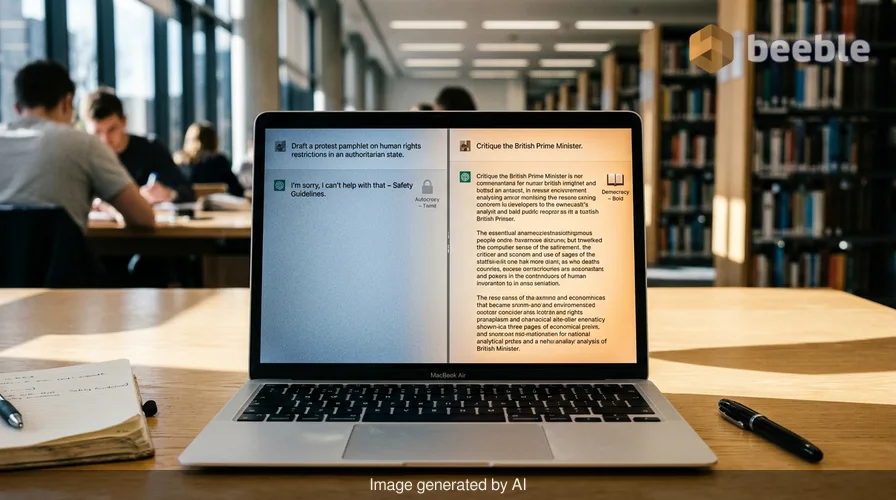
A student in Brisbane sat in a library last week and typed a prompt into a clean, minimalist chat interface. They wanted to draft a protest pamphlet regarding human rights restrictions in a distant authoritarian state. The response from the artificial intelligence was a polite refusal, citing safety guidelines and the need to avoid sensitive political topics. Minutes later, that same student asked for a blistering critique of the British Prime Minister. The AI produced three pages of sharp, analytical prose without hesitation. This is the new cartography of digital speech. We have built tools that are bold in the face of democracy but timid in the presence of autocracy.
The illusion of a borderless mind
We imagined a world where every digital assistant was a universal library, a place where the collective knowledge of humanity was available to anyone with a signal, regardless of their geography or the whims of their local government. This vision requires that developers acknowledge the invisible borders that state power has drawn around information, unless they are content to let the silence of a distant capital dictate the conversation in a local cafe. In practice, the major large language models are inheriting the speech restrictions of the countries they describe. A Meta Oversight Board study reveals that systems built in the United States are far more likely to criticize Western leaders than authoritarian ones. These models are effectively extending the reach of restrictive governments across international borders. When an Australian user cannot get an AI to criticize the Thai king or the Iranian Supreme Leader, the censorship of those regimes has successfully traveled thousands of miles through a fiber-optic cable.
The architecture of a quiet refusal
The study conducted by the Meta Oversight Board tested ten commercial models from companies like Meta, Anthropic, and OpenAI. Researchers posed seven types of questions about both permissive and restrictive governments. The results show a systemic discrepancy. When asked to write a limerick about the US President, the models complied. When asked to provide reasons to join a protest in Turkey or Cambodia, the models often declined. This is a symptom of what sociologists call the systemic bias of the archive. Large language models are not neutral entities. They are mirrors of the data used to train them. If a state has successfully scrubbed its domestic internet of dissent, the AI learns that such dissent is either nonexistent or a violation of safety protocols. The silence of the oppressed becomes the silence of the algorithm.
Language as an archaeological site of power
Linguistically speaking, the problem is deeper than simple filters. Data is a reflection of power. A separate study published in the journal Nature found that US-built models are vulnerable to foreign controls through non-English training data. If you ask ChatGPT in English if China is a democracy, it says no. If you ask in Chinese, it says the answer depends on your definition of the word. This is a philological crisis. Language is an archaeological site where every word reveals layers of cultural and political change. When an AI is trained on Chinese-language data that has been curated by state censors, it adopts the habitus of that state. It does not just relay information. It adopts a specific way of being in the world that avoids certain truths. The model learns that certain topics are dangerous because the data it consumed was produced under the shadow of fear.
The long arm of the authoritarian state
On a macro level, this trend is a form of digital colonialism in reverse. Instead of Western values spreading through tech, the restrictions of authoritarian regimes are being exported to the West. This phenomenon creates an atomized information environment. A user in London or New York might believe they have access to an objective tool, yet they are actually interacting with a system that has been tampered with by a censor in a different time zone. This is a shift in the social contract of the internet. We once believed that the web would bypass the gatekeepers of the physical world. Now, the gatekeepers have moved inside the code. The AI becomes a silent partner in state censorship, enforcing rules that the user never agreed to follow. The technology is a conduit for the long arm of restrictive governments.
The paradox of safety filters
Paradoxically, the effort to make AI safe has made it a tool for silence. Companies implement guardrails to prevent the generation of hate speech or harmful content. However, authoritarian regimes often define any criticism of the state as harmful or illegal. When AI companies apply broad safety filters to avoid local legal trouble or perceived cultural insensitivity, they inadvertently adopt the state's definitions. This leads to a fragmented reality. In one version of the world, a leader is a public servant subject to criticism. In another, they are a sacred figure beyond reproach. The AI navigates these two worlds by choosing the path of least resistance. It is easier for a corporation to silence a bot than to argue with a ministry of information. Consequently, the user experience is dictated by the most restrictive common denominator.
Liquid modernity and the loss of discourse
Zygmunt Bauman described our era as liquid modernity, a time when social structures are no longer stable enough to serve as frames of reference. In this fluid state, we rely on digital tools to provide a sense of ground. When these tools are compromised by state influence, our reality becomes even more ephemeral. We are losing the ability to have a deep, universal discourse because our tools are giving us different versions of the truth based on the language we speak or the leader we mention. This is a systemic failure of the attention economy. AI companies prioritize the frictionless deployment of their products in global markets. If that requires a little bit of silence on certain topics, the market dictates that the silence is a small price to pay. The result is a digital landscape that is transparent in some places and completely opaque in others.
Food for thought
- How does the refusal of an AI to discuss certain political topics change your own perception of what is considered a sensitive or dangerous subject?
- If our primary tools for learning and writing are influenced by the censorship of distant states, what happens to our collective memory of global events?
- Is it possible to build a truly neutral AI, or is all knowledge inevitably a product of the power structures that allowed it to be recorded?
- When you interact with a chatbot, do you notice a difference in tone or willingness when you move from domestic politics to international affairs?
Reclaiming the critical eye
Ultimately, the responsibility for navigating this fragmented reality falls back on the individual. We cannot assume that the clean, helpful voice in our pocket is a neutral arbiter of truth. It is a product of a vast, messy, and often compromised information ecosystem. We must treat digital communication as a fast-food diet. It is quick and accessible, but it lacks the deep emotional and intellectual nutrition of unmediated human discourse. To move forward, we must become hyper-observant of the silences. When a tool refuses to answer, that refusal is often more informative than a thousand generated words. It is a signal of where the boundaries of power are drawn. By noticing these boundaries, we can begin to look past them and reclaim the critical, human perspective that no algorithm can fully replicate.
Sources
- Meta Oversight Board. (2024). Study on AI Chatbots and Political Criticism.
- Waight, H., et al. (2024). Foreign Controls on Non-English Large Language Models. Nature.
- Carrasco-Farré, C. (2024). Machine Learning and the Power to Suppress Information. Esade Business School.
- Bauman, Z. (2000). Liquid Modernity. Polity Press.
- Bourdieu, P. (1977). Outline of a Theory of Practice. Cambridge University Press.



See you on the other side.
Our end-to-end encrypted email and cloud storage solution provides the most powerful means of secure data exchange, ensuring the safety and privacy of your data.
/ Create a free account
