

Who will pay to take out the galactic trash?

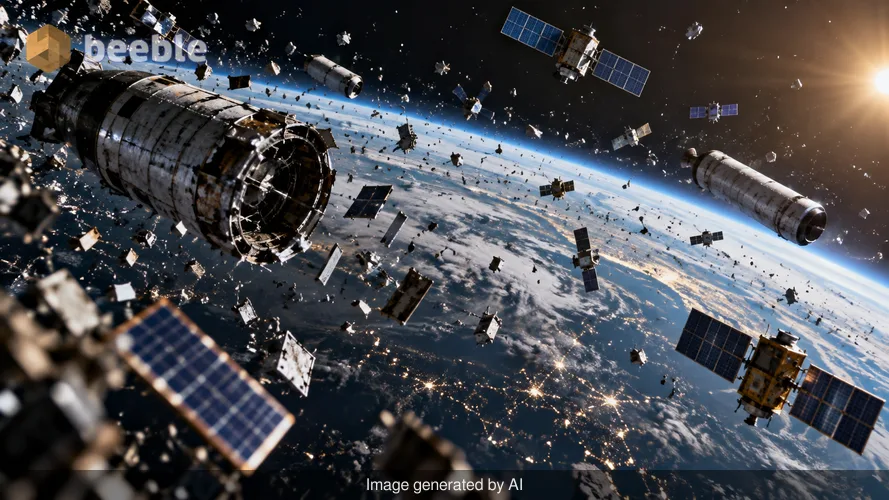
When was the last time you checked your phone for a weather update or used a map to find a new restaurant? Most people perform these tasks dozens of times a day without considering the aging hardware that makes them possible. Right now, thousands of satellites circle the planet to provide the invisible data that runs modern life. But there is a growing problem in the neighborhood. Low Earth Orbit is a high-speed bowling alley where the pins never leave the lane. Every defunct satellite and discarded rocket stage stays in play, moving at speeds ten times faster than a bullet. If we do not start cleaning up, the digital services we rely on could become expensive, unreliable, or simply vanish.
The physics of a high speed junkyard
To understand why a few pieces of trash matter, you have to look at the math of orbital velocity. A marble-sized piece of aluminum in orbit carries the same energy as a bowling ball dropped from a skyscraper. When that marble hits a billion-dollar weather satellite, it does not just leave a dent. It shatters the target into thousands of new, smaller pieces of junk. This is a systemic risk that scientists call the Kessler Syndrome. It is a chain reaction where one collision creates more debris, which leads to more collisions, eventually turning the space around Earth into a graveyard of shrapnel.
As of October 2026, the situation has moved beyond theoretical concern. The North American Aerospace Defense Command tracks over 35,000 objects larger than 10 centimeters. However, there are likely millions of smaller fragments that are too small to see but large enough to kill a mission. For the average user, this means the risk to the GPS network is higher today than it was five years ago. If a key navigation satellite is lost to a random piece of a 1980s Soviet rocket, your phone might struggle to find your location, or your food delivery might never arrive because the logistics network lost its eyes in the sky.
The tow truck drivers of the stars
The market for space debris removal is finally moving from experimental labs to the launchpad. Several companies are attempting to become the first orbital tow truck services. Astroscale, a Japanese company with a global presence, recently demonstrated that its ADRAS-J satellite can approach and inspect large pieces of debris with extreme precision. Their goal is to eventually use magnetic grapples to grab old satellites and drag them down into the atmosphere where they burn up safely.
Conversely, the European Space Agency is working with a startup called ClearSpace to launch the first actual removal mission. The ClearSpace-1 mission uses a four-armed claw to hug a 100-kilogram piece of a Vega rocket. It is a primitive solution but a foundational one. If you can catch one piece of trash, you can eventually catch a hundred. These missions are technically difficult because the targets are not designed to be grabbed. They are often tumbling, they have no handles, and they are moving at 17,000 miles per hour. Attempting to catch one is like trying to grab a spinning fan blade without breaking your hand.
The tragedy of the common orbit
The biggest hurdle for these companies is not the engineering. It is the invoice. Space is a textbook example of a market failure. During the 20th century, countries launched rockets without a plan for what happens when they stop working. Now, those old rocket stages belong to governments that may no longer exist or lack the budget to clean them up. International law says that the country that launched an object is responsible for it forever. However, there is no law that forces a country to remove its junk if it is not currently hitting anyone else.
This creates a situation where no one wants to pay for the cleanup. A commercial satellite operator like SpaceX or Amazon might be willing to pay to protect their own fleet, but they are hesitant to spend money to remove a fragment that belongs to a competitor. To put it another way, nobody wants to pay for a street sweeper when they are only one of a thousand people using the road. The European Space Agency has started to lead by example by buying "removal services" from private companies, effectively acting as the first customer for a new industry. This shift is transparently designed to prove that the technology works so that regulations can eventually mandate cleanup for everyone.
What this means for your monthly bills
You might think that orbital mechanics are far removed from your bank account, but the cost of space trash will eventually land on the consumer. Currently, satellite operators must build their spacecraft with extra fuel and heavy shielding to survive the debris environment. These requirements make satellites heavier and more expensive to launch. When an operator has to move a satellite to avoid a collision, they use up precious fuel, which shortens the lifespan of the craft. A satellite that lasts 10 years instead of 15 is a massive financial loss.
Ultimately, companies pass these costs to the user. Whether you pay for satellite internet, a high-end weather app, or even just use a car with an integrated navigation system, you are paying an "orbital tax." If the debris problem worsens, insurance premiums for space launches will skyrocket. Some analysts predict that the cost of maintaining a global satellite constellation could double by 2030 if debris mitigation is not standardized. The cheap, high-speed internet currently reaching rural areas via Starlink or Kuiper relies on a clear path through the atmosphere. If that path becomes a minefield, those monthly subscription prices will move in only one direction.
New rules for a crowded sky
Governments are finally beginning to treat orbit like a natural resource that needs protection. The Federal Communications Commission in the United States recently implemented a rule that requires satellite operators to deorbit their spacecraft within five years of completing their mission. Previously, the guideline was 25 years. This change is a practical step toward stopping the growth of the problem, but it does nothing to fix the junk that is already there. It is like a city passing a law against littering while ignoring the mountain of trash already sitting in the town square.
We are also seeing the emergence of "life extension" services. Companies like Northrop Grumman are building robots that can dock with aging satellites and provide them with new engines or fuel. By keeping old satellites functional for longer, we reduce the need to launch new ones, which slows the rate of debris creation. This is the orbital equivalent of repairing a car instead of buying a new one and leaving the old one in the middle of the highway. It is a streamlined approach that solves two problems at once: it saves money for the operator and keeps the orbit cleaner.
The bottom line on orbital hygiene
The race to clean up space is not just about environmentalism. It is about protecting the backbone of the modern economy. Our global financial markets, agricultural sensors, and emergency response systems all hang on a thin layer of functioning technology just a few hundred miles above our heads. The engineering to fix this is emerging, but the political will to fund it remains volatile. We are moving toward a period where space sustainability will be as standard as car emissions testing. For the average user, the best outcome is an invisible one. You want your GPS to keep working and your internet to stay fast without having to think about the robotic claws and magnetic nets patrolling the sky.
As you look at your phone today, realize that the data you see is a miracle of industrial coordination. The next time you hear about a new mission to catch a piece of space junk, see it for what it is. It is not just a scientific experiment. It is a maintenance crew working to keep the lights on for the rest of us. We are finally learning that in a world of interconnected technology, there is no such thing as throwing something away.
Sources:
- European Space Agency: Space Debris Office annual report 2025
- Astroscale: ADRAS-J Mission Status Updates
- Federal Communications Commission: Second Report and Order on Space Debris Mitigation
- NASA Orbital Debris Program Office: Quarterly News 2026
- ClearSpace-1 Project Documentation



See you on the other side.
Our end-to-end encrypted email and cloud storage solution provides the most powerful means of secure data exchange, ensuring the safety and privacy of your data.
/ Create a free account
