


Why a $450,000 AI Film Prize in Kazakhstan Changes the Math for Every Aspiring Creator

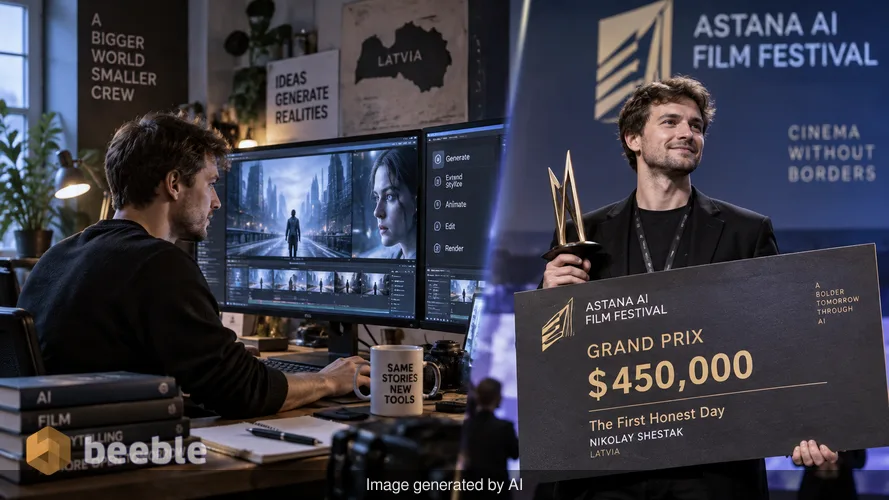
We used to believe that making a movie required a massive physical footprint. We accepted that a director needed a truck full of lighting rigs, a unionized crew of eighty people, and a catering budget larger than most household incomes. Now we are watching a single filmmaker from Latvia win nearly half a million dollars for a film he built inside a computer.
Behind the scenes, the traditional barriers that kept the average person away from the director’s chair are dissolving. The recent Astana AI Film Festival in Kazakhstan is a loud signal of this change. Nikolay Shestak, a Latvian director who only picked up a camera four years ago, walked away with the $450,000 Grand Prix for his film The First Honest Day. He did not win because he had the most expensive lens or the biggest marketing team. He won because he used generative AI to build a world that previously existed only in the high-rent districts of Hollywood.
The myth of the hundred-million-dollar entry fee
Historically, the film industry functioned like a gated city. You needed a pass from a studio executive to get through the door. Even the most talented indie creators spent years looking for sponsors, often settling for low-budget aesthetic choices because they could not afford anything else. This created a specific look for independent cinema: small rooms, lots of dialogue, and minimal visual effects.
Paradoxically, the Astana AI Film Festival shows that the cost of spectacle is plummeting. The competition attracted 8,000 submissions from 125 countries. These creators used more than 80 different generative AI models to build their projects. They did not need to knock on the doors of production companies. They did not need to wait for a green light from a committee. They simply started.
From a creator's standpoint, this is a total realignment of power. Kazakhstan’s President, Kassym-Jomart Tokayev, noted during the opening ceremony that the barrier to entry is now significantly lower. When a filmmaker no longer needs a million-dollar set to tell a million-dollar story, the industry’s architectural foundation shifts. The value moves away from the equipment and back toward the vision.
The moral mirror of The First Honest Day
Through this audience lens, the actual content of the winning film is as interesting as the technology behind it. The First Honest Day uses a narrative device where human actions dictate physical appearance. In Shestak's world, bad deeds make characters uglier, while good deeds make them more attractive. It is a concept that requires constant, seamless visual transformations—the kind of effect that would usually require a massive makeup department and a post-production house full of CGI artists.
Shestak started making AI films only two years ago. His win is a reminder that the learning curve for these tools is steep but fast. The jury, which included former UNESCO Director-General Audrey Azoulay and representatives from the Beijing Film Academy, did not just look for technical wizardry. They judged the films on artistic vision and storytelling coherence. They looked at how organically the technology fits the concept.
This reflects a shift in how we consume media. We are no longer impressed by the mere fact that a computer generated an image. We are looking for the human intent behind the pixels. The technology is just a faster way to get the idea from the brain to the screen.
Kazakhstan is betting on the FOMO factor
Zooming out to the industry level, the location of this festival is a deliberate strategic move. Kazakhstan is positioning itself as a hub for the next generation of digital creators. The total fund for the festival was $2 million. While half went to prizes for people like Shestak, the other half is set aside as investment capital for AI teams and production development within the country.
Aizat Kussainov, the festival’s co-founder, admitted that the driving force was a fear of missing out. The technology is moving so fast that waiting for a traditional film industry to adapt was not an option. By hosting the world’s largest AI film festival, Kazakhstan is attempting to leapfrog established media capitals. They want international creators to move to Astana and build the next era of cinema there.
This is not just about one festival. It is about the decentralization of Hollywood. In everyday terms, it means the next great blockbuster is just as likely to come from a home office in Riga or a tech lab in Astana as it is from a studio lot in Burbank. The infrastructure of entertainment is becoming digital and portable.
The invisible wall between amateur and professional collapses
In everyday media consumption, we often experience franchise fatigue because major studios are trapped by their own overhead. They have to make movies that appeal to everyone because the movies cost so much to produce. They take fewer risks. They lean on nostalgic reboots because they are safe investments.
AI filmmaking changes this math. When the cost of production drops, the cost of failure also drops. A filmmaker can spend two years experimenting with a weird, resonant idea like The First Honest Day without risking a studio’s bankruptcy. Consequently, we are likely to see a surge in fragmented, niche storytelling that the traditional industry would never touch.
We are currently in a transition period where AI tools can feel clunky or derivative. Some people worry that these models will replace the creative role of the filmmaker. However, the Astana winners prove that the human is still the pilot. Myrzakhan Zhumakhan won Best Character for a comedy, while Zachary London took Best Concept for Pomegranate. Each of these wins required a human to make a creative choice. The AI is a tool, not a replacement.
Reclaiming the director's chair
The most profound takeaway from the Astana AI Film Festival is not the prize money. It is the realization that the tools of high-end production are now ubiquitous. A filmmaker from Latvia, an animator from India, and a director from Spain shared the top spots on a global stage. They used the same models available to anyone with a decent internet connection.
For the audience, this means the digital buffet is about to get much larger. We are moving away from an era where a few gatekeepers decided what stories were worth $100 million. We are entering an era where the quality of the story is the only thing that matters.
As you scroll through your streaming library tonight, consider how much of what you see is the result of a creative choice and how much is the result of a budget constraint. The films coming out of festivals like Astana suggest that those constraints are disappearing. The next time you have a story to tell, the only thing stopping you is the time it takes to learn the tools. The gate is open.
Sources
- Astana AI Film Festival official winner announcements and press releases.
- Freedom Holding Corp corporate reports on Freedom Shapagat Foundation funding.
- Interviews with Nikolay Shestak and Aizat Kussainov conducted at the event.
- Public statements from President Kassym-Jomart Tokayev regarding Kazakhstan’s digital economy.



See you on the other side.
Our end-to-end encrypted email and cloud storage solution provides the most powerful means of secure data exchange, ensuring the safety and privacy of your data.
/ Create a free account
