


Why a demoted title of technical staff explains the new gold rush of tech elites

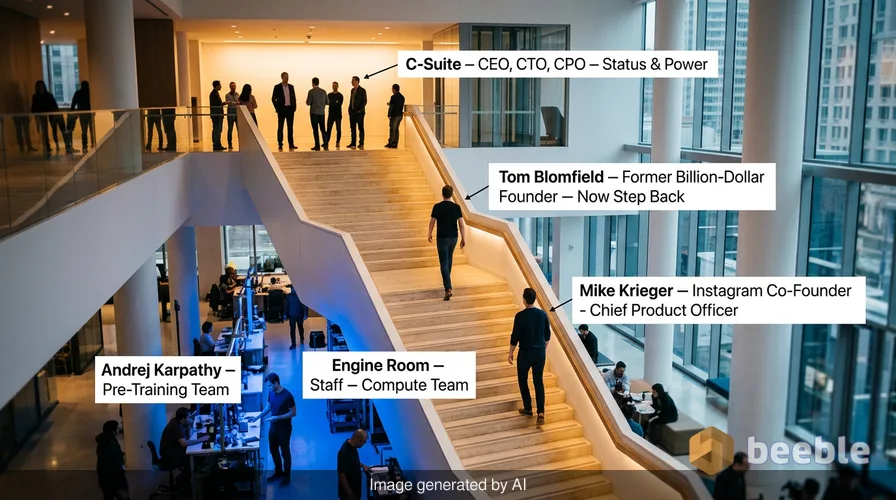
Tom Blomfield recently sat in a position that most people spend their entire lives trying to reach. He was the founder of two billion-dollar companies, Monzo and GoCardless. He spent years as a Group Partner at Y Combinator, the world’s most prestigious startup accelerator. In the traditional narrative of success, Blomfield had won the game. He had the money, the status, and the leisure to spend his days mentoring the next generation. Yet, in July 2026, he made a move that confused those outside the Silicon Valley bubble. He joined Anthropic as a member of technical staff. He did not join as an executive. He did not take a board seat. He stepped back into the engine room to work on the compute team.
This is a signal in the noise of a shifting economy. Blomfield is part of a growing cohort of tech winners who are trading their C-suite titles for the humble label of staff. This trend includes figures like Mike Krieger, the Instagram co-founder who joined Anthropic as chief product officer, and Andrej Karpathy, who moved from leading AI at Tesla to a pre-training team at a lab. Even Peter Bailis, who was the CTO of Workday, a company with eight billion dollars in revenue, left that post to become a member of technical staff at Anthropic. On an individual level, these choices look like personal passion projects. On a macro level, they reveal a profound transformation in how the global elite views power and relevance in the age of artificial intelligence.
The linguistic camouflage of the technical staff title
Linguistically speaking, the phrase "member of technical staff" is an archaeological remnant of an older era. It dates back to institutions like Bell Labs and Xerox PARC, where the goal was to create a flat, research-heavy environment. By using this title today, companies like OpenAI and Anthropic are performing a deliberate act of semantic flattening. They strip away the hierarchy of the corporate ladder to suggest that everyone is simply a builder. This is a rejection of the liquid modernity that has defined the last two decades of tech, where titles like "Vice President of Growth" or "Chief Visionary Officer" proliferated. These titles were often ephemeral and lacked a connection to the actual work of creation.
In everyday terms, this flattening acts as a social lubricant for the ultra-wealthy. It allows a billionaire to work alongside a 24-year-old PhD graduate without the friction of traditional rank. For the established founder, this title is a form of cultural camouflage. It signals that they are not here to manage spreadsheets or attend quarterly earnings calls. They are here to touch the frontier of the technology itself. This linguistic shift reflects a broader societal pattern where status is no longer derived from how many people you manage, but from how close you are to the source of systemic change.
The sociological habitus of the permanent founder
To understand why a successful person would return to a high-pressure grind, we must look at the concept of habitus. This sociological term describes the deeply ingrained habits and dispositions that individuals possess based on their life experiences. For the tech winners of the 2010s, their habitus is defined by the hunt for the next platform shift. They are socially and psychologically programmed to be at the center of innovation. For them, a quiet retirement is a form of social death. Being a venture capitalist or a board member is often an atomized experience, separated from the visceral thrill of building something that changes the collective reality.
Consequently, the allure of AI is not just about the money. It is about the fear of becoming a historical footnote. Eric Wu, who led Opendoor for a decade, admitted that his decision to launch a new AI startup, NavigateAI, was driven by the fear of future regret. This is the paradox of the successful founder. The more they achieve, the more they realize that the world moves on quickly. In the fast-moving current of the modern economy, standing still feels like falling behind. Their habitus demands they remain in the arena, even if the role they take is technically a step down from their previous heights.
AI as the solid ground in a liquid world
Sociologists often describe our current era as one of liquid modernity, where social structures, jobs, and technologies are in a state of constant flux. Nothing feels permanent. The social media era was the peak of this liquidity, characterized by fleeting trends and ephemeral content. AI represents a shift back toward something that feels solid. It is a fundamental change in the infrastructure of human thought and production. For the people who built the apps of the last decade, AI is the new bedrock. They see it as a formative moment that will define the next fifty years of human history.
Behind the scenes of this trend is the realization that the previous wave of tech success was just a prelude. People like Chamath Palihapitiya, the former Facebook executive, are returning to operational roles because they believe the scale of AI is vastly greater than the mobile internet. Palihapitiya’s return as CEO of 8090 Labs is a bet on this systemic shift. When a person who has already made hundreds of millions of dollars decides to go "all in" on a new startup, they are signaling that the potential rewards are significant enough to justify the loss of their leisure time. They are trading the transient comfort of the boardroom for the foundational work of the lab.
The architecture of the new elite
Historically, the elite have always sought ways to distinguish themselves through exclusive knowledge. In the past, this might have been a classical education or access to high-society circles. Today, the new distinction is technical proximity to the frontier of AI. This creates a new form of social stratification. There are the people who use AI, and then there are the people who are in the room when the models are trained. The latter group is becoming a new technological priesthood. Joining a technical staff is a way to enter this inner sanctum.
This move also serves as a coping mechanism for the anxiety of the modern age. Even the most successful people feel the systemic pressure of a world that is rapidly automating. By joining the teams building these tools, they move from being subjects of the change to being its architects. It is a way to reclaim agency in a fragmented world. When Peter Bailis left a CTO role at a massive corporation for a staff position at an AI lab, he was moving toward the center of power. In the current economy, an $8 billion revenue stream is less interesting than the code that will eventually automate that revenue stream.
Through the lens of the new grind
Ultimately, this trend reveals that the concept of retirement is changing for those at the top of the social hierarchy. The traditional idea of success involved reaching a point where you no longer had to work. Now, success is the ability to choose the most difficult and interesting work available. The "grind" has been rebranded as a luxury. It is a sign of high status to be busy with the things that matter most to the future of the species. The technical staff title is a badge of honor because it proves that the individual still has the skills to contribute at the highest level.
On an individual level, this should prompt a reflection on our own definitions of success. If the people who have everything are choosing to go back to the beginning, it suggests that the true value of work is not found in the title or the paycheck, but in the relevance of the task. We are witnessing the end of the executive as a status symbol and the rise of the specialized builder. This shift is not just happening in Silicon Valley. It is a symptom of a world that increasingly values deep expertise over general management. The move from the corner office to the technical lab is a roadmap for navigating an uncertain future.
As we observe this shift, it is worth questioning our own attachment to hierarchy. The technical winners are showing that influence is often found in the most unassuming places. They are choosing to be students again, sitting in rooms with people half their age, learning the nuances of a new language. This humility is perhaps the most practical takeaway from the trend. In a world defined by rapid change, the only way to remain relevant is to remain curious. The next time you see a high-profile executive take a junior title, remember that they are not stepping down. They are stepping toward the center of the world.
Sources
- Zygmunt Bauman, Liquid Modernity (Sociological study on transience in modern life).
- Pierre Bourdieu, The Logic of Practice (Introduction of the concept of habitus).
- Anthropic and OpenAI public career disclosures and job title structures.
- Publicly available interviews and statements from Tom Blomfield, Eric Wu, and Chamath Palihapitiya.
- Market data on AI investment trends and Series A funding rounds from Salesforce Ventures.



See you on the other side.
Our end-to-end encrypted email and cloud storage solution provides the most powerful means of secure data exchange, ensuring the safety and privacy of your data.
/ Create a free account
