


Why a missing refresh button signals the future of digital sovereignty

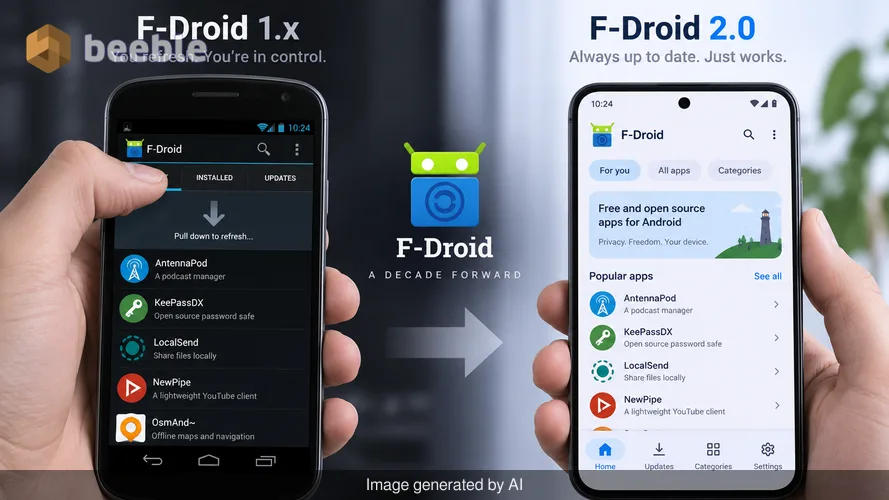
A specific muscle memory exists for every veteran Android user. When an app list feels stale, the thumb reaches for the top of the screen and pulls down. This tactile tick, the pull-to-refresh gesture, is a digital security blanket. It confirms that we are in control and that the data is current. In the newly released F-Droid 2.0, this gesture is gone from the main app screen. Its absence is the first hint that the community-driven repository has moved beyond its origins as a niche tool for enthusiasts. The developers removed the manual refresh because the system now handles updates automatically. This small change in user behavior reflects a decade-long shift in how we interact with the invisible architecture of our phones.
For ten years, the F-Droid client was a piece of living history. While the Google Play Store evolved into a high-gloss, algorithmically curated shopping mall, F-Droid remained a static library. It was functional but felt like a relic of the Android Gingerbread era. It was a tool that required the user to do the work: manual refreshes, manual APK installations, and manual navigation through a utilitarian interface. The 2.0 update changes the relationship between the user and the code. It is the first major rewrite in the project's history, moving from legacy XML layouts to a modern codebase built entirely with Kotlin Compose.
Rebuilding the foundation with Kotlin Compose
Under the hood, the transition to Kotlin Compose is a response to years of technical debt. Historically, building Android interfaces involved a complex dance between XML files and Java or Kotlin logic. This separation often created friction when developers tried to implement modern design elements like smooth transitions or reactive layouts. Compose is a declarative framework. It allows developers to describe the UI in terms of its state. When the underlying data changes, the interface updates itself automatically.
This shift to a modern framework makes the app store feel responsive for the first time. The interface is no longer a series of slow-loading lists. It is a fluid environment that supports Android’s Material You theming. Through this user lens, the update is about aesthetics. From a developer’s standpoint, it is about sustainability. The new codebase is easier to maintain and faster to iterate on. It removes the friction that prevented F-Droid from keeping pace with the rapid changes in the Android ecosystem. The app now uses the same design language as the rest of a modern phone, which reduces the cognitive load for new users who are accustomed to the polished experience of proprietary stores.
Bridging the gap between security and friction
One of the greatest barriers to using F-Droid was always the installation process. Google has historically categorized any app source outside the Play Store as a potential threat. Consequently, installing an open-source app required a series of scary system warnings and multiple taps to approve an APK file. In everyday terms, it felt like sneaking into your own house through a window because the front door was locked. F-Droid 2.0 addresses this friction by using the Android pre-approval API.
This technical change alters the installation flow. Instead of downloading a file and then launching a separate installer, the user verifies the installation before the download begins. You tap a button in F-Droid and then confirm a system pop-up. The operating system treats the request with less hostility because the handshake happens through official channels. It is still one more tap than the Play Store requires, but the experience is much closer to the seamless standard users expect. This compromise shows a pragmatic approach to security. It respects the safety protocols of the Android OS while reclaiming the ease of use that was previously reserved for Google’s own services.
Navigating the geography of open source
As the repository grew to include thousands of apps, the old search mechanism became insufficient. Zooming out to the industry level, search is the primary way we interact with data. Proprietary stores use search to gather data on what you want so they can sell you an alternative. F-Droid uses it to connect you with a tool. Paradoxically, the privacy-focused nature of F-Droid made it harder to find things in the past. It did not track your interests, so it could not suggest what you might like.
F-Droid 2.0 improves discovery without compromising privacy. The new search engine indexes app descriptions and translations rather than just titles. If you search for a specific utility like a firewall or a password manager, the results are now based on what the app does, not just what it is named. The Discover page now features categories that drill down into specialized niches. This allows users to find tools for specific tasks, such as document scanning or local-network file sharing, without knowing the name of the software beforehand. The update turns a raw list of files into a searchable knowledge base.
The philosophy of an invisible storefront
The most profound change in F-Droid 2.0 is the introduction of simultaneous downloads and automatic updates. In practice, this means the app store finally gets out of the way. Software updates are like home renovations: they are necessary, but the process is disruptive. By automating the update cycle, F-Droid removes the need for the user to manage their own digital maintenance. The app checks for new versions and installs them in the background.
This functionality brings F-Droid to parity with the Play Store in terms of convenience, but it maintains a fundamental difference in philosophy. The Play Store is a business. Its goal is to keep you inside the store, looking at suggestions and advertisements. F-Droid is a utility. Its goal is to provide you with the software you need and then disappear. The removal of the pull-to-refresh gesture is a sign of confidence. The developers are stating that you no longer need to check their work. The system is reliable enough to operate without constant supervision.
Reclaiming the digital tools of the trade
Ultimately, the rollout of F-Droid 2.0 is about digital sovereignty. We live in an era where most software is rented or locked within a walled garden. Proprietary ecosystems are convenient, but they are also opaque. They dictate what you can install and track how you use it. F-Droid represents a different path. It is a collection of tools that belong to the community, where the code is transparent and the user is the owner, not the product.
Technically speaking, the 2.0 update is a successful modernization of a vital piece of infrastructure. On an individual level, it is an invitation to reconsider our relationship with our devices. We have become accustomed to the friction of sideloading and the clutter of ad-supported stores. F-Droid 2.0 proves that open-source software can be as intuitive and streamlined as the best proprietary alternatives. It reminds us that we have a choice in how we access our digital tools. The new client is currently rolling out in stages, and it is available for manual download for those who want to see the future of open-source Android today.
Key takeaways for the digital citizen
- Observe the ritual: Notice how often you manually refresh or check for updates in your apps. This behavior is often a response to software that feels unreliable or opaque.
- Question the friction: When an operating system makes it hard to install an app from an outside source, ask whether that friction is for your protection or to protect a corporate monopoly.
- Value transparency: Open-source software like the apps found on F-Droid allows anyone to inspect the code. This transparency is the only real defense against hidden tracking and unwanted data collection.
- Support community infrastructure: Digital tools require maintenance. F-Droid exists because of a multiyear effort by volunteers to rebuild a ten-year-old system from the ground up.
Sources:
- F-Droid Official Blog Release Notes for Version 2.0.0
- Kotlin Compose Documentation for Android Developers
- Android Developer API Reference for Package Installer Pre-approval
- F-Droid Repository Statistics and Contributor Documentation on GitLab



See you on the other side.
Our end-to-end encrypted email and cloud storage solution provides the most powerful means of secure data exchange, ensuring the safety and privacy of your data.
/ Create a free account
