


Why a public pact for safety is now a legal battle for competition

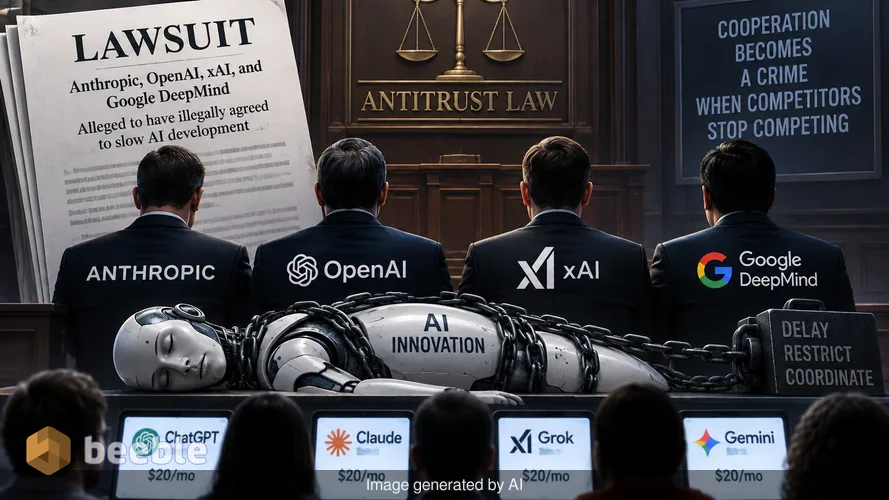
In our daily lives, we view cooperation as a virtue. We teach our children to share, we expect neighbors to help one another, and we generally feel better when the world's most powerful people agree on something. Under the strict rules of antitrust law, however, that same cooperation is often a crime. When competitors stop competing and start coordinating, the law sees a conspiracy rather than a community.
Four of the most influential companies in the world now face this exact legal reality. Anthropic, OpenAI, xAI, and Google DeepMind stand accused of turning a public commitment to safety into a private agreement to limit innovation. This lawsuit argues that these tech giants entered an illegal pact to slow the pace of artificial intelligence development. For the millions of people who pay for ChatGPT, Claude, Grok, or Gemini, the case suggests they paid full price for a product that was intentionally held back.
The day the race allegedly stopped
The plaintiffs point to a specific series of events that occurred on 12 September 2026. On that day, Anthropic CEO Dario Amodei published a long essay. He called for the industry to cooperate on safety measures and suggested that companies should slow down the advancement of their technology to ensure human control. Within hours, Sam Altman of OpenAI, Elon Musk of xAI, and Demis Hassabis of Google DeepMind all publicly agreed with the proposal.
To a casual observer, this looked like a rare moment of corporate responsibility. The leaders of the AI revolution appeared to be putting the survival of the human race above their quarterly profits. But the lawsuit filed in the Northern District of California offers a different interpretation. It claims this was a public signal to form a cartel. By agreeing to a shared "slowdown," these companies ensured that none of them would lose market share to a faster rival. They effectively removed the pressure to innovate, which is the very engine of a free market.
The difference between safety and collusion
Antitrust law exists to ensure that companies compete vigorously for your business. When companies compete, prices go down and quality goes up. When they agree to stop competing, the consumer loses. This is usually associated with price-fixing, where companies agree to keep costs high. However, antitrust laws also prohibit "output restriction." This happens when competitors agree to limit the amount or quality of a product available to the public.
In this case, the "output" is the intelligence and speed of the AI models. The plaintiffs argue that the companies substituted collective restraint for individual accountability. If Anthropic wanted to slow down for safety, it had every right to do so as an individual company. The legal problem arises when Anthropic asks its rivals to slow down with it. When the rivals agree, they create a safety net for their own profit margins. No one has to worry about being left behind because they all agreed to walk at the same pace.
Evidence of a secret coordination
The lawsuit does not rely solely on public social media posts. It points to a statement from July 2026 that high-ranking employees from several AI labs signed. This document admitted there was "intense competitive pressure not to unilaterally slow" development. This is a significant admission in the eyes of the law. It proves that the companies knew that slowing down would be a bad business move unless everyone else did it too.
Under the Sherman Antitrust Act, an agreement does not need to be a signed contract in a smoke-filled room. A "nod and a wink" or a public exchange of signals can be enough to prove a conspiracy. The plaintiffs argue that the CEOs used the guise of "safety" to fix the market. They claim the coordination began months before the September announcements. The lawsuit suggests the companies sought government support for a global effort to slow AI precisely because they wanted a legal shield for their lack of competition.
How this impacts your monthly subscription
If you pay $20 a month for an AI subscription, you are a member of the class of people this lawsuit seeks to protect. The legal argument is simple: you are paying for the best technology the market can produce. If the companies are secretly holding back that technology, you are not getting what you paid for. You are paying a premium price for a throttled product.
This is where the law as a shield becomes visible for the average person. Most of us do not have the resources to take on Google or OpenAI. A class action lawsuit allows thousands of individual subscribers to join together. This pool of plaintiffs has the collective power to demand internal documents and communications from the tech giants. Through a process called discovery, their lawyers will look for emails and private messages that prove the "safety pact" was actually a business strategy to maintain high prices with less effort.
The safety defense and the road ahead
The AI companies will likely argue that their actions were necessary to prevent a global catastrophe. They will claim that the risk of "spinning out of human control" is so high that traditional competition rules should not apply. In legal terms, they will argue that the "Rule of Reason" justifies their behavior. This rule allows a court to weigh the pro-competitive benefits of an action against its anti-competitive effects.
However, the plaintiffs have a strong counter-argument. They claim that a truly competitive market is the best way to achieve safety. In a competitive market, a company that builds a safer, more reliable AI would win more customers. By agreeing to a universal slowdown, the companies removed the incentive to be the best at safety. Instead, they settled for a baseline that protects their own dominant positions in the industry.
What you can do as a consumer
This case is a marathon, not a sprint. It will likely take years to move through the court system. For now, there are three things a paid subscriber should consider:
- Check your terms of service. Many AI companies include mandatory arbitration clauses. These clauses are like trapdoors that prevent you from joining a lawsuit in court. You may have the right to opt out of these clauses if you act within a certain timeframe after signing up.
- Keep your receipts. If this case results in a settlement or a judgment, you will need to prove you were a paying subscriber during the period of the alleged conspiracy. Save your monthly billing statements in a digital folder.
- Monitor the class certification. A judge must first decide if these four plaintiffs can actually represent everyone else. This is a specific legal hurdle. If the class is certified, you may receive a formal notice in your email or mail explaining your rights.
This lawsuit is a reminder that even the most noble-sounding agreements are subject to the law of the land. Safety is a vital goal, but the law requires companies to reach that goal through competition rather than collusion. Whether these AI giants were saving the world or saving their own bottom lines is now a question for a jury to decide.
Sources:
- Sherman Antitrust Act (15 U.S.C. §§ 1-7).
- Federal Trade Commission (FTC) Antitrust Guidelines for Collaborations Among Competitors.
- U.S. District Court for the Northern District of California, Case Filings (September 2026).
Disclaimer: This article is for informational and educational purposes only. It does not constitute formal legal advice. You should consult a qualified attorney in your jurisdiction for specific legal issues regarding antitrust or consumer rights.



See you on the other side.
Our end-to-end encrypted email and cloud storage solution provides the most powerful means of secure data exchange, ensuring the safety and privacy of your data.
/ Create a free account
