


Why a thirty percent chance of Senate success matters for your digital wallet and the future of money

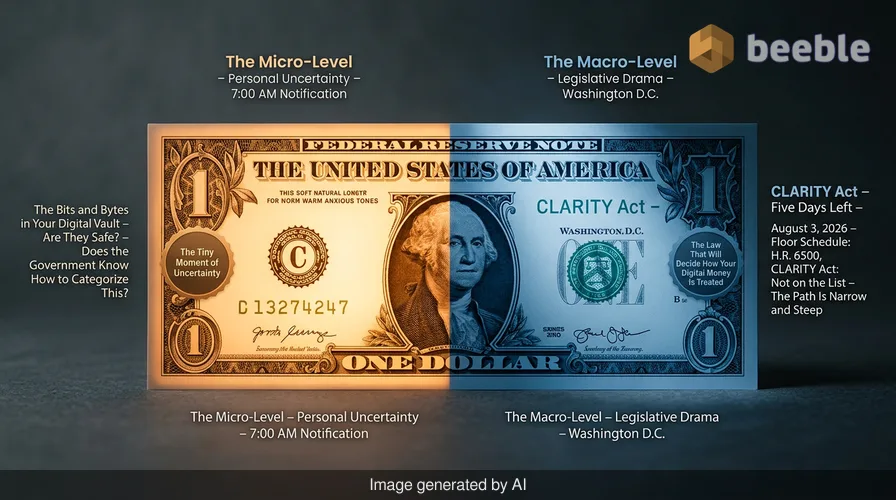
A notification pings on your phone at 7:00 AM. It is a crypto exchange app alert. You look at the balance of your digital dollars, the ones you bought to earn a little extra yield while your traditional savings account offered almost nothing. You wonder if the money is safe. You wonder if the government actually knows how to categorize the bits and bytes sitting in your digital vault. This tiny moment of uncertainty is the micro-level version of a much larger drama currently unfolding in Washington D.C. behind heavy mahogany doors and through frantic staff emails.
Today is August 3, 2026. The U.S. Senate has exactly five days left before the state work period begins on August 10. For the CLARITY Act, a piece of legislation that would finally decide how your digital money is treated by law, this is the final stretch of the summer. The floor schedule for Monday opens with a government funding bill known as H.R. 6500. The CLARITY Act is nowhere to be found on that list. This absence is the first sign that the path for this bill is narrow and steep.
The five-day countdown for the clarity act
Inside the Senate, time is the most expensive commodity. A bill needs sixty votes to clear the procedural hurdle known as cloture, which ends debate and moves a vote forward. Republicans currently hold fifty-three seats. Even if every single Republican voted for the CLARITY Act, they would still need at least seven Democrats to join them. This math is difficult because every absence or defection increases the pressure on the remaining votes. Senators Josh Hawley and Rand Paul have already expressed their opposition, which makes the hunt for Democratic support even more urgent.
Galaxy analysts placed the odds of the bill passing this year at roughly 30 percent in late July. This figure matches the sentiment on Polymarket, where traders bet real money on political outcomes. When a prediction market gives a 70 percent chance of failure, it suggests that the obstacles are not just procedural but ideological. The Senate is a global mood ring for the nation's financial anxiety, and right now, that ring is showing deep purple streaks of hesitation.
The ethics loophole and the battle over family businesses
One of the most persistent friction points involves the language around government ethics. Senate Banking Democrats argue that the current draft contains significant loopholes. Specifically, they claim the bill would allow senior officials, including Donald Trump, to continue profiting from their existing crypto ventures. The current draft bars these officials from issuing or sponsoring new digital assets until 2029, but it is vague about what happens to holdings they already own.
Staff members renewed their complaints on July 30, focusing on how the bill treats family-owned businesses and enforcement authority. To a retail investor, this might seem like distant political bickering. Paradoxically, these rules define the integrity of the entire market. If the public perceives that the rules were written to protect the portfolios of the powerful, the trust that supports the value of digital assets could erode. Trust is the collective belief system that gives any currency its power.
Why banks fear your digital dollar rewards
Beyond the ethics debate, there is a systemic fight over where your money lives. Traditional banks are lobbying hard against a provision involving stablecoin rewards. Many crypto platforms offer rewards to users who hold stablecoins, often at rates that outperform standard bank accounts. The banking industry calls this a loophole. They argue that if these rewards look and act like deposit interest, they will pull liquidity out of the traditional banking system. This movement of money could leave banks with less cash to fund mortgages or small business loans.
Crypto companies view this as a transparent attempt to stifle competition. They argue that a broad ban on rewards would essentially protect banks from having to offer better rates to their customers. The current compromise in the CLARITY Act bars passive interest on stablecoin balances but still allows rewards for transaction activity or staking. In everyday terms, this is a battle over whether your digital wallet can function like a high-yield savings account or if it must remain a neutral tool for payments.
The difference between neutral software and financial tools
Another deep-seated disagreement involves how the law treats decentralized finance, or DeFi. The bill places digital commodity exchanges and brokers under the Bank Secrecy Act. This means they must identify their customers and monitor for suspicious activity, just like a traditional bank. Senate Banking Democrats, however, worry that the draft leaves gaps for decentralized platforms and mixers that help people hide their transaction history.
Their complaint targets the exemption language. They want to know which platforms count as financial intermediaries and which qualify as neutral software. This is not just a technicality for developers. For the average user, the outcome determines whether you can use a private wallet without a middleman or if every digital interaction requires a background check. The tension is between the privacy of a glass bank vault and the transparency required by law enforcement to stop money laundering.
The sixty-vote math in a fifty-three seat senate
If negotiators find a compromise on ethics and bank rewards this week, the bill still faces a mechanical nightmare. The Senate process is slow. A motion to proceed, a cloture filing, and the subsequent debate time can consume several days. If a single senator objects to a unanimous-consent agreement, the clock can run out before a final vote occurs. The Senate calendar is currently a crowded parking lot, with government funding and various nominations competing for the same few spots.
Zooming out, the stakes of this five-day window extend far beyond 2026. If the CLARITY Act fails to move now, it slides into a September docket that is already full of election-year posturing and urgent funding deadlines. A missed window now likely means the bill stays in a drawer until after the November elections. This delay keeps the industry in a state of regulatory limbo, where companies operate under the constant threat of lawsuits rather than clear rules.
What happens if the senate clock runs out on friday
Silence from the Senate leadership through Friday will be the loudest signal for the market. If we do not see a motion to proceed or a public list of Democratic supporters, the 30 percent chance of passage will likely drop toward zero. Financially speaking, this means the volatility in the crypto market will continue to be driven by legal uncertainty rather than technical innovation. Your digital wallet remains in a legal gray zone where the protections you take for granted in a traditional bank do not yet exist.
Ultimately, the fight over the CLARITY Act is a study in how traditional power structures react to decentralized technology. The outcome will tell us if the government views crypto as a systemic threat to be contained or as a legitimate evolution of the financial system. As you check your phone for the next market update, remember that the value of your assets is being weighed against the political interests of banks and the personal balance sheets of presidential candidates. True financial mindfulness requires recognizing that while you hold the keys to your digital vault, the rules of the road are still being paved by a handful of people in a room in Washington.
Sources
Senate Banking Committee, H.R. 3633 Legislative Text and May 14 Markup Summary.
U.S. House of Representatives, H.R. 3633 Vote Records, July 17, 2025.
Galaxy Research, CLARITY Act Passage Odds Report, July 25, 2026.
Polymarket, Senate Legislative Outcomes Tracker, August 2026.
Senate Periodical Press Gallery, Floor Schedule for the Week of August 3, 2026.



See you on the other side.
Our end-to-end encrypted email and cloud storage solution provides the most powerful means of secure data exchange, ensuring the safety and privacy of your data.
/ Create a free account
