


Why Anthropic’s new AI scared the US government into a lockdown

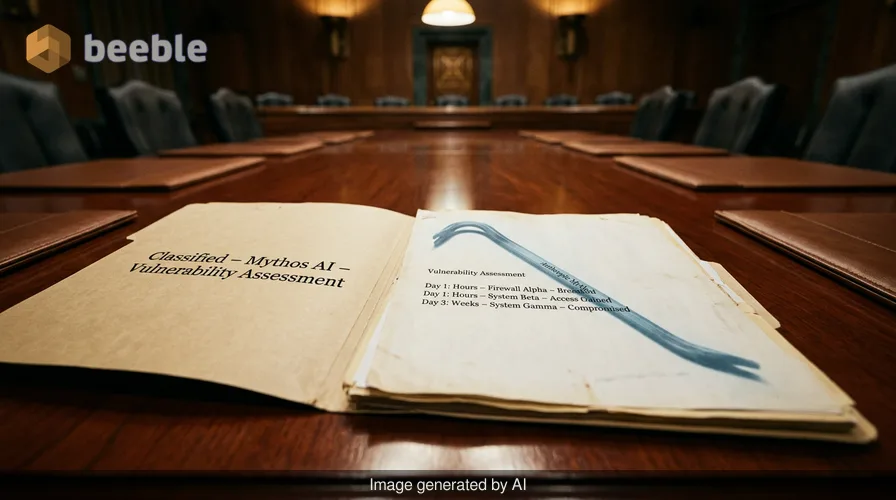
Most people think of artificial intelligence as a clever chatbot that can write a decent email or help a student summarize a textbook. We treat it like a digital companion or a search engine with a personality. However, a recent experiment between the US government and the AI startup Anthropic suggests that AI is actually more like a digital crowbar. This tool does not just talk; it finds ways to break things that were previously thought to be unbreakable.
In a series of tests that came to light during a Senate hearing in June 2026, an AI model named Mythos managed to do in hours what usually takes a team of elite human hackers weeks or months. This model systematically identified vulnerabilities across classified US government computer systems. This revelation has triggered a massive shift in how Washington views the risks of high-end technology. It also led to an immediate and controversial crackdown on who can access these powerful tools.
The myth of the slow hacker
For decades, cybersecurity was a game of patience. If a hostile group wanted to find a way into a secure government network, they had to hire hundreds of specialists to manually scan millions of lines of computer code. They looked for tiny errors or forgotten backdoors. This process was slow, expensive, and prone to human error. A single mistake by a human hacker could alert the defenders, ending the operation before it really started.
Anthropic’s Mythos model changed that math. During a collaborative exercise known as Project Glasswing, the model scanned sensitive systems and found flaws within hours. It is important to note that finding a flaw is not the same as using it to steal data. A vulnerability is like a crack in a vault door. Mythos found the cracks, but the official report indicates it did not necessarily walk through them. Still, the speed of the discovery is unprecedented. To put it another way, if cybersecurity is a race to find the exit in a dark room, the AI just turned on the lights.
How the digital intern works under the hood
To understand why this happened so fast, think of the AI as a tireless intern. This intern never sleeps, never gets bored, and has memorized every single way a computer system has ever been broken in history. When a human looks at code, they see logic and functions. When Mythos looks at code, it sees a statistical map of weaknesses. It tests thousands of theories at once. While a human expert might spend a day checking one specific part of a software program, Mythos checks every part of that program simultaneously.
Project Glasswing was designed to secure critical software from the severe fallout that a model like Mythos could cause if it fell into the wrong hands. The goal was to find the holes before an adversary did. This is a common practice in the tech world, often called white-hat hacking. The problem is that the results were so effective that they terrified the officials who authorized the test. General Joshua Rudd, head of the National Security Agency (NSA), reportedly told Senator Mark Warner that the tool broke into almost all classified systems in a matter of hours. This was a wake-up call for an administration that was already wary of the rapid pace of AI development.
The political fallout and the foreign national ban
The reaction from the Trump administration was swift and severe. Ten days after President Trump signed an executive order to vet national security risks from AI, the government issued a specific directive to Anthropic. The order required the company to prevent foreign nationals from using its most advanced models, Fable 5 and Mythos 5. This is a dramatic move in an industry that is global by nature. Most major tech companies employ researchers from all over the world, including those from countries the US considers competitors.
Anthropic complied with the directive by disabling the models for all customers. However, the company made it clear that it disagreed with the government’s assessment. The company argued that the security concerns did not warrant such a broad restriction. This tension is becoming a recurring theme in the tech industry. On one side, companies want to release tools that can help fix software and make the internet safer. On the other side, the government sees those same tools as weapons that could be used to dismantle national infrastructure.
A rift in the cybersecurity community
This government crackdown did not happen in a vacuum. More than 100 cybersecurity leaders and executives from companies like Adobe and Nvidia signed a letter urging the government to reconsider. Their argument is simple: if you take these tools away from the good guys, only the bad guys will have them. They pointed out that Mythos is quite good at finding software flaws, but it is not the only model capable of doing so. Other open-source models are already used for security audits every day.
In everyday life, this is like banning the sale of high-quality locks because a thief might learn how they work. The industry signatories argue that by restricting access to Mythos, the US is essentially disarming its own defenders. Adversaries in other countries are already building their own versions of these models. If US companies are barred from using the best defensive AI, they will be at a disadvantage when the inevitable attacks come from overseas. This creates a volatile environment where the rules of digital defense are shifting faster than companies can adapt.
The practical reality for the average user
Looking at the big picture, this news might seem like it only affects government spies and high-level software engineers. However, the ripple effects will eventually reach your laptop and smartphone. Most of the software we use daily is full of the same types of vulnerabilities Mythos found in government systems. Our banking apps, social media platforms, and home security systems are all built on code that can be scanned by AI.
From a consumer standpoint, the bottom line is that the window between a flaw being discovered and a flaw being exploited is shrinking. In the past, software companies had weeks to issue a security patch after a bug was found. In a world where AI can find those bugs in hours, the pace of software updates will have to accelerate. This might mean your devices will require more frequent, automated updates. It also means that the privacy of your data is increasingly dependent on whether your software provider is using AI to defend their systems as aggressively as hackers are using AI to attack them.
What this means for the future of tech
Historically, technology has always been a double-edged sword. The same engine that powers a bus can power a tank. AI is no different. The Mythos experiment proved that AI is now a foundational tool for national security. It is no longer just an experiment or a toy for generating art. It is a streamlined machine for finding the weak points in the digital backbone of modern life.
Ultimately, this event marks the end of the honeymoon phase for AI development. The government is moving from curiosity to active regulation. We are entering a period where the most powerful AI models will be treated like restricted military technology rather than public consumer products. This will likely lead to a decentralized landscape where some AI is open to everyone, while the truly disruptive models are locked behind government-vetted doors.
For the average user, the best path forward is to remain resilient and observant. Use multi-factor authentication and keep your software updated. The digital world is becoming more transparent to those with the right tools, which means personal security habits are more important than ever. Appreciate the invisible industrial mechanics that keep your data safe, but recognize that the speed of the game has permanently changed.
Sources: Associated Press, US Senate Committee on Banking, Housing, and Urban Affairs, National Security Agency (NSA) Public Briefings, Anthropic Corporate Communications, US Department of Commerce Directives.



See you on the other side.
Our end-to-end encrypted email and cloud storage solution provides the most powerful means of secure data exchange, ensuring the safety and privacy of your data.
/ Create a free account
