


Why Apple is building a second brain specifically for China

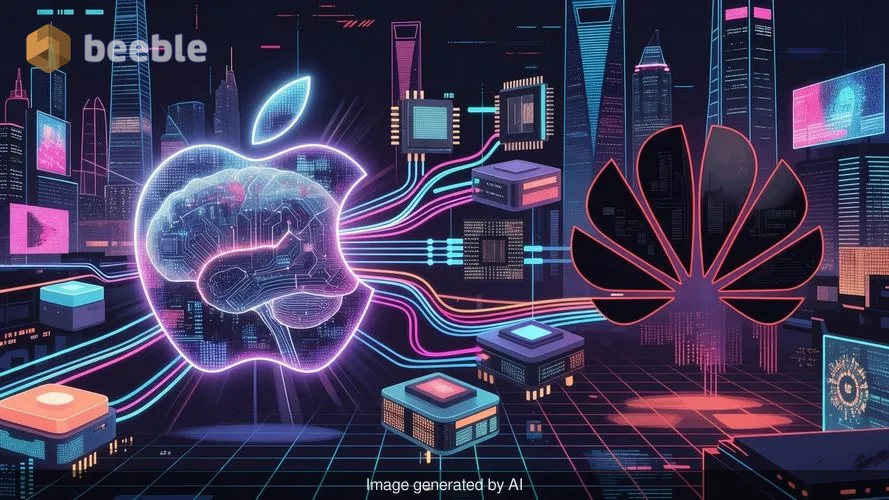
The popular narrative suggests that Apple is simply a middleman in the Chinese artificial intelligence market. Many analysts assume the company is just leasing technology from local giants to satisfy government regulators while keeping its own engineering at a safe distance. While this story of a passive Apple seems logical, the reality is a significant shift in how the company manages its most important overseas market. Apple is training its own large language model designed from the ground up for China. This move marks a sharp departure from the strategy of relying entirely on external partners for the intelligent features that define the modern smartphone experience.
Developing a proprietary model in partnership with Alibaba is a calculated risk. For years, the tech world watched as U.S. giants struggled to bridge the gap between Western software and Chinese compliance. By building its own brain for the iPhone, Apple is attempting to solve a problem that has historically forced foreign firms to choose between leaving the market or offering a diluted product. This is a technical and political maneuver intended to keep the iPhone relevant in a region where local competitors like Huawei are gaining ground with their own advanced AI systems.
the myth of the passive middleman
For the average user, the distinction between a licensed AI and a proprietary one might seem academic. However, this distinction is the difference between an integrated experience and a bolted-on feature. In the United States, Apple Intelligence uses a blend of on-device processing and a partnership with OpenAI to handle complex requests. In China, OpenAI's ChatGPT and Anthropic's Claude are unavailable. This gap led many to believe Apple would simply swap one third-party engine for another, using Alibaba’s Qwen or Baidu’s Ernie Bot as a total replacement.
Looking at the big picture, a total reliance on third parties creates a volatile foundation for a premium product. If Apple only used external models, it would lose control over the speed, privacy, and personality of its digital assistant. By training its own model, Apple ensures that the foundational logic of the iPhone remains consistent with its global brand. This proprietary model acts as a tireless intern that understands the nuances of the Chinese language and local cultural norms without needing to constantly check in with an outside server owned by a competitor.
why a localized brain is a technical necessity
Practically speaking, training a language model for China is not just about translation. It is about navigating a specific digital ecosystem. The way a user in Beijing interacts with their phone—from mobile payments to social media integration—is systemic and different from a user in London. A model trained on Western data would struggle to provide the streamlined experience Chinese consumers expect. Apple needs its AI to understand the interconnected nature of apps like WeChat and Alipay while maintaining the strict privacy standards the company promotes.
Under the hood, this training process requires massive amounts of data and computing power. This is where the partnership with Alibaba enters the frame. Alibaba provides the infrastructure and the local data expertise required to refine a model that meets both Apple’s performance standards and the specific linguistic requirements of the region. This collaboration is a rare instance of a U.S. firm and a Chinese firm working closely on foundational AI technology during a period of shifting trade relations.
inside the alibaba alliance
Alibaba is the invisible backbone of this new strategy. While Apple designs the architecture, Alibaba provides the training support. This relationship is practical for both parties. For Apple, it provides a scalable way to process data within Chinese borders, which is a legal requirement for any firm operating in the country. For Alibaba, the tie-up provides a tangible boost to its reputation as a global leader in AI infrastructure.
Alibaba’s U.S.-listed shares reacted positively to early news of this partnership. Investors recognize that being the primary partner for Apple in China is a resilient position to hold. The collaboration extends beyond just providing servers. Apple is also incorporating Alibaba’s Qwen model into specific features of Apple Intelligence, such as Writing Tools and the Mac-specific version of Siri. This creates a dual-track system where Apple’s own model handles core tasks while Alibaba’s technology steps in for specific, data-heavy generative functions.
clearing the beijing regulatory hurdles
Every piece of software that generates content in China must pass a transparent but rigorous review by the Cyberspace Administration of China. This watchdog ensures that AI models do not produce content that violates local laws or social stability guidelines. In July 2026, Apple finally cleared this process. This approval makes Apple the first foreign company to gain permission to offer its own proprietary AI model to the Chinese public.
This regulatory milestone was not a simple formality. The company spent months adapting its features to meet the overarching requirements of the Chinese government. The process was so intensive that it delayed the rollout of Apple Intelligence in the region by several months. By obtaining this registration, Apple has built a bridge over the regulatory moat that currently keeps other Western AI firms out of the country. This positioning gives Apple a unique advantage in the high-end smartphone market.
how this changes the everyday iphone experience
From a consumer standpoint, the result of this work will be felt in the coming months through an iOS update. Users in China will see a version of Siri that is more responsive and capable of handling local tasks. The Writing Tools feature will be able to summarize long documents and compose emails in Mandarin with a level of fluency that previous versions lacked. Because much of this happens on a model Apple trained itself, the privacy protections are more robust than if every request were sent to a third-party cloud.
| Feature | US/Global Version | China Version |
|---|---|---|
| Core LLM | Apple Proprietary + OpenAI | Apple Proprietary (China-specific) |
| Cloud Partner | Private Cloud Compute | Alibaba / Baidu Infrastructure |
| Third-Party Integration | ChatGPT | Alibaba Qwen / Baidu Ernie |
| Regulatory Body | Standard Privacy Audits | CAC Registration & Compliance |
| Device Support | iPhone 15 Pro and Newer | iPhone 15 Pro and Newer |
In everyday life, this means the iPhone remains a viable tool for professionals who need AI assistance but are wary of using multiple separate apps for different tasks. The integration is intended to be intuitive. A user can ask their phone to organize a meeting or draft a response to a text message, and the device will switch between its own local brain and the Alibaba-powered cloud features without the user noticing the transition.
the broader impact on global tech diplomacy
Zooming out, this development is a case study in how global corporations are adapting to a decentralized tech world. The era of shipping a single, uniform product to every country is ending. Instead, we are seeing the emergence of regional variants that are identical on the outside but fundamentally different under the hood. Apple’s decision to build a specialized brain for China shows that the company views the region as a distinct digital territory that requires its own foundational technology.
This strategy also has implications for the wider AI industry. If Apple can successfully navigate the opaque regulatory environment in China while maintaining its brand identity, other firms may attempt to follow the same blueprint. However, the cost of entry is high. It requires a combination of high-end hardware sales, deep pockets for infrastructure, and a willingness to engage in long-term diplomacy with local regulators. For now, Apple stands alone in this approach.
the bottom line for your pocket and your privacy
Ultimately, Apple’s move to train its own model in China is about survival through customization. The company is fighting a cyclical downturn in its Chinese sales by leaning into the AI trend that has defined the last two years of consumer tech. For the user, the immediate benefit is a more capable device that does not feel like a second-class version of the American original.
As a consumer, you should observe how your devices handle your data as these features roll out. The integration of Alibaba’s technology into the iPhone is a pragmatic solution to a geographical problem, but it also means your data will be interacting with a different set of systems than it would in Europe or North America. The invisible industrial mechanics of AI training are now shaping the geopolitical boundaries of our digital lives. Whether you are in a boardroom in Shanghai or a coffee shop in San Francisco, the silicon in your pocket is becoming a reflection of the laws and partnerships of the land where it resides.
Sources:
- Alibaba Group Q1 2026 Earnings Report
- Cyberspace Administration of China Generative AI Filing Records
- Apple Newsroom Statement on Regional Software Updates
- World Governments Summit 2025 Keynote by Joe Tsai
- Reuters Industrial Analysis on Apple-Baidu Partnerships



See you on the other side.
Our end-to-end encrypted email and cloud storage solution provides the most powerful means of secure data exchange, ensuring the safety and privacy of your data.
/ Create a free account
