


Why can't the newest AI models handle more than two days of popularity?

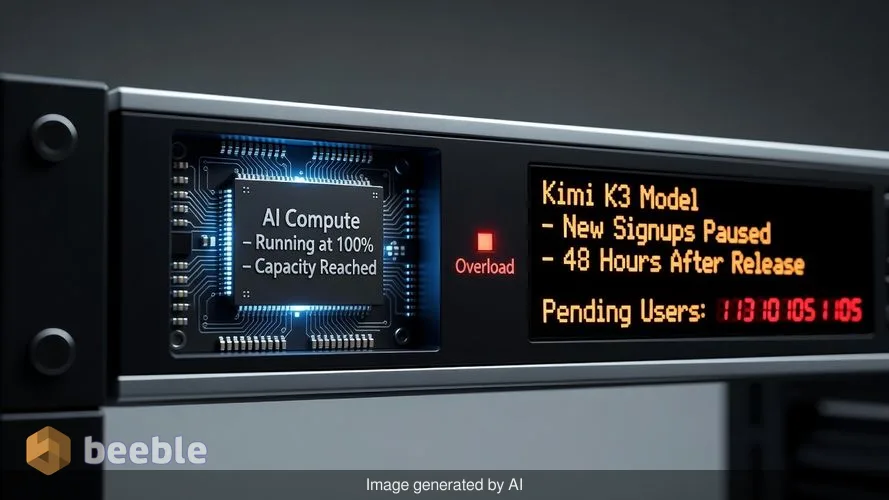
Most people treat artificial intelligence as a bottomless pit of digital wisdom. We expect it to be available at the tap of a button, anywhere and at any time. While the software feels infinite, the physical reality is surprisingly fragile. This week, the industry received a blunt reminder that AI is a physical commodity as much as a digital one. Moonshot AI, a prominent developer in Beijing, had to pause new signups for its flagship Kimi K3 model just 48 hours after its release. The reason was simple. So many people tried to use the system that the company ran out of computer processing power.
This event challenges the popular narrative that AI is an unstoppable force of nature. In reality, every time you ask a chatbot to write an email or explain a physics concept, a physical chip in a data center somewhere works at high speed. When demand spikes, those chips hit their limit. Moonshot AI confirmed that user interest pushed its systems to the edge, forcing a temporary shutdown for new users. This creates a strange situation where the world has a revolutionary tool that almost nobody can join for the moment.
the physical limits of digital brains
To understand why Kimi K3 broke the internet, we have to look under the hood at its architecture. Moonshot built this model with 2.8 trillion parameters. In the world of machine learning, parameters are the variables the system uses to make decisions. If we think of an AI as a tireless intern, parameters are like the connections in that intern’s brain. A model with 2.8 trillion parameters is a massive digital structure. It requires an immense amount of memory and processing cycles just to generate a single sentence of response.
Running a model of this scale is a heavy industrial task. It is not like hosting a simple website or a mobile app. It requires thousands of specialized chips working in perfect synchronization. When Moonshot released Kimi K3 as an open-weight system, they invited the entire world to test it. Because the model is free and highly capable, the stampede of users was immediate. The company underestimated how much digital crude oil—the processing power from high-end microchips—it would need to fuel this specific intern.
why open weight models are changing the game
Kimi K3 is part of a shifting trend in the AI industry toward open-weight models. Traditionally, companies like OpenAI or Anthropic keep their models behind a paywall. You can talk to the AI, but you cannot see how it works or run it on your own hardware. Open-weight models are different. They allow developers to examine the underlying logic and adapt the system for specific tasks. This transparency is a disruptive force in the market.
| Model Name | Parameters | Access Type | Current Status |
|---|---|---|---|
| Moonshot Kimi K3 | 2.8 Trillion | Open-Weight | Signups Paused |
| DeepSeek V4 | 2.2 Trillion | Open-Weight | Active |
| Alibaba Qwen3.8 Max | 2.4 Trillion | Closed/Preview | Limited Access |
| GPT-5.6 Sol | Undisclosed | Closed | Paid Subscription |
By releasing such a large model for free, Moonshot effectively democratized high-tier computing power. However, this strategy backfired because they could not provide the infrastructure to match their ambition. Users who already have accounts can still use the service, but the digital doors are locked for everyone else. Moonshot says it will add capacity in batches, but this takes time. Data centers do not appear overnight, and the chips required to run these models are in short supply globally.
the global ripple in the stock market
On the market side, this capacity crisis has a secondary effect on global finance. When Kimi K3 topped the leaderboards for coding and logic, it caused a stir on Wall Street. Investors began to worry that free, powerful Chinese models would erode the profits of American tech giants. If a user can get world-class AI performance for free, they are less likely to pay a twenty-dollar monthly subscription to a US-based provider. This realization led to a volatile week for US tech stocks.
This pressure is ironic. The US has implemented strict export controls to prevent advanced chips from reaching China. These restrictions are meant to slow down Chinese AI development. Yet, companies like Moonshot and DeepSeek continue to release models that rival or exceed American versions. The bottleneck for these firms is no longer just the intelligence of their code. The bottleneck is the sheer volume of hardware they can plug into the wall. Even with the best software in the world, you cannot serve a million users if you only have enough chips for half that number.
the invisible backbone of the ai economy
We often forget that AI is the invisible backbone of modern life. It filters our spam, suggests our music, and now writes our code. But this backbone is made of silicon and copper. The Moonshot situation shows that we are entering an era of resource scarcity in the digital world. Just as a city can experience a water shortage during a heatwave, the internet can experience a compute shortage during an AI launch.
For the average user, this means the era of free, unlimited AI might be shorter than we think. As models get larger and more complex, the cost to run them rises. A 2.8 trillion-parameter model is a scalable solution only if you have a massive budget for electricity and hardware. Moonshot's decision to pause signups is a pragmatic choice to save their existing service from a total crash. It shows that even the most advanced tech companies must respect the laws of physics and supply chains.
what this means for your digital habits
Looking at the big picture, the Kimi K3 pause tells us three things about the future of technology. First, the competition between China and the US is no longer about who has the best idea. It is about who has the most hardware. Second, the price of AI services will likely remain volatile. Companies will offer free access to gain users, but they will quickly hit a wall where they must charge money to cover their electricity bills.
Third, we should expect more localized AI. If the giant models in the cloud are constantly hitting capacity limits, developers will look for ways to run smaller, streamlined models on our phones and laptops. This would reduce the strain on the central servers. Practically speaking, the next time a major AI model launches, you should sign up in the first hour. If you wait 48 hours, the digital gates might already be closed.
Ultimately, we must view AI as a finite resource. It is a powerful tool, but it requires a massive amount of physical support. The next time your favorite app is slow or a new service is unavailable, remember that somewhere, a data center is working at its absolute limit. Our digital world is only as strong as the hardware that supports it.
Sources:
- Moonshot AI Official Communications, July 2026.
- Omdia Technology Research: AI Infrastructure Report by Lian Jye Su.
- South China Morning Post: Analysis of Kimi K3 Benchmarks.
- Alibaba Cloud: Qwen3.8 Max Technical Preview.
- Zhipu AI: GLM-5.2 Release Documentation.



See you on the other side.
Our end-to-end encrypted email and cloud storage solution provides the most powerful means of secure data exchange, ensuring the safety and privacy of your data.
/ Create a free account
