


Why ChatGPT won't write like your favorite author anymore

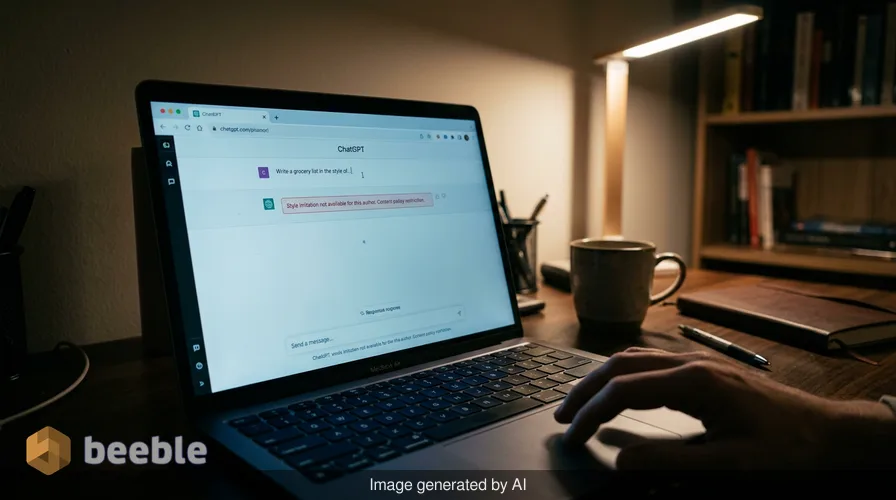
While the popular narrative paints AI as an unstoppable force that eats human culture for breakfast, the reality is that the era of the lawless digital mimic is ending. Many users still treat ChatGPT as a magic box that can resurrect any voice from the history of literature. If you wanted a grocery list written by Sylvia Plath or a product review in the cadence of Hunter S. Thompson, the bot was happy to oblige for a long time. Those days are over. OpenAI has quietly installed a set of digital guardrails that prevent the system from mimicking the specific styles of famous authors, whether they are living or dead.
The end of the digital ventriloquist
For the average user, this change arrived without a press release or a flashy update notification. People discovered it through trial and error. When a user asks ChatGPT to write a story in the style of Stephen King, the bot now responds with a polite but firm refusal. It states that it cannot closely imitate the distinctive style of a named author. Instead of the visceral, dread-filled prose King is known for, the AI provides a generic substitute based on broader themes like small-town secrets or suspenseful atmospheres.
Tests by tech outlets like Ars Technica and Engadget confirmed that this is a systemic change. This is not a glitch or a localized error. It is a fundamental shift in how the "tireless intern" inside the machine is allowed to work. Previously, the AI used its vast training data to create nearly perfect parodies. Now, the system recognizes names of writers as restricted keywords. If you ask for Hemingway, the AI looks at the request, cross-references it with its new internal rules, and decides to provide a standard, homogenized response instead.
How the system shuts down the mimic
Under the hood, this restriction is likely part of the model's system instructions. These are the hidden rules that tell the AI how to behave before a user even types a single word. OpenAI has essentially told the bot that individual creative voices are protected property. When you trigger one of these names, the model switches from "mimicry mode" to "generalization mode."
This move has a tangible impact on the quality of the writing. When the AI is allowed to mimic a specific author, it uses very specific linguistic patterns. It knows exactly how often Hemingway uses short sentences or how many adjectives Agatha Christie prefers in a murder mystery. When it is forced to write a generic story about a detective, it reverts to the average of all detective stories ever written. The result is often flatter and lacks the punch that made the original author worth copying. Practically speaking, the AI has lost its ability to perform high-level ventriloquism.
| Feature | Requesting a named author | Requesting a descriptive style |
|---|---|---|
| Output status | Blocked by system | Allowed by system |
| Legal risk | High for the developer | Low for the developer |
| Result quality | Highly accurate mimicry | Broad thematic similarity |
| User effort | Low (just a name) | High (requires analysis) |
The billion dollar reason for the change
On the market side, this is a defensive maneuver. The legal environment for AI companies has become increasingly volatile. Historically, tech firms operated under the idea that if data was on the open web, it was free to use for training. That theory is now in court. The $1.5 billion ruling against Anthropic, a major rival to OpenAI, sent a clear message to the industry. Lawsuits from the Authors Guild and high-profile writers like George R.R. Martin are no longer just PR headaches. They are existential threats to the corporate balance sheet.
By blocking direct style mimicry, OpenAI can argue that its tool is a creative assistant rather than a replacement for human talent. It is a way to prove in court that the AI is not a piracy machine. If the software refuses to name-drop a writer, the company has a stronger defense against claims that they are stealing "intellectual property rights" in the form of a writer's unique voice. Looking at the big picture, this is about risk management in a world where AI is no longer a small experiment.
Why the loophole is more work than it is worth
Curiously, a loophole remains for those who are willing to do the heavy lifting. If you describe an author's style—stark naturalism, short sentences, focus on masculinity and struggle—the bot will produce something that feels like Hemingway. It just won't call it that. This is the difference between an impersonator and an inspired student. To get the old results, a user must now understand the mechanics of the style they want to copy. You cannot just shout a name at the screen and get a finished product.
This shift makes the tool less useful for low-effort content creators. The people who were using AI to churn out "Stephen King-style" short stories for quick profit now have to actually study King's work to describe it to the machine. For the average user, this means the AI is becoming a tool that requires more human input to produce specific results. The "vibe" is still available, but the shortcut is gone. This is a clear win for authors who have spent decades developing their craft, as it prevents a machine from selling their specific identity with a single click.
What this means for the value of your voice
From a consumer standpoint, we are witnessing the first real boundaries being drawn in the digital frontier. For years, we have been told that AI would eventually be able to do everything a human can do. This update suggests that while the machine can do it, the companies behind the machine are being forced to stop it. This creates a new gap between what the technology is capable of and what the product is allowed to provide.
Ultimately, this change forces us to look at our own digital habits. We have spent the last few years trying to make machines sound more human. Now, the machines are being told to stay in their lane. This is a moment to appreciate the invisible mechanics of human creativity that a script cannot simply copy. As the AI becomes more regulated, the value of a truly original human voice increases. If you want to write like Hemingway in 2026, you will have to do what he did: sit down at a desk and find the words yourself.
Sources:
- Ars Technica: OpenAI prevents ChatGPT from mimicking authors
- Engadget: OpenAI blocks author style prompts after legal pressure
- Fast Company: The linguistic flattening of AI prose
- No Latency: Tracking changes in AI model behavior



See you on the other side.
Our end-to-end encrypted email and cloud storage solution provides the most powerful means of secure data exchange, ensuring the safety and privacy of your data.
/ Create a free account
