


Why did Microsoft just delete the parts of AI you were supposed to love?

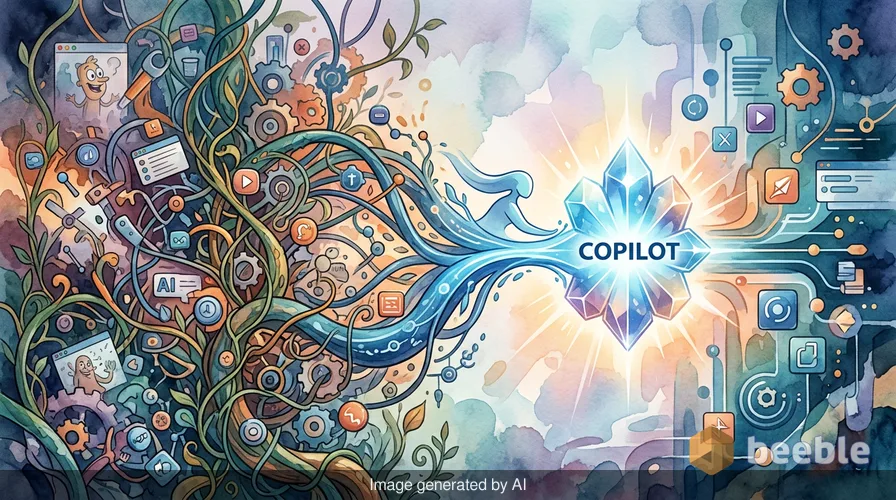
The prevailing wisdom in Silicon Valley suggests that software is a race to add the most buttons. For the last two years, Microsoft treated AI like a tireless intern who stayed late every night but spent half their time rearranging the supply closet instead of doing the filing. The company launched features at a breakneck pace, hoping something would stick. Now, Microsoft is admitting that a Swiss Army knife with fifty blades is too heavy to carry.
Microsoft recently announced a major overhaul of its Copilot ecosystem. By August 18, 2026, the tech giant will merge its separate consumer and business apps into a single experience. During this process, it is also removing several AI capabilities that once received heavy promotion. These include AI-generated podcasts, experimental features in Copilot Labs, and the goofy animated character named Mico. The move suggests a hard truth in the tech world. Being first to market is useless if the product is too confusing for a regular person to use.
The end of the digital Swiss Army knife
Software companies often fall into a trap called feature creep. They assume that if one AI tool is good, ten AI tools are ten times better. This logic led to the creation of two separate versions of Copilot: one for your personal life and one for your job. For a user, this meant juggling two different interfaces, two different sets of privacy rules, and two different subscription models.
Looking at the big picture, this fragmentation was a barrier to adoption. If you wanted to use AI to plan a family vacation and then use it to summarize a work meeting, you had to switch digital contexts constantly. Microsoft EVP Jacob Andreou recently signaled this change in an internal memo. He stated that the app must earn the right to exist in the lives of customers. This is corporate code for a simple reality. People were not using the extra features, and the complexity was driving them toward simpler competitors like ChatGPT or Claude.
One Copilot to rule the workspace
The merger of the consumer and Microsoft 365 Copilot apps is a tactical consolidation. Historically, Microsoft has tried to keep home and work lives in separate silos. However, the way people use AI is messy. A freelancer might use their work laptop to research a recipe, or a corporate employee might use their personal phone to draft a quick email for a colleague.
By combining these apps, Microsoft is streamlining its backend infrastructure. This helps the company push updates faster and ensures that a user has a consistent experience regardless of which device they use. Under the hood, this merger simplifies how Microsoft handles data permissions. It creates a clearer path for your files to move between the app and OneDrive. When the apps merge, any files you created in the standalone Copilot app will automatically move to your OneDrive storage. This prevents the loss of work during the transition.
The death of the floating blob
One of the most visible casualties of this cleanup is Mico. This animated character was an attempt to give the AI a personality. It was a floating, expressive blob that many users compared to Clippy, the infamous office assistant from the 1990s. While Microsoft hoped Mico would make the AI feel more human, it often felt like an unnecessary distraction.
In everyday life, most people use AI for utility rather than companionship. They want an answer to a question or a summary of a document. They do not necessarily want a cartoon character blinking at them while they work. Removing Mico is a sign that Microsoft is shifting its focus from novelty to productivity. The company is trading charm for speed.
Why deep research is moving behind a paywall
Perhaps the most significant change for power users is the removal of Deep Research and the experimental Copilot Labs. These tools allowed users to perform complex, multi-step tasks like planning a full travel itinerary or conducting detailed market analysis.
From a consumer standpoint, losing these features for free is a blow. Microsoft is moving the Researcher feature exclusively to its paying professional users. This reflects a broader trend in the industry where the most advanced, resource-heavy AI tasks are reserved for those who pay a monthly fee. AI is expensive to run. Every complex query requires significant power from massive data centers. By cutting these features from the free consumer tier, Microsoft is managing its operational costs.
| Feature | Status after August 2026 | Practical Impact for Users |
|---|---|---|
| Consumer Copilot App | Merged | Users will use one app for home and work |
| Deep Research | Removed | Free users lose advanced multi-step search |
| Mico (Mascot) | Removed | Interface becomes cleaner and less "animated" |
| Group Chats | Removed | AI can no longer be added to multi-user chat threads |
| AI Podcasts | Removed | Users can no longer turn documents into audio shows |
| Files & History | Migrated | All generated content moves to OneDrive |
A market shift toward leaner software
Microsoft is not the only company thinning out its AI offerings. OpenAI recently merged its agentic features into the main ChatGPT interface. Google is doing the same with Gemini, combining its research tools and web browsing into a more unified experience. These companies are realizing that the "app store" model for AI—where you have a thousand tiny specialized tools—is not what users actually want.
Practically speaking, we are seeing the end of the AI gold rush era and the beginning of the utility era. In the gold rush, companies threw every possible idea at the wall to see what stuck. In the utility era, they keep only the tools that work every day. For the average user, this is a positive development. It means fewer menus to navigate and a more predictable tool.
What this means for your digital habits
The bottom line is that your AI experience is about to become less flashy but more reliable. If you relied on the AI-generated podcast feature to listen to your notes during a commute, you need to find an alternative before the 2026 deadline. If you used Group Chats to brainstorm with friends, you will need to copy those conversations elsewhere.
Ultimately, this consolidation is an admission that AI is not a separate category of technology. It is a feature that belongs inside the tools we already use, like Word, Excel, and Outlook. Microsoft is stopping the attempt to make Copilot a destination. Instead, it is making Copilot a part of the scenery.
As a user, you should observe how often you actually used the "extra" features Microsoft is cutting. If you didn't even know Mico had a name or that you could generate a podcast, you are the reason these features are disappearing. This shift encourages us to view AI as a practical assistant rather than a digital toy. It is time to stop looking for the next shiny feature and start focusing on how these tools actually save us time. The next time you open Copilot, you might find fewer buttons, but the ones that remain will likely work much better than they did before.
Sources
- Microsoft Support Documentation, "Changes to Copilot Features," 2026.
- GeekWire, "Microsoft to Merge Copilot Apps and Cut Experimental Features," August 2026.
- The Information, Internal Memo from Jacob Andreou regarding Copilot Strategy, July 2026.
- OpenAI Corporate Blog, "Simplifying the ChatGPT Experience," 2026.
- Google Workspace Updates, "Gemini Integration and Feature Consolidation," 2026.



See you on the other side.
Our end-to-end encrypted email and cloud storage solution provides the most powerful means of secure data exchange, ensuring the safety and privacy of your data.
/ Create a free account
