


Why Ford just killed the assembly line to build a $30,000 truck

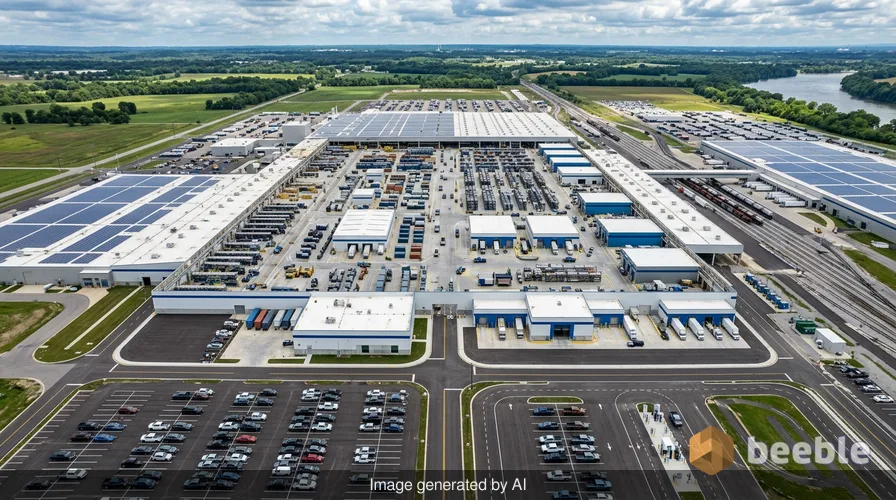
In 1913, Henry Ford famously debuted the moving assembly line at the Highland Park plant, a system that reduced the time it took to build a chassis from twelve hours to ninety-three minutes. That single change made car ownership possible for the middle class and defined the industrial world for over a century. Today, the automaker has officially scrapped that foundational philosophy. In a massive $2 billion bet on the future of transportation, Ford has spent the last two years gutting its Louisville Assembly Plant in Kentucky to replace the traditional linear line with a system that looks less like a conveyor and more like a high-speed logistics hub.
The target for this overhaul is a new electric midsize truck named the Fathom. Ford confirmed this week that the factory rebuild is on schedule, with the first production-level tooling already under test. By the first quarter of 2027, the company expects to begin building prototypes, with consumer-ready vehicles following later that year. This is not just another factory refresh. It is a total rejection of the way cars were built for the last hundred years to survive in an era of volatile battery costs and aggressive global competition.
Breaking the 113 year old assembly chain
Historically, the assembly line was a rigid, one-way street. A frame started at one end, and parts were added sequentially until a finished car rolled off the other. If one station jammed, the entire line stopped. Under the hood of the new Louisville facility, Ford is implementing what it calls a universal production system. This method is the brainchild of Alan Clarke, a former Tesla executive who now leads Ford’s skunkworks team. Instead of a single line, the factory uses a three-branched assembly tree.
In simple terms, think of this like building a high-end desktop computer rather than a traditional house. In the old system, you had to wait for the walls to go up before you could install the wiring. In the new three-branch system, the front of the truck, the rear of the truck, and the central battery structure are built simultaneously on separate branches. Workers and robots assemble the front and rear sections as independent modules. On the third branch, the structural battery pack is mated with the seats, the center consoles, and the carpeting. These three massive finished pieces only meet at the very end to become a truck.
This decentralized approach has tangible benefits for the speed of the factory. Ford projects that it will assemble the Fathom 15% faster than the gasoline vehicles previously built at the same plant. Because the different sections of the car are built in parallel, a delay in the seat installation does not necessarily stop the work on the front axle. This efficiency is necessary because Ford is targeting a price point below $30,000, a figure that is historically difficult to achieve for long-range electric vehicles.
Borrowing from the Tesla playbook with unicastings
To make a $30,000 electric truck profitable, Ford had to find a way to remove hundreds of parts from the chassis. Looking at the big picture, heavy industry is the invisible backbone of modern life, and that backbone is currently being reshaped by a process called unicasting. This technique involves using massive casting machines to create large, single-piece aluminum components that replace dozens of smaller stamped steel parts that previously required welding or bolting together.
Tesla popularized this method to simplify its manufacturing, and Ford is now adopting it for the Fathom. By using single-piece castings for the front and rear of the vehicle, Ford reduces the complexity of its supply chain. Fewer parts mean fewer suppliers to manage, fewer points of failure in the assembly process, and a lighter overall vehicle. For the average user, this means a truck that is potentially more resilient. A frame made of fewer, larger pieces is often stiffer and less prone to the rattles and squeaks that develop in vehicles with hundreds of interconnected metal joints.
However, this streamlined manufacturing has a trade-off. While unicasting makes the truck cheaper and faster to build at the factory, it can make heavy repairs more expensive. If a single-piece rear frame is damaged in a collision, a technician might have to replace the entire module rather than just a few small brackets. Ford is betting that the upfront savings and the 15% gain in production speed will outweigh these long-term repair concerns for the budget-conscious buyer.
The factory that thinks in high definition
Behind the jargon of factory overhauls lies a massive investment in invisible infrastructure. As part of the $2 billion project, Ford nearly tripled its Wi-Fi coverage within the Louisville plant. The facility now has 1,080 access points to provide the high-bandwidth, low-latency connectivity required for modern software checks. This is a significant shift in how we think about quality control.
In a traditional plant, a car was finished and then driven to a test track or a diagnostic station. With the Fathom, the truck is interconnected with the factory’s central brain from the moment the battery module is assembled. Each of the 1,080 Wi-Fi points allows the factory to run thousands of software checks while the truck is still moving through its assembly branch. If a sensor is miscalibrated or a software bug is detected in the infotainment system, the factory knows instantly.
This level of connectivity is a response to the systemic software issues that plagued Ford’s earlier EV efforts, such as the Mustang Mach-E and the F-150 Lightning. Those vehicles were often held at the factory for weeks to receive software patches after they were fully built. By moving the software validation into the assembly process itself, Ford is trying to ensure that every Fathom that leaves the plant is truly finished. This setup allows for a level of transparency in the manufacturing process that was previously impossible.
The $30,000 threshold and the global market
On the market side, the Fathom is a defensive move against an emerging wave of affordable electric vehicles from China. Companies like BYD and Xiaomi have already mastered the art of building high-volume, low-cost EVs that Ford’s previous assembly lines simply could not match. Historically, American automakers have struggled to make a profit on small or midsize vehicles, often relying on the high margins of massive SUVs and heavy-duty trucks to keep the lights on.
Ford’s previous EV strategy followed this old logic by launching expensive, high-margin products first. But the Fathom represents a pivot toward the mass market. To put it another way, Ford is trying to do for the EV what the Model T did for the internal combustion engine. By stripping out the moving assembly line and adopting Clarke’s modular system, the company is attempting to reach a price point that makes electric driving a practical choice for people who are currently priced out of the market.
| Feature | Former Louisville System | New Fathom Universal System |
|---|---|---|
| Assembly Type | Sequential Linear Line | Three-Branch Modular Tree |
| Primary Chassis Parts | Stamped Steel (hundreds) | Aluminum Unicastings (handful) |
| Production Speed | Baseline | 15% Faster |
| Connectivity | Standard Industrial Wi-Fi | 1,080 High-Bandwidth Access Points |
| Training Site | Local On-the-Job | Allen Park Development Center |
What this means for your next vehicle purchase
Ultimately, the success of the Fathom will depend on whether Ford can actually deliver a truck for under $30,000 without sacrificing the utility that truck buyers expect. From a consumer standpoint, this factory overhaul suggests that the era of the $50,000 "entry-level" electric truck is coming to an end. As Ford moves toward production in 2027, the real test will be the reliability of the new universal platform.
Practically speaking, you should watch for how other manufacturers react to this 15% speed increase. If Ford succeeds in lowering its production costs through unicasting and modular assembly, it will force a price war in the midsize truck segment. For the everyday user, this means more choices and better technology at lower prices. It also means that the digital health of your vehicle will be determined long before it reaches the dealership floor, thanks to those 1,080 Wi-Fi points watching over the assembly.
You might not care about how many Wi-Fi access points are in a Kentucky factory, but you will care about the price tag on the window sticker. Ford’s decision to bury its century-old assembly line is a clear signal that the old ways of making cars are no longer fast enough or cheap enough to survive. As 2027 approaches, the industrial mechanics of the Fathom will likely determine whether the American electric vehicle market can finally move from a luxury niche into the driveways of average families.
Sources: Ford Motor Company official 2026 factory update, Louisville Assembly Plant industrial report, New Models Program Development Center training logs.



See you on the other side.
Our end-to-end encrypted email and cloud storage solution provides the most powerful means of secure data exchange, ensuring the safety and privacy of your data.
/ Create a free account
