


Why Google delaying its newest AI model is actually a win for your battery life

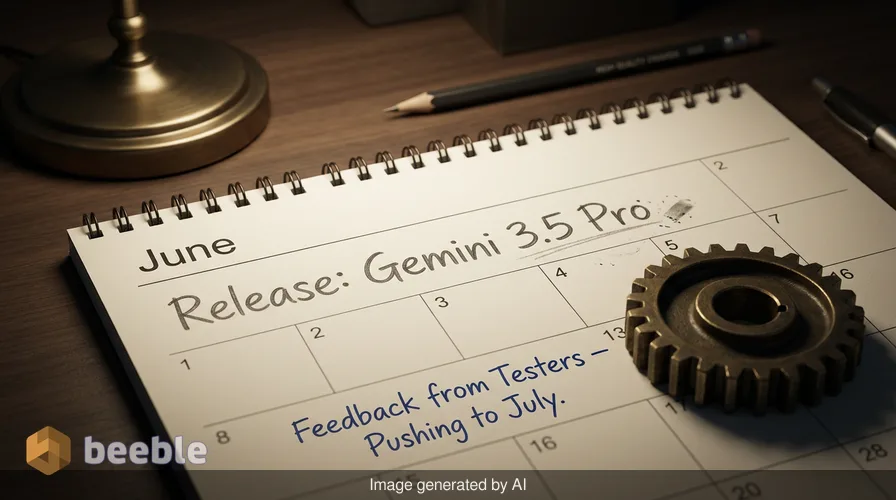
A product delay is usually a disaster for a Silicon Valley giant. For Google, a one-month slide for Gemini 3.5 Pro is a sign that the company finally respects the complexity of its own creations. While some see the shift from June to July as a failure to meet a deadline, the reality is more practical. The industry has reached a point where raw power is less valuable than reliability. Google promised Gemini 3.5 Pro at its I/O developer conference in May. CEO Sundar Pichai stated the model would arrive in June. Now, late in the month, the company is pushing that target back to July to gather more feedback from early testers.
This delay suggests a shift in how tech companies handle the AI arms race. In previous years, the goal was to release a model as quickly as possible, even if it produced strange or incorrect results. Today, the stakes are higher. Users expect AI to act as a tireless intern that can manage complex tasks without constant supervision. If that intern makes a mistake in a coding project or a financial spreadsheet, the damage is tangible. By taking an extra four weeks, Google is attempting to ensure that Gemini 3.5 Pro is a tool rather than a toy.
The practical side of long horizon tasks
Google designed Gemini 3.5 Pro to excel at what engineers call long-horizon tasks. In simple terms, this refers to jobs that require many steps over a long period. Most current AI models are good at quick answers. You ask for a recipe, and it gives you one. Long-horizon tasks are different. Imagine asking an AI to plan a three-week trip, book the flights, adjust the itinerary based on weather, and send calendar invites to your friends. This requires the model to hold a massive amount of information in its active memory without getting confused.
Behind the jargon, this is a memory problem. When an AI model processes a large document or a long conversation, it uses something called a context window. Gemini has historically led the market in this area. However, having a large memory is useless if the AI cannot find the specific detail it needs. The delay indicates that Google is refining how the model retrieves information from these deep archives. For the average user, this means the AI is less likely to hallucinate or invent facts when you ask it to summarize a 500-page PDF.
Practically speaking, this reliability is the foundational requirement for AI agents. An agent is more than a chatbot. It is a piece of software that can navigate your computer or the web to get things done. If you want an AI to organize your tax returns, it has to be perfect. A one-month delay for testing is a small price to pay for a system that does not delete the wrong files.
Why coding has become the ultimate benchmark
The context for this delay includes intense pressure from rivals like Anthropic and OpenAI. While Google models performed well last year, its competitors have taken a lead in a specific area: computer programming. This is not just a concern for software engineers. Coding is the primary way these labs test the logic and reasoning of an AI. If a model can write complex code, it can usually think through other logical problems with similar precision.
On the market side, coding is the first major way companies are making money from AI. Businesses pay for tools that help their developers work faster. If Google falls behind in coding, it loses a massive chunk of the enterprise market. Early testers have been using Gemini 3.5 Pro on platforms like Antigravity and the benchmarking site LMArena. These environments provide a global mood ring for AI performance. The feedback likely showed that while Gemini 3.5 was fast, it needed more polish to beat the latest versions of Claude or GPT-4o in logical consistency.
Looking at the big picture, coding is the digital crude oil of the modern economy. It powers everything from your banking app to the sensors in your car. When Google tweaks its model to be better at coding, it is essentially making the underlying logic of all its future products more resilient. This extra month of testing allows the company to feed the model more real-world scenarios where previous versions might have stumbled.
The hidden problem of token consumption
One of the most interesting reasons for the July delay involves a smaller model called Gemini 3.5 Flash. This version is designed for speed and low cost. However, early feedback suggested that Flash consumed tokens too quickly. In the AI world, a token is like a digital syllable. Models use tokens to process and generate text. If a model is inefficient, it uses more tokens than necessary to complete a task. This makes the AI more expensive for developers and slower for consumers.
What this means is that Google is trying to prevent Gemini 3.5 Pro from being a gas-guzzler. If an AI uses too much processing power for a simple request, it drains your laptop battery and increases the load on data centers. Google is incorporating the lessons from the Flash model into the Pro model to make it more streamlined. This involves tweaking the math under the hood so the model can reach the same conclusion using less computational energy.
For the average user, this efficiency is decentralized. It shows up as a faster response on your phone or a lower monthly subscription fee for AI services. When a model is optimized, it can run on smaller devices without needing a constant connection to a massive server farm. Google is likely using this extra time to ensure that the Pro model provides the best balance of intelligence and resource management.
What this means for your digital habits
When Gemini 3.5 Pro finally launches in July, the impact will be systemic rather than isolated. You will likely see these updates appear first in Google Workspace tools like Docs and Gmail. The goal is to move away from simple text generation toward actual assistance.
| Feature | Current AI Capability | Gemini 3.5 Pro Target |
|---|---|---|
| Memory | Remembers recent parts of a chat | Retains context across massive documents |
| Logic | Follows simple A-to-B instructions | Solves multi-step problems independently |
| Speed | Fast but often repetitive | Efficient token usage for lower latency |
| Agency | Suggests actions for you to take | Executes actions across multiple apps |
For someone who uses Google tools every day, this means the 'Help me write' button will become a 'Help me do' button. Instead of just drafting an email, the AI might be able to look at your spreadsheet, calculate your remaining budget, and then draft the email to your boss. This shift requires a level of trust that Google cannot afford to break. If the AI hallucinates a budget number, the user loses faith in the entire system.
Ultimately, the delay is a sign of a maturing industry. The era of 'move fast and break things' is ending for AI because there is too much at stake. Google is now competing in a volatile market where reputation is the most valuable currency. A July launch allows them to fix the slow leaks in the model before the public gets a chance to find them.
Looking beyond the release date
From a consumer standpoint, the wait for Gemini 3.5 Pro should be viewed through the lens of transparency. In the past, tech companies might have shipped a flawed product and fixed it later with updates. With frontier AI, the foundational training of the model is harder to change once it is live. The tweaks Google is making now are likely deep in the neural network. These changes affect how the model perceives relationships between ideas.
Curiously, this delay might also give Google more time to prepare its hardware. AI models require immense amounts of specialized chips to run. By pushing the launch to July, Google can ensure that its data centers are ready for the sudden surge in traffic that a new model launch creates. This prevents the frustrating 'service at capacity' messages that often plague new AI releases.
As we move toward the new launch date, it is worth observing how you currently use these tools. Most people use AI as a search engine replacement. Gemini 3.5 Pro is designed to be something else entirely. It is a logic engine. When it arrives, the focus will not be on how well it writes a poem, but on how well it handles the invisible industrial mechanics of your digital life. The delay is not a sign of a company in trouble. It is a sign of a company that knows the difference between a demo and a durable product.
Sources
- Business Insider report on Google AI timelines.
- Google I/O 2026 keynote archive for model announcements.
- LMArena Chatbot Arena leaderboard data for coding benchmarks.
- Google Antigravity platform tester documentation.



See you on the other side.
Our end-to-end encrypted email and cloud storage solution provides the most powerful means of secure data exchange, ensuring the safety and privacy of your data.
/ Create a free account
