


Why Google's fastest billion users might not be enough to save Gemini

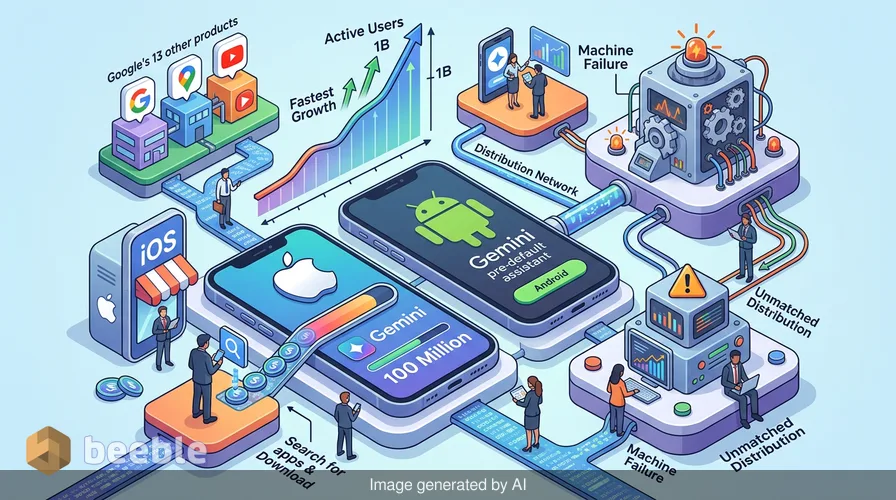
Does a billion users actually prove a product is winning, or just that it is impossible to avoid? Google CEO Sundar Pichai announced this week that Gemini is the fastest product in the company history to reach one billion monthly active users. To put that in perspective, Google has 13 other products with a billion users, including Search, Maps, and YouTube. Most of those took years or even a decade to hit that milestone. Gemini did it in a fraction of the time. While this number is a massive achievement for any software team, it comes at a moment when the engine behind the growth is starting to show signs of mechanical failure.
Looking at the big picture, the speed of this adoption is a result of Google's unmatched distribution network. If you own an Android phone, Gemini is likely already your default assistant or a suggested download. However, the raw data suggests something more interesting is happening on the other side of the fence. About 100 million of these users are on iOS. These people had to go to the App Store, search for Gemini, and manually download it. This is a deliberate choice. It indicates that Gemini has graduated from being a pre-installed utility to a destination for a significant portion of the mobile market.
How we talk to our digital apprentice
AI is a tireless intern that never sleeps, but we are learning that users do not want to interact with that intern through a keyboard. Google VP Josh Woodward shared that 63 percent of active users now rely on voice input. A growing segment of the population is voice-only, meaning they never type a single prompt. This shift is practical. It is much easier to ask a phone for a recipe or a summary of an email while driving or cooking than it is to thumb through a text box.
Even more disruptive is the rise of Gemini Live, where 20 percent of users share their camera feeds or screens with the AI. These users treat the software as a second pair of eyes. They show the robot a broken bicycle chain or a complex spreadsheet and ask for immediate help. This is a foundational change in how we use computers. We are moving away from clicking icons and toward a collaborative experience where the software perceives the world alongside us. For the average user, this means the barrier between having a problem and finding a solution is thinner than ever before.
The high cost of artificial imagination
On the market side, this scale comes with a staggering price tag. Google is currently burning through compute power to generate 150 million images every day. Businesses use these tools to create marketing materials, and students use them for projects, but a large portion of this output consists of memes and social media filler. Every time a user generates a picture of a cat in a space suit, a server in a data center consumes electricity and water for cooling.
This high volume of activity is the reason Google's cash flow turned negative for the first time in its history. The company is spending billions on AI infrastructure to keep up with the demand. To manage the risks of AI-generated content, Google uses SynthID to watermark these images. This technology embeds a digital signature that is invisible to the human eye but detectable by software. It is a necessary tool in a world where 150 million fake images enter the internet every 24 hours. Without these safeguards, the digital world risks becoming an opaque soup of unverified content.
Cracks in the silicon foundation
Behind the jargon of user growth, the technical side of Gemini is facing a volatile period. Google recently lost several top researchers, and DeepMind cofounder Demis Hassabis stepped back from his primary leadership role to focus on other areas. Reports suggest a disagreement over the company's direction. While the executive team wants to scale existing models to as many users as possible, the research side is more interested in the next big scientific breakthrough. This tension is visible in the product pipeline.
Google promised to release Gemini 3.5 Pro in June of this year. That date passed without a launch. Now, in August 2026, the model is still missing. Internal reports indicate that the version of Gemini 3.5 Pro intended for release struggled with coding tasks. It lagged behind competitors like OpenAI and Anthropic, making it a liability rather than an asset. Google is already training Gemini 4, but skipping a mid-cycle update like 3.5 Pro suggests that the hyperscaling approach is hitting a wall. It is harder to make these models smarter simply by throwing more data and more money at them.
Why the missing 3.5 Pro matters to you
For the everyday user, a delay in a model release might seem like an inside-baseball industry problem. However, it has tangible effects on the tools you use every morning. If Gemini's coding and reasoning abilities stall, the features in Gmail and Docs also stall. You might notice that the AI summary of your meeting is less accurate or that the AI Overviews in your search results become repetitive.
When a company prioritizes user growth over model performance, the product becomes a mile wide and an inch deep. Gemini is currently the most accessible AI on the planet, but it is not necessarily the smartest. If the gap between Gemini and its rivals continues to widen, the billion-user milestone will feel like a hollow victory. Users are resilient and will stay with a product out of habit for a while, but eventually, they migrate toward the tool that actually works better.
Practical foresight for the AI user
As we look at the big picture, the lesson for consumers is to stay platform-agnostic. Google is banking on its presence in your pocket to keep you in the Gemini ecosystem. They are making it easy to use voice and video because those features create a high level of stickiness. Once you are used to showing your camera to an AI to get help with your homework or your car, it is hard to switch to a competitor that does not have that same level of integration.
However, you should observe your own digital habits. If you find yourself using Gemini because it is the button on your home screen rather than because it gives the best answers, you are participating in a marketing trend rather than a technological one. Pay attention to the quality of the summaries and the accuracy of the images you see. As the industry faces a systemic slowdown in model improvements, the most valuable skill for a consumer is the ability to tell the difference between a tool that is popular and a tool that is reliable.
Ultimately, Google has won the race for scale. Now it has to win the race for intelligence. A billion users provide a massive amount of data, but data alone cannot fix a model that is struggling to learn. The next six months will determine if Gemini remains a leader or becomes a legacy product that people use simply because it was already there.
Sources
- Google Q2 2026 Earnings Call and CEO Remarks
- Google DeepMind Internal Product Roadmap Reports
- Workspace and Gemini User Engagement Metrics, August 2026
- SynthID Technical Documentation and Implementation Review
- Bureau of Economic Analysis: Technology Infrastructure Expenditure Reports



See you on the other side.
Our end-to-end encrypted email and cloud storage solution provides the most powerful means of secure data exchange, ensuring the safety and privacy of your data.
/ Create a free account
