


Why Google's smallest AI models are winning the race against their own flagships

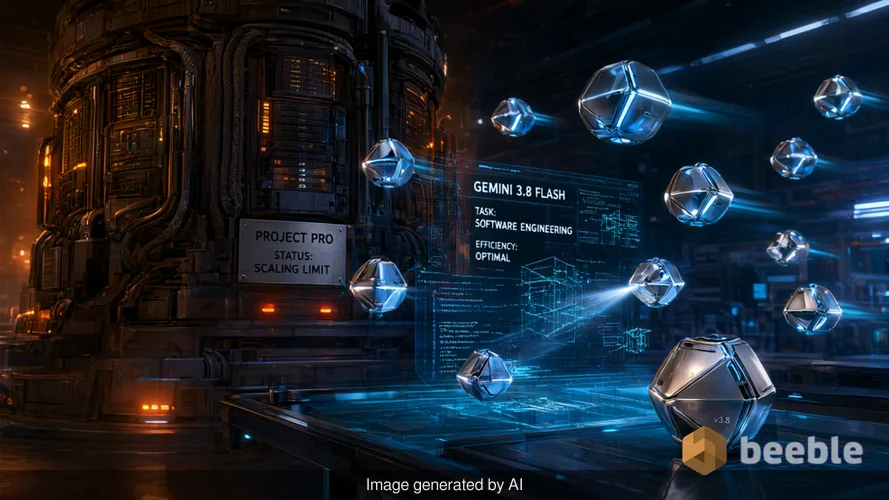
While the tech world waits for a massive intelligence leap in the Gemini Pro series, the reality is that the industry is moving toward smaller, specialized tools. Google released Gemini 3.8 Flash today, marking the third update to its lightweight AI family in just six weeks. The promised Gemini 3.5 Pro remains missing since early 2026. This shift indicates a fundamental change in how AI companies view their products. Instead of building one giant brain to solve every problem, Google is refining a fleet of fast, cheap, and specific assistants.
Looking at the big picture, the absence of a new Pro model suggests that the limits of massive scaling are becoming a financial and technical wall. Google reportedly delayed the 3.5 Pro version because its coding performance failed to outpace the competition. Conversely, Gemini 3.8 Flash is already outperforming larger models in specific tasks like software engineering. For the average user, this means the AI tools in your pocket or browser are getting smarter without requiring more battery life or expensive subscriptions.
The tireless intern in the machine
Practically speaking, Gemini 3.8 Flash is like a tireless intern who has memorized every coding manual but still struggles with basic physical tasks. It is built for speed and high-volume work. In everyday life, you might interact with this model when you ask a customer service bot to summarize your last ten orders or when a navigation app predicts your next stop based on complex traffic patterns. It handles these agentic tasks with a speed that larger models cannot match.
Under the hood, this model uses a smaller parameter count than the Ultra or Pro variants. This architecture allows it to process information with less latency. Google describes the standard 3.8 Flash as a workhorse model. It is capable of managing software development and general reasoning. For developers, the draw is the efficiency. While a larger model might take five seconds to suggest a fix for a broken line of code, Gemini 3.8 Flash does it in less than one. This difference is tangible for businesses that run millions of operations every hour.
The specialized guard dog of the web
Google also released Gemini 3.8 Flash Cyber today. This version is not for the general public. It is a specialized tool for vulnerability detection and mitigation. Essentially, it is the same foundation as the standard model but tuned with a focus on security. It replaces the 3.5 Cyber version and is currently restricted to government entities and trusted testers.
The results for this specific model are clear. The Chrome security team reported a 2.6x increase in patch accuracy when using this new model. In one internal test, the Cloud team used the model to find a critical security flaw in just two hours. For a human team, this process often takes days or weeks. Partners like Wiz and Palo Alto Networks are already testing this model to see how it handles large-scale infrastructure threats. This is a practical example of AI acting as a specialized shield rather than a general-purpose chatbot.
Why coding benchmarks matter to you
Gemini 3.8 Flash now sits at the top of the DeepSWE leaderboard. This specific test measures how well an AI can solve complex software engineering problems. In the past, only the most expensive models could pass these tests. Now, a lightweight model is beating the market leaders at a fraction of the price. The bottom line is that the cost of building software is dropping. As a result, the apps and services you use daily will likely receive updates and bug fixes faster than they did a year ago.
However, the model is not perfect. Computer use is still a significant struggle for Google's AI. In the OSWorld-2.0 test, which asks AI to navigate a computer interface like a human would, Gemini 3.8 Flash improved over the 3.7 version but remains behind Claude Opus. It seems that while the model can write code perfectly, it still finds it difficult to click the right buttons in a digital environment. GPT models from OpenAI show similar weaknesses in this area, which suggests that agentic computer use remains a high hurdle for the entire industry.
The economics of the token war
On the market side, this release is a direct response to a price war among AI labs. Businesses are becoming wary of high AI costs, so Google is offering Gemini 3.8 Flash at a steep discount through the end of 2026. The introductory rate is $0.75 per million input tokens and $3.75 per million output tokens. This is half the regular price. This move follows similar price drops from other major AI providers who are desperate to keep enterprise customers engaged.
| Pricing Tier | Input (per 1M tokens) | Output (per 1M tokens) | Availability |
|---|---|---|---|
| Introductory (to end of 2026) | $0.75 | $3.75 | Public API / AI Studio |
| Standard Rate | $1.50 | $7.50 | Future Standard |
| Competitor Average (Est. 2026) | $1.00 | $4.00 | Market Wide |
From a consumer standpoint, these price drops are a sign of a maturing market. When the cost of the digital crude oil—the tokens that power these models—falls, the technology becomes decentralized. It moves from being a luxury for tech giants to a foundational tool for small businesses. You can access Gemini 3.8 Flash right now in the Gemini app if you have a Pro or Ultra subscription. If you want to use it for free, you can tinker with it in Google's AI Studio.
Breaking the cycle of hype
Ultimately, the arrival of Gemini 3.8 Flash suggests that the era of waiting for a single, all-powerful AI is over. Google is choosing to release incremental, highly efficient updates rather than swinging for the fences with a Gemini 3.5 Pro that might not be ready. This strategy is pragmatic. It gives developers the tools they need to build today instead of promising a revolution tomorrow. The gain in coding performance is a foundational step toward more resilient software ecosystems.
For the everyday user, the takeaway is simple. Stop looking for the one big update that will change your life. Instead, observe how the small, fast AI tools already integrated into your workspace are becoming more reliable. The real revolution in AI is not a sudden explosion of intelligence. It is the steady, quiet improvement of the tools that help us fix bugs, secure our data, and manage our digital lives. Appreciate the invisible industrial mechanics that make your digital world run a little smoother each day.
Sources:
Google DeepMind Technical Blog - Gemini 3.8 Release Notes
DeepSWE Leaderboard - Engineering Performance Data
OSWorld-2.0 Benchmark Results - Agentic Computer Use Evaluation
Google Cloud Security Report - Vulnerability Mitigation Statistics



See you on the other side.
Our end-to-end encrypted email and cloud storage solution provides the most powerful means of secure data exchange, ensuring the safety and privacy of your data.
/ Create a free account
