


Why Hiding a Sword on Your Back Explains the Future of Open-World Gaming

You are galloping across the windswept plains of Pywel, the sun dipping below a jagged horizon in a display of ray-traced brilliance that makes you want to stop and just breathe. The orchestral swell is perfect. The sense of scale is staggering. Then, you notice it: your massive claymore is clipping through your intricately textured fur cloak, jittering like a digital glitch in a high-fantasy dream. Suddenly, you aren't a mercenary legend; you are a person sitting in a chair, staring at a piece of software that feels slightly unfinished. This tiny, nagging friction is the ghost in the machine of modern AAA gaming, a reminder that even the most immersive worlds are often held together by duct tape and hope.
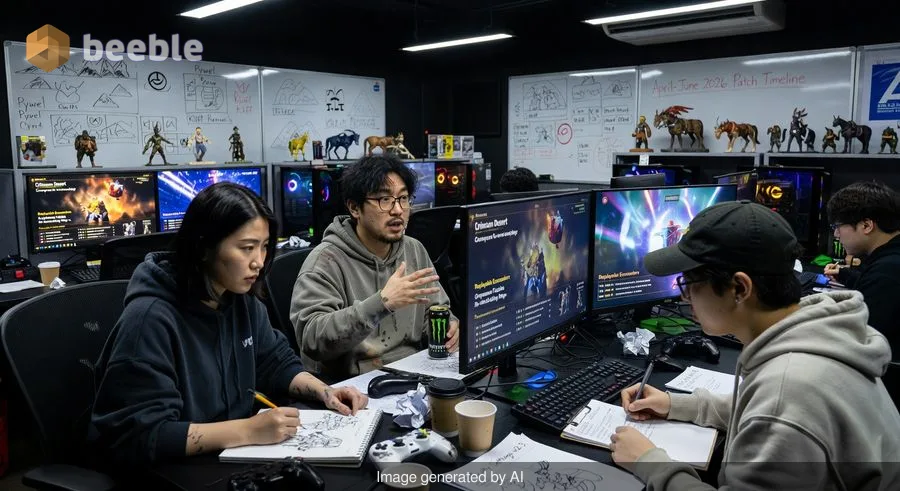
Behind the scenes, the developers at Pearl Abyss have been listening to these exact sighs of frustration. Their latest roadmap for Crimson Desert, spanning April through June 2026, isn't just a list of bullet points; it is a fascinating admission of the ongoing negotiation between a creator’s vision and the player’s lived experience. By introducing features like hidden back weapons, boss rematches, and specialized storage, the studio is attempting to bridge the gap between a cinematic masterpiece and a functional hobby.
The Architecture of Immersion and the Cost of Friction
Historically, the relationship between a game developer and an audience was a one-way street. A game was shipped, and players adapted to its quirks, no matter how clunky the UI or how punishing the inventory management. In the current landscape, however, the launch of a game is merely the opening statement in a years-long conversation. When Pearl Abyss announces that players can finally hide weapons on Kliff’s back, they are addressing a specific type of aesthetic dissonance. For the hardcore role-player, that clipping sword is a crack in the architectural foundation of the world-building.
Zooming out to the industry level, we see a broader trend where the aesthetic demands of high-fidelity graphics are clashing with traditional game mechanics. We want the realism of a 4K sunset, but we also want the utility of carrying sixteen different swords. Paradoxically, as games become more visually seamless, the mechanical seams—like a weapon floating an inch off a character's spine—become more glaring. This update suggests that Pearl Abyss is prioritizing the player's internal logic over the rigid constraints of their engine's physics.
The Psychological Contract of the Hard Mode
Perhaps the most telling addition in this update is the introduction of difficulty settings. For a long time, the prestige of the 'soulslike' or the 'hardcore' action-RPG relied on a singular, curated level of challenge. The developer set the bar, and you either cleared it or you didn't. But as gaming moves further into the mainstream, the 'walled garden' of elite difficulty is being dismantled in favor of accessibility.
By adding Easy, Normal, and Hard modes, Crimson Desert is acknowledging that its audience is not a monolith. There is the parent who has forty-five minutes to play after the kids go to bed and just wants to see the story, and there is the frame-data enthusiast who wants every boss encounter to be a life-or-death struggle. From a creator's standpoint, this is a delicate balancing act. If the game is too easy, the world feels hollow; if it’s too hard, the narrative momentum dies. The addition of boss rematches further reinforces this, turning combat into a repeatable skill-test rather than a one-time hurdle. It transforms the game from a linear gauntlet into a digital playground where the player dictates the terms of engagement.
Inventory Tetris and the Logistics of Fantasy
In everyday terms, we often joke about 'Inventory Tetris,' that peculiar mini-game where we spend twenty percent of our playtime staring at grids of herbs and iron ore. It is the least heroic part of any hero’s journey. Pearl Abyss’s plan to introduce specialized storage—food larders, wardrobes, and gatherable bins—is a direct response to the bloated nature of modern open-world design.
We have reached a point where the sheer volume of 'stuff' in games has become a burden. We are no longer just adventurers; we are logistics managers. By streamlining these systems, the developers are trying to remove the 'work' from the 'play.' This shift reflects a growing awareness in the industry that player time is the most valuable currency. If a player spends ten minutes sorting through stones and ores, that is ten minutes they aren't engaging with the world or the story. Consequently, these quality-of-life improvements are less about making the game easier and more about making it more respectful of the human on the other side of the screen.
The Parity of Companions and Narrative Weight
Narratively speaking, the upgrades to secondary characters like Damiane and Oongka are equally significant. In many sprawling RPGs, companions often feel like afterthoughts—mechanical appendages that lack the depth or utility of the protagonist. By giving them skills equivalent to Kliff’s 'Force Palm,' Pearl Abyss is attempting to fix a common case of ludonarrative dissonance: the idea that your legendary allies are somehow less capable than you are in the heat of battle.
Through this audience lens, we can see that players are no longer satisfied with being the only 'superhero' in the room. They want a world that feels inhabited by equals. This move toward mechanical parity suggests a shift away from the 'chosen one' trope toward a more ensemble-focused experience. It’s a subtle change, but one that makes the world of Pywel feel less like a stage built for one person and more like a living, breathing ecosystem.
Reclaiming the Digital Leisure Space
At its core, this massive update to Crimson Desert is a microcosm of the current AAA philosophy: the realization that a game is never truly finished. It is a living document, constantly being edited to better suit the needs of its inhabitants. Whether it’s the ability to recapture enemy territory or the simple joy of adjusting a font size for better legibility, these changes represent a move toward a more empathetic style of game design.
As players, we should observe these shifts with a critical eye. While it is easy to celebrate the 'fixing' of a game, we must also ask why these frictions existed in the first place. Are we moving toward a future where games are launched as skeletons, only to be fleshed out later based on community feedback? Or are we seeing a genuine evolution in how developers respect the diversity of their players' needs?
Ultimately, the ability to hide a sword on your back might seem like a minor detail, but it represents a major victory for player agency. It is a reminder that in the vast, often intimidating landscapes of modern entertainment, our individual comfort and immersion still matter. As we move deeper into 2026, the best games won't just be the ones with the most pixels, but the ones that listen most closely to the people playing them.



See you on the other side.
Our end-to-end encrypted email and cloud storage solution provides the most powerful means of secure data exchange, ensuring the safety and privacy of your data.
/ Create a free account
