


Why India’s Hands-Off Approach to AI Just Ended

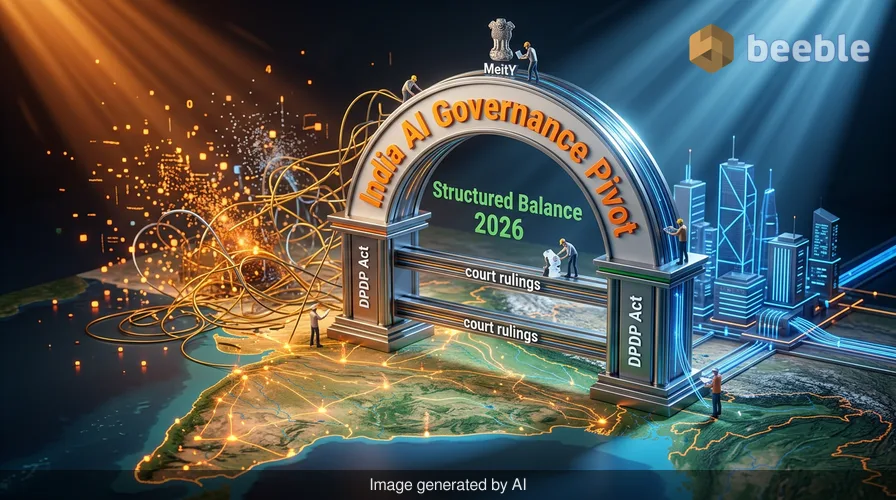
For a brief moment in early 2023, India was the wild frontier for artificial intelligence. While the European Union was debating the granular details of the AI Act, the Indian Ministry of Electronics and Information Technology (MeitY) famously stated it had no plans to regulate AI. They argued that a light-touch approach was necessary to foster a burgeoning tech ecosystem. But as any seasoned developer knows, code that works in a sandbox often breaks when it hits the real world. By mid-2024, the wind had shifted, and as we move through 2026, the regulatory landscape has transformed from an open field into a carefully structured architecture.
India has pivoted from a passive observer to an active architect of AI governance. This shift isn't just about red tape; it is a sophisticated attempt to balance the dizzying speed of innovation with the fundamental rights of 1.4 billion people. Whether you are a global tech giant or a local startup, the rules of engagement in the world’s most populous digital market have changed. To navigate this new terrain, we must look behind the curtain of recent court rulings, administrative advisories, and the overarching framework of the Digital Personal Data Protection (DPDP) Act.
The Great Pivoting: From Laissez-Faire to Guardrails
The turning point came when regulators realized that the digital footprints we leave behind—our trail of breadcrumbs—were being harvested by large language models (LLMs) without a clear map or a compass. The first sign of trouble was a series of advisories from MeitY that caught the industry off guard. Suddenly, platforms were told that "unreliable" or "under-testing" AI models should not be released to the Indian public without explicit permission or, at the very least, clear warning labels.
In practice, this means the government no longer views AI as a harmless novelty. Instead, they see it as a powerful utility that requires a robust safety check. Curiously, this move was less about stopping progress and more about preventing systemic bias and deepfakes from destabilizing a volatile digital social fabric. The authorities have essentially moved the goalposts: they now expect companies to prove their models are safe before they reach the masses, rather than cleaning up the mess after a digital oil spill occurs.
The Courtroom as an AI Laboratory
While the government writes the rules, the courts are where the real-world friction of AI is being polished. Indian courts have emerged as surprising pioneers in protecting "personality rights." In landmark cases, judges have ruled that an individual’s voice, image, and likeness are not just data points for a training set; they are extensions of the person. Essentially, using AI to mimic a famous actor’s voice for a commercial—even if the AI created the audio from scratch—is becoming a legal minefield.
These rulings serve as a vital reminder that privacy is a fundamental human right in India, enshrined by the Supreme Court. The judiciary is treating AI-generated content not as a creative miracle, but as a potential intrusive force. For developers, this means the days of "scraping everything" are over. If your model produces an output that mimics a real person without their granular consent, you are no longer just an innovator; you are a potential defendant.
The DPDP Act: A New Compass for Data Fiduciaries
At the heart of this governance push is the Digital Personal Data Protection Act. To understand this law, we must translate the jargon: the Act introduces the term "Data Fiduciary." In simple terms, a Data Fiduciary is any entity—like a bank, a social media app, or an AI lab—that decides why and how your personal data is processed. They are the trustees of your digital life.
From a compliance standpoint, the DPDP Act changes the math for AI training. Under this framework, using personal data to train an AI model requires a clear legal basis. While some argued that "legitimate interest" (a legal term meaning a company can use data if it has a good reason that doesn't harm the user) should cover AI training, Indian regulators have been more stringent. They emphasize the need for transparency. You cannot hide your data-hungry appetites in a labyrinth of terms of service. Consent must be clear, specific, and revocable.
Privacy by Design as the Foundation
When I investigate data practices at major firms, I look for what we call Privacy by Design. Think of it as the foundation of a house. If you build your AI on a swamp of non-consensual, biased data, the entire structure will eventually sink under the weight of regulatory fines and public distrust. The Indian framework is increasingly forcing companies to build privacy into the very code of their AI models.
This involves data minimization—the practice of only collecting what you absolutely need. If a weather app uses an AI chatbot to tell you if it’s raining, does it really need access to your entire contact list? Probably not. The new Indian standards suggest that any data collection that is not proportionate to the service provided is a red flag. Consequently, the role of the Data Protection Officer (DPO) has evolved into a vital translator who speaks both the language of the software engineer and the language of the judge.
The Transparency Trap: Labeling the Ghost in the Machine
One of the most actionable shifts in India’s AI policy is the requirement for disclosure. Regulators are increasingly wary of the opaque nature of AI decision-making. If an algorithm denies someone a loan or a job, the "black box" excuse no longer holds water. Users have a right to know they are interacting with an automated system.
Furthermore, the government has pushed for digital watermarking. This is the digital equivalent of a sealed envelope; it tells the recipient where the content came from and whether it was modified by a machine. In a landscape where deepfakes can spark real-world unrest, this transparency is viewed not as a burden, but as a systemic necessity for maintaining trust in the digital economy.
Navigating the New Compliance Maze
For businesses operating in India, the transition has been precarious but manageable for those who prioritize digital hygiene. We are seeing a move toward pseudonymous data processing, where identifying markers are removed before the AI ever sees the information. This acts as a digital witness protection program for users, allowing the AI to learn patterns without knowing exactly who provided the data.
| Compliance Pillar | Action Required | Why It Matters |
|---|---|---|
| Granular Consent | Break down permissions into specific uses. | Prevents broad, predatory data harvesting. |
| AI Labeling | Mark all AI-generated media clearly. | Protects against misinformation and deepfakes. |
| Data Localization | Store sensitive personal data within India. | Ensures sovereign control over critical citizen info. |
| Model Auditing | Test for bias and "hallucinations" regularly. | Reduces the risk of discriminatory automated decisions. |
Moving Toward a Sovereign AI
Ultimately, India’s goal is what policymakers call "Sovereign AI." They want to build a version of the future that isn't just imported from Silicon Valley or Beijing. By creating a unique regulatory patchwork quilt—combining strict data protection with a push for homegrown LLMs—India is attempting to create a digital public infrastructure that is both robust and culturally nuanced.
As we look ahead, the complexity will only grow. Notwithstanding the challenges, the message from New Delhi is clear: the right to innovate does not supersede the right to privacy. For the individual user, this is an empowering shift. You are no longer just a source of raw material for a machine; you are a stakeholder with the power to ask, "Why are you using my data, and how do I make you stop?"
Key Takeaways for Businesses and Users:
- Audit Your Data: If you are a developer, map your training data back to its source. If you can't prove it was legally obtained, it is a toxic asset.
- Review Permissions: Users should treat app permissions as keys to their home. If an AI tool asks for more than it needs, use an "opt-out" button as an emergency exit.
- Stay Transparent: Whether through watermarks or clear UI disclosures, honesty about AI involvement is the best defense against regulatory scrutiny.
- Monitor the DPO: Ensure your Data Protection Officer is integrated into the product development cycle, not just the legal review at the end.
Sources:
- Digital Personal Data Protection Act (DPDP), 2023.
- MeitY Advisory on AI Models and Intermediaries (March 2024 and subsequent updates).
- Delhi High Court Ruling in Anil Kapoor v. Simply Life India & Ors (Personality Rights).
- Telecom Regulatory Authority of India (TRAI) Recommendations on Leveraging AI and Big Data.
- Supreme Court of India, Justice K.S. Puttaswamy (Retd.) v. Union of India (Right to Privacy).
Disclaimer: This article is intended for informational and journalistic purposes only. It explores the evolving tech-legal landscape in India and does not constitute formal legal advice. For specific compliance requirements, please consult with a qualified legal professional specializing in Indian technology law.



See you on the other side.
Our end-to-end encrypted email and cloud storage solution provides the most powerful means of secure data exchange, ensuring the safety and privacy of your data.
/ Create a free account
