


Why Is Apple Finally Giving You the Keys to Your Phone's AI Brain?

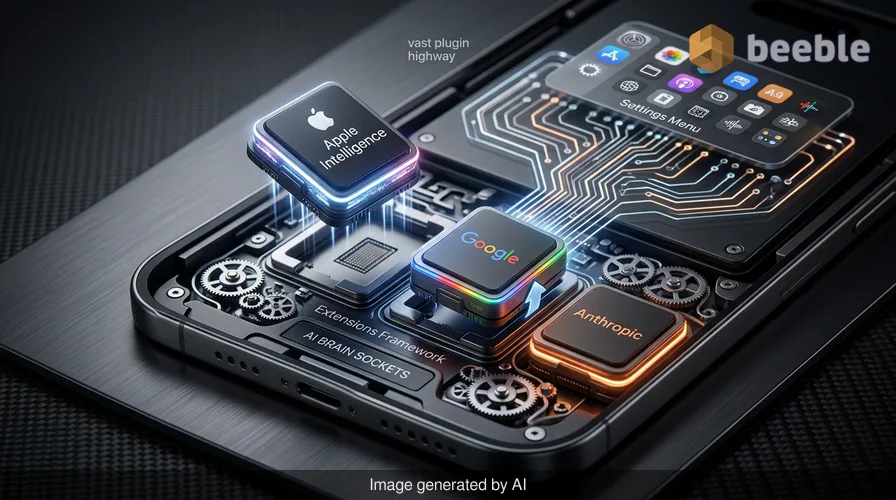
Have you ever found yourself wishing your iPhone’s autocorrect was a little more like ChatGPT, or that Siri could summarize a long work document with the nuance of a professional researcher? For years, the Apple experience has been defined by a "my way or the highway" philosophy. You used Apple’s apps, Apple’s ecosystem, and Apple’s intelligence. But as we look toward the release of iOS 27, that famous walled garden is getting a series of very large, very interconnected doors.
Reports emerging this May indicate that Apple is preparing a fundamental shift in how its devices think. Instead of forcing users to rely solely on Apple’s homegrown AI, the company is introducing a feature internally called "Extensions." This isn't just a new button in the settings menu; it is a systemic redesign that allows you to swap out the "brain" of your device for models built by Google, Anthropic, and potentially others. Looking at the big picture, this represents one of the most significant pivots in the company’s history, moving from a hardware-and-software monolith to a sophisticated platform for the world's most powerful AI engines.
The Open Door Policy: How Extensions Work
To understand what this means in everyday life, imagine your iPhone as a high-end car chassis. Historically, Apple provided the engine, too. With iOS 27, Apple is still providing the car, but they are letting you decide which engine to drop under the hood.
Behind the jargon, the Extensions feature allows third-party large language models (LLMs) to plug directly into the core functions of the operating system. When you use Writing Tools to polish an email, or ask Siri to plan a multi-stop road trip through the Alps, you won’t be limited to Apple’s internal logic. Instead, a prompt might appear asking if you’d like to use Google’s Gemini for its search-heavy capabilities or Anthropic’s Claude for its creative writing flair.
Practically speaking, this integration happens through the Apple Intelligence framework. Because these models are "Extensions," they aren't just siloed inside an app you download from the App Store. They have permission—granted by you—to interact with your calendar, your messages, and your files. This creates a streamlined experience where the AI acts as a tireless intern, handling the heavy lifting of data processing while you simply provide the direction.
The Shifting Strategy: Hardware Over Infrastructure
There has been a persistent narrative that Apple is "behind" in the AI race. While competitors like Microsoft and Google have spent billions of dollars on the digital crude oil of our age—massive server farms and the electricity to run them—Apple has taken a more resilient, wait-and-see approach.
On the market side, Apple’s strategy is becoming clear: they don't want to win the war of building the best model; they want to win the war of being the best place to use those models. By focusing on the hardware—the robust chips in your iPhone and Mac—Apple is positioning itself as the ultimate interface.
| Feature | Apple Intelligence (Native) | Third-Party Extensions (Google/Anthropic) |
|---|---|---|
| Primary Focus | Privacy-first, local on-device tasks. | Complex reasoning, large-scale data synthesis. |
| Data Handling | On-device or Private Cloud Compute. | Subject to the provider’s privacy policy. |
| Best For | Daily scheduling, photo editing, basic Siri tasks. | Deep research, creative coding, complex drafting. |
| Connectivity | Works offline for many tasks. | Usually requires an active internet connection. |
Essentially, Apple is acknowledging that no single AI can be everything to everyone. Some users need the transparent privacy of an on-device model, while others need the massive, scalable power of a cloud-based giant. By offering a Choose Your Own Adventure approach, Apple ensures that no matter which AI company eventually "wins" the intelligence race, the user will still be holding an iPhone when they use it.
The Changing of the Guard: The Ternus Era
This strategic shift arrives at a pivotal moment for the company's leadership. With long-serving CEO Tim Cook preparing to step down, the task of steering this massive ship falls to John Ternus. As the incoming top executive, Ternus is inheriting a company at a crossroads.
Historically, Apple has been protective of its user experience to a fault. However, Ternus appears to be embracing a more decentralized vision. Under his guidance, Apple is leaning into its strengths as a hardware designer while becoming more pragmatic about its software partnerships. The company is already seeing a tangible increase in AI-based revenue, not necessarily from building the models themselves, but from the services and subscriptions that facilitate their use.
Curiously, the status of ChatGPT remains the big question mark. While OpenAI’s flagship model was the first to be integrated into earlier versions of Apple Intelligence, its future as the default choice is no longer guaranteed. In the iOS 27 era, ChatGPT will likely just be one of many voices in a crowded room, forced to compete for your attention alongside Google and Anthropic.
What This Means for You: The "So What?" Filter
For the average user, this news is both exciting and a little overwhelming. We are moving away from a world where technology "just works" in one specific way, and into a world where we have to manage the intelligence our devices use.
From a consumer standpoint, here are the foundational things to consider:
- The Subscription Trap: While Apple Intelligence remains free for now, many of these high-end Extensions will likely require their own monthly fees. Your phone bill might soon include a line item for your preferred AI "brain."
- Privacy Trade-offs: Apple’s own AI is built on a foundational promise of privacy, often processing data on your device so it never leaves your pocket. Once you engage a third-party extension from Google or Anthropic, your data is likely hitting their servers. You will need to decide if the extra "smartness" is worth the data exchange.
- Battery and Performance: Running these complex models—even if much of the work happens in the cloud—requires significant energy. Users with older hardware might find that choosing the most powerful AI model leads to a volatile battery life.
Ultimately, this move reflects the maturing of the AI industry. We are moving past the era of novelty chatbots and into a period where AI is a functional tool integrated into our most personal devices.
Practical Foresight
As we approach the rollout of these features, it is time to start observing your own digital habits. Are you using AI mostly for quick summaries and photo tweaks, or are you relying on it for deep, analytical work?
If you value privacy above all else, you will likely want to stick with Apple’s native, on-device models. But if you find yourself constantly jumping between apps to get the best results, the "Extensions" feature in iOS 27 will be a disruptive breath of fresh air. It is a reminder that in the modern tech landscape, the most powerful tool isn't the one that does everything—it’s the one that lets you choose who does it for you.
Keep an eye on the "Privacy Report" features that will undoubtedly accompany these updates. In this new era, being a tech consumer isn't just about picking a phone; it’s about auditing the consultants you allow to live inside it.
Sources:
- Apple Internal Software Documentation (Leaked test versions, May 2026)
- Market Analysis Report: The Shift to AI Platform Aggregation
- Quarterly Earnings Call Transcript: Apple Services and Hardware Integration Strategy
- Industry Deep-Dive: The Ternus Transition and Apple’s Future Roadmap



See you on the other side.
Our end-to-end encrypted email and cloud storage solution provides the most powerful means of secure data exchange, ensuring the safety and privacy of your data.
/ Create a free account
