


Why Is ChatGPT Trying to Replace Every Other App on Your Phone?

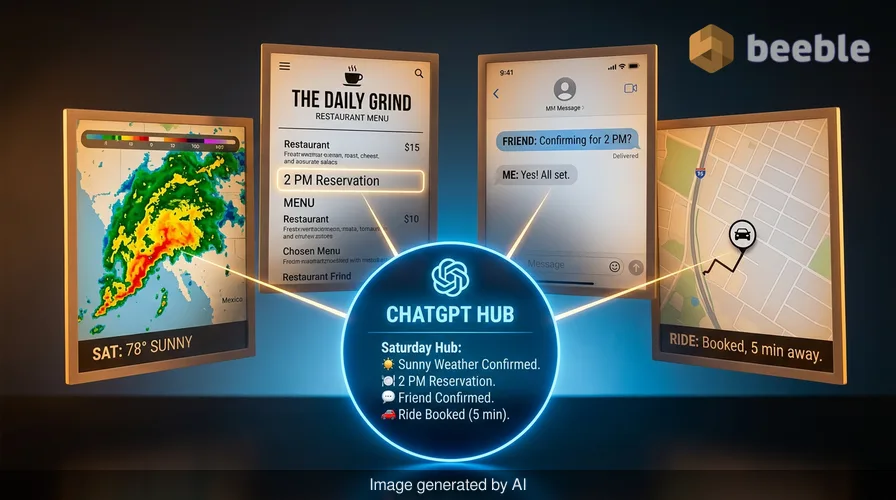
Have you noticed how many different apps you open just to plan a single Saturday afternoon? You check a weather app, browse a restaurant site, message a friend, and maybe book a ride. OpenAI thinks this fragmented experience is a waste of time. The company is preparing a major redesign of ChatGPT that moves it away from a simple text box toward a central hub for your digital life. Reports from The Financial Times indicate this overhaul is coming in the next few weeks.
This shift marks the transition from a chatbot into what industry analysts call a super app. In simple terms, OpenAI wants ChatGPT to be the only door you walk through to get things done online. Instead of jumping between tabs, you stay in one place while the AI handles the logistics. This redesign is more than a fresh coat of paint. It is a fundamental change in how the company expects you to interact with the internet. Looking at the big picture, this move aligns with OpenAI's goal to secure a massive valuation as it prepares to go public.
Beyond the simple chat box
For most users, ChatGPT has been a place to ask questions or summarize long emails. The upcoming overhaul changes that dynamic by integrating external tools directly into the interface. The Financial Times reports that the new version has deep connections with partners like Canva and Booking.com. Practically speaking, this means you can ask the AI to design a wedding invitation and then book the hotel for the event without leaving the chat interface.
Behind the jargon of unified interfaces, this is about reducing friction. Every time you switch apps, there is a chance you will get distracted or give up on a task. By keeping you inside its own ecosystem, OpenAI becomes the gatekeeper for your digital transactions. This version of ChatGPT has coding tools and image generation baked into a streamlined workspace. It functions like a tireless intern who has access to your files, your calendar, and your credit card.
Historically, other tech giants have tried this approach. In China, apps like WeChat became essential because they combined messaging, banking, and shopping into one package. Western companies have struggled to replicate this success because the market is more fragmented. OpenAI is betting that generative AI is the glue that can finally hold these different services together. This is a disruptive move that could change how developers build apps in the future. If users start doing everything through ChatGPT, the individual apps on your home screen become less important.
Why enterprise users are the real target
While the overhaul will reach free users, the real prize is the corporate world. OpenAI wants more enterprise users to adopt ChatGPT as their primary work platform. For a large company, having a tool that handles coding, data analysis, and document creation in one place is a tangible benefit. It reduces the number of separate software subscriptions a business has to manage. This is where the revenue growth lives.
On the market side, enterprise contracts are more stable and lucrative than individual five-dollar-a-month subscriptions. These businesses require robust security and the ability to deploy AI across thousands of employees at once. The Financial Times suggests that this redesign makes the tool more attractive to those large-scale buyers. By turning ChatGPT into a comprehensive workstation, OpenAI makes it harder for a company to switch to a competitor. Once an entire workforce uses a specific tool for their daily tasks, that tool becomes foundational to the business.
Under the hood, this requires a massive amount of computing power and a complex web of partnerships. OpenAI already has a directory that connects to Dropbox and Spotify. The upcoming change takes this further by making those connections invisible and automatic. You will not have to search for a specific plugin. The AI will simply know which tool to use based on your request. This type of interconnected system is what makes a super app powerful. It moves the burden of choice from the user to the software.
Racing toward a September public offering
The timing of this overhaul is not accidental. OpenAI is reportedly eyeing an initial public offering as soon as September 2026. To hit the valuation numbers its investors expect, the company needs to show it is more than just a viral trend. It needs to prove it has a scalable business model that can dominate the tech sector for a decade. A super app that captures both consumer attention and corporate budgets is a strong argument for a high stock price.
Curiously, OpenAI is not the only company in this race. Its main rival, Anthropic, has also announced plans for a public offering. This creates a volatile environment where both companies are rushing to release new features to win over investors. The tech industry often moves in these cyclical patterns of intense competition followed by consolidation. Right now, we are in the middle of a massive expansion phase where companies are throwing everything at the wall to see what sticks.
From a consumer standpoint, this competition is usually good news in the short term. It leads to faster updates and more powerful tools being released for free or at lower prices. However, it also means your data becomes the currency that fuels this growth. As ChatGPT becomes more integrated with your other accounts, the amount of information OpenAI has about your habits increases. This is the trade-off for the convenience of a super app. You get a streamlined experience, but you lose a layer of digital privacy.
How your digital habits are about to change
What this means for the average user is a slow migration away from the search bar and toward the prompt bar. If this overhaul works, you might stop using Google to find a flight and start using ChatGPT to book it. You might stop opening Photoshop to make a quick edit and just describe the change to the AI. This shift is systemic and will likely change how we perceive our devices. Your smartphone could eventually become a simple screen that displays the output of a single, all-powerful AI application.
| Feature | Old ChatGPT | New ChatGPT Super App |
|---|---|---|
| Core Function | Text-based conversation | Task execution and tool integration |
| Third-Party Access | Limited to specific plugins | Seamless partner apps (Canva, Booking) |
| Primary User | Casual consumers and students | Enterprise workforces and power users |
| App Ecosystem | Isolated chat interface | Unified hub for browser and coding |
| Revenue Focus | Individual subscriptions | Large-scale corporate deployments |
Ultimately, the goal is to make the AI feel like a natural extension of your thoughts rather than a separate tool. If you need to write a report, the AI has the data ready. If you need to plan a trip, the AI has the prices. This level of automation is unprecedented in consumer technology. It represents a move away from the era of "there is an app for that" toward an era of "the AI handles that."
To put it another way, OpenAI is trying to build the operating system of the future. In the past, Windows or iOS provided the platform for other companies to build apps. Now, OpenAI wants to be the platform and the app at the same time. This is a bold gamble that could either solidify its lead or create a backlash from partners who feel their traffic is being stolen. The bottom line is that the way you use the internet is about to get much quieter. You will spend less time clicking and more time talking to a screen that finally understands what you want.
As this rollout begins, observe your own digital habits. Notice how often you reach for a specialized app when a simple request to an AI might suffice. The transition to a super app will not happen overnight, but it will happen one integrated task at a time. Pay attention to which companies OpenAI partners with next, as those will be the services that survive the shift into this new, centralized digital environment. The era of the scattered home screen is ending, and the era of the singular AI interface is arriving.



See you on the other side.
Our end-to-end encrypted email and cloud storage solution provides the most powerful means of secure data exchange, ensuring the safety and privacy of your data.
/ Create a free account
