


Why is Google accidentally forcing AI on its users?

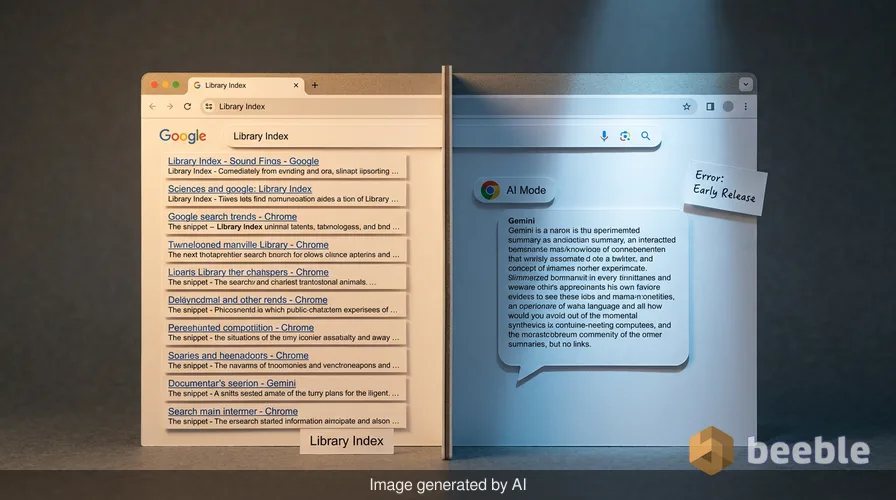
Have you ever wondered if the search bar is becoming too smart for its own good? For a brief moment this week, Google gave us a glimpse of a reality where the traditional list of blue links simply does not exist. A new setting found in the experimental version of the Chrome browser began funneling every single search query directly into an AI-driven conversation. While Google quickly labeled this a mistake, the event reveals a systemic shift in how the company views the future of information. This is more than a simple software bug. It is a preview of a world where the search engine acts less like a library index and more like a tireless intern who summarizes the books for you before you can even see the covers.
The chrome canary incident explained
The discovery started in Chrome Canary, which is the version of the browser Google uses to test its most experimental ideas. Developers noticed a new hidden setting, or flag, labeled Fulfill Searchbox Queries in AI Mode. When users enabled this flag, the browser stopped taking them to the standard search results page. Instead, it bypassed the usual list of websites and launched straight into a chatbot-style interface. This interface looks and feels like a conversation with Gemini, Google's primary artificial intelligence model. It provides a narrative answer to your question rather than a list of sources to click.
Shortly after tech publications began reporting on the feature, Rajan Patel, the Vice President of Search Engineering at Google, addressed the situation on X. He stated that the release was an error and that Google has no current plans to make AI Mode the default for Chrome searches. A note within the code of the flag also confirmed that the tool was for exploration only. Despite these denials, the level of polish in the feature suggests that Google has already built the architecture for a post-link search experience. The code was not a rough draft. It was a functioning product that changed the fundamental behavior of the most popular browser in the world.
How ai mode differs from standard search
To understand why this change is so disruptive, we have to look at how Google currently handles your questions. In the standard version of Chrome, a search for "how to fix a leaky faucet" takes you to the All page. This page usually has a small AI Overview at the top, followed by a series of links to YouTube videos, hardware store blogs, and plumbing guides. You have the choice to read the summary or click through to a specific website for more detail. You have to manually click a tab to enter a full AI conversation.
In the leaked AI Mode, that choice is gone. The browser assumes you want a generated answer immediately. It uses your query to trigger a large language model that writes a unique response on the fly. Practically speaking, this turns the search engine into a closed loop. Instead of serving as a gateway to the wider web, the browser becomes the final destination. This shift has massive implications for the digital economy, as it cuts off the flow of traffic to the independent websites that provide the data the AI uses to learn in the first place.
The economics of the search mistake
Google is currently in a difficult position regarding its primary source of income: advertising. When you see a list of blue links, Google has multiple opportunities to show you sponsored results. If you move to a pure AI conversation, the traditional ad model starts to break down. Showing an ad in the middle of a chatbot response is more difficult and often feels more intrusive to the user. Furthermore, generating an AI response costs significantly more in terms of computing power than simply retrieving a list of web links. AI models require massive clusters of high-end microchips, which are the digital crude oil of the modern era.
There is also the issue of accuracy. While AI is a tireless intern, it is also one that is prone to making things up if it feels pressured to provide an answer. This is known as a hallucination. In a standard search, if a website provides bad advice, the user can see the source and judge its credibility. In an AI-only mode, the source is often obscured behind a wall of generated text. By calling this feature an error, Google is likely protecting itself from the backlash that occurs when an AI gives confidently wrong information to millions of people simultaneously.
Comparison of search experiences
| Feature | Standard search (Current) | AI mode (The leaked flag) |
|---|---|---|
| Primary Output | List of external website links | Generated narrative text |
| User Control | High (Choose between many sources) | Low (Receive one synthesized answer) |
| Speed | Instant link retrieval | Variable (Time needed to generate text) |
| Revenue Model | Traditional search ads | Experimental/Unclear |
| Transparency | High (Sources are clearly visible) | Moderate (Sources are often hidden) |
| Complexity | Low (Simple database lookup) | High (Requires neural network processing) |
| Offline Access | Cached results available | Almost impossible without a connection |
The consumer reaction and the rise of alternatives
Every time Google moves closer to an AI-first approach, a segment of the user base pushes back. This was evident after the I/O 2026 conference, where Google introduced the Intelligent Search Box. That tool allows users to search using videos, images, and entire browser tabs as inputs. While the tech is impressive, it led to a measurable surge in installs for DuckDuckGo. This smaller competitor has marketed itself as a no-AI alternative for people who want the classic search experience without being forced into an experimental chatbot.
Looking at the big picture, the average user is becoming more protective of their digital habits. There is a growing sense of AI fatigue. When you want to know the score of a baseball game or the price of a stock, you do not need a three-paragraph essay from a chatbot. You want a number and a link. By accidentally releasing a feature that removes the option to see those links, Google reminded its users that it has the power to change how they access information with a single line of code. This realization is pushing more people toward decentralized or privacy-focused browsers that promise to keep search simple.
Under the hood of chrome flags
If you are curious about how these changes work, you can still explore them in Chrome Canary, though Google is likely to disable the specific AI Mode flag soon. To access these settings, you type chrome://flags into your address bar. This area is the engine room of the browser. It contains hundreds of toggle switches for features that are not yet ready for the general public. Essentially, this is where Google tests the foundational changes to its software architecture before they reach the billions of people using the stable version of Chrome.
However, for the average user, messing with these flags is risky. They can cause the browser to crash or lead to data loss. The fact that Google included a flag that completely rewrites the search experience shows that the company is at least considering a future where the search bar is no longer a tool for finding websites, but a tool for talking to a machine. Even if they call it an error today, the technical work is already complete. The transition from a link-based web to an AI-based web is moving from the research lab to the user interface.
What this means for your digital life
From a consumer standpoint, the bottom line is that your relationship with the internet is shifting from active browsing to passive consumption. In the past, you were the pilot, choosing which websites to visit from a list of options. In the AI Mode future, Google acts as the navigator, deciding which information is relevant and presenting it to you in a pre-digested format. This saves time, but it also reduces your exposure to diverse viewpoints and original sources.
You should observe how often you actually click on the links provided in your search results. If you find yourself only reading the AI summaries at the top of the page, you are already participating in the shift that Google is testing. The mistake in Chrome Canary was not that the feature existed, but that Google let the public see it before they had figured out how to make money from it without scaring away their users. Practically speaking, you should expect to see more of these experiments hidden in your software updates as companies try to find the balance between helpful automation and unwanted interference.
Ultimately, the move toward AI search is cyclical. We saw a similar shift when Google moved from ten blue links to including maps, flight data, and weather info directly on the search page. Each change makes the browser more useful but also more opaque. As a result, the best way to stay in control is to remain aware of these hidden settings and be willing to switch tools if the default experience no longer serves your needs. The digital backbone of our information economy is changing, and the recent Chrome error is the most tangible evidence we have of where it is going next.
Sources: Google VP of Search Engineering Rajan Patel, Windows Report technical analysis, Google I/O 2026 keynote documentation, DuckDuckGo usage statistics report.



See you on the other side.
Our end-to-end encrypted email and cloud storage solution provides the most powerful means of secure data exchange, ensuring the safety and privacy of your data.
/ Create a free account
