


Why is Google updating its AI every twenty-one days?

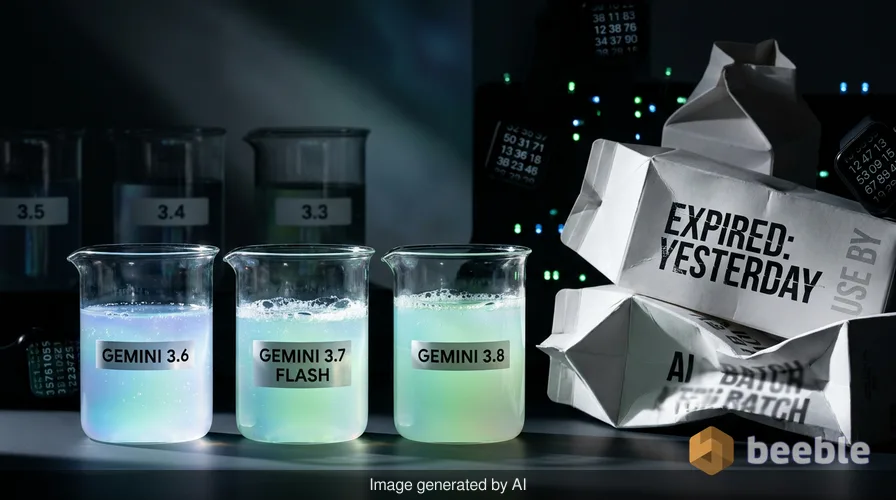
While conventional wisdom suggests that a new product version represents months or years of careful labor, Google is currently treating its AI version numbers like expiration dates on a carton of milk. The announcement of Gemini 3.7 Flash comes exactly three weeks after the release of version 3.6. For the average observer, this pace feels less like a steady march of progress and more like a frantic game of catch-up. Technology usually follows a predictable cycle of anticipation and release, but the artificial intelligence sector has abandoned that schedule in favor of a permanent state of revision.
Looking at the big picture, this rapid-fire release strategy signals a shift in how tech giants maintain their market position. Google is no longer waiting for massive, foundational breakthroughs to update its tools. Instead, the company is pushing out incremental optimizations as soon as they pass internal testing. This approach keeps the Gemini brand in the news cycle, but it also risks confusing the developers and businesses that actually use these tools. In simple terms, if the software you use for work changes twice a month, it becomes harder to build a stable foundation for your own projects.
The rise of the digital tireless intern
Under the hood, Gemini 3.7 Flash is designed to be a workhorse. Google aims this specific model at high-volume, repetitive tasks rather than the deep, creative reasoning expected from a flagship model. Practically speaking, think of this AI as a tireless intern. It is not there to write a novel or solve the world's most complex physics equations. It is there to sort through thousands of emails, write basic snippets of code, and summarize long technical documents without complaining about the workload.
The technical data supports this role. Senior Director Tulsee Doshi highlighted a significant jump in coding benchmarks. In the FrontierCode 1.1 Main test, Gemini 3.7 Flash moved from a 34.4 percent score to 43.6 percent. More importantly, its performance on DeepSWE v1.1—a test that measures how well an AI can handle real-world software engineering tasks—jumped from 49 percent to 65.3 percent. These are not just academic numbers. For a developer, this means the AI is less likely to produce code that breaks the moment you try to run it. It represents a tangible improvement in the reliability of the suggestions the AI provides during a workday.
Reading the fine print at scale
One of the most boring yet vital tasks in modern business is document processing. Companies have thousands of PDFs, manuals, and reports that contain critical information buried in complex layouts. Gemini 3.7 Flash targets this specific headache through improvements in the GDP.pdf benchmark. This metric evaluates how well a model extracts and understands information from dense documents. The new version scored 34 percent, a notable rise from the 22 percent managed by the three-week-old 3.6 Flash model.
In everyday life, this means the AI is getting better at answering questions about your insurance policy or a 200-page gadget manual. Historically, AI models struggled with documents that had weird formatting, tables, or small text. While a 34 percent score shows there is still a long way to go before these models are perfect, the 12-point jump in just twenty-one days suggests that Google is focusing heavily on making its AI more useful for administrative tasks. The goal is a streamlined experience where the user does not have to worry about whether the AI missed a footnote on page 47.
Agents and the automation bench
The term agentic performance is a common piece of jargon in the current AI climate. It describes the ability of an AI to not just talk, but to do. This involves executing workflows, such as booking a flight, updating a database, or managing a calendar. Google tested Gemini 3.7 Flash on AutomationBench, which measures these capabilities. The model rose to a 30.4 percent score from the previous 17 percent. This increase suggests that Google is prioritizing the ability of Gemini to act as an assistant that performs tasks on behalf of the user.
From a consumer standpoint, the promise of an AI agent is a more intuitive way to interact with technology. Instead of clicking through five different menus to change a settings preference, a user should be able to tell the AI to do it. However, the gap between a 30 percent score and 100 percent reliability is where the frustration lies. We are currently in a volatile period where the AI is smart enough to try the task but still fails often enough that a human must watch it closely. Google is essentially asking its users to be the supervisors for these emerging automated systems.
The invisible price war in the cloud
On the market side, this release is as much about accounting as it is about engineering. Google is introducing 3.7 Flash with an introductory price that is half of what they charged for the previous version. At $0.75 per one million input tokens and $3.75 per one million output tokens, Google is trying to stay relevant in a market where prices are falling faster than a slow leak in a tire. This aggressive pricing is a direct response to OpenAI, which recently lowered the cost of its own GPT 5.6 models.
The economics of AI are increasingly decentralized and competitive. For a small business building an app, a 50 percent price cut is a massive deal. It changes the math on whether an AI-powered feature is profitable or a money pit. But even with this cut, Google is still more expensive than OpenAI’s Luna model, which costs a mere $0.20 per million input tokens. This suggests that Google believes its model offers enough extra value—perhaps through its integration with the wider Google Workspace—to justify a premium price over its rivals.
The ghost of the flagship model
Curiously, all of this news about the Flash model highlights a glaring absence. Google promised the flagship Gemini 3.5 Pro would launch in June. It is now mid-August, and there is still no sign of it. Instead of the high-performance model everyone was waiting for, we are getting frequent updates to the budget-friendly version. This delay creates a narrative that Google is struggling to perfect its most advanced logic, even as it excels at refining its faster, smaller models.
There are systemic reasons for this delay. Reports of an exodus of AI talent from Google to competitors like Anthropic suggest internal friction. Building a massive model like 3.5 Pro requires a stable team and immense computing resources. By releasing 3.7 Flash now, Google maintains the appearance of momentum while its premier engineers likely work to fix the coding and reasoning gaps that have plagued earlier Pro versions. The result is a lopsided lineup where the lightweight tools are evolving faster than the heavy-duty ones.
Who actually gets to use the new AI
Availability for Gemini 3.7 Flash is surprisingly narrow for such a big announcement. It is available to developers through the API and AI Studio, and for corporate users via Gemini Enterprise. For the average person using the free Gemini app, the experience remains unchanged. The regular chatbot is still running on the 3.6 Flash model. If an individual wants to see what the 3.7 Flash model can do, they must pay for an AI Pro or Ultra subscription to access the Gemini Spark agent.
This creates a transparent divide between the enthusiasts who pay for the latest updates and the general public. It is a common strategy in the tech industry to put the best features behind a paywall, but it feels particularly stark when the update cycle is this fast. A user could pay for a subscription today to get version 3.7, only to find version 3.8 arriving before their first monthly bill is even due. This creates a resilient sense of FOMO—fear of missing out—among tech-savvy consumers who feel they must constantly pay to stay current.
Ultimately, Gemini 3.7 Flash is a foundational update that prioritizes efficiency and cost over raw intelligence. It is a tool for the builder rather than the dreamer. The bottom line is that Google is prioritizing the plumbing of the AI world. It wants to ensure that when a business plugs Gemini into its system, it works reliably and cheaply. While the lack of a flagship model is disappointing, the rapid improvements in document processing and coding suggest that the AI we use for everyday chores is getting much better at its job.
Instead of waiting for a single revolutionary moment in AI, you should observe how these small, frequent updates change your digital habits. The next time your phone summarizes a long email or helps you fix a spreadsheet error, you are likely seeing the results of these incremental three-week cycles. Appreciate the invisible industrial mechanics that make your digital life slightly easier each month. The future of AI is not arriving in one giant leap, but in a series of small, fast, and increasingly affordable steps.
Sources:
Google Gemini Developer Documentation
FrontierCode 1.1 Technical Report
AutomationBench Q3 2026 Industry Comparison
OpenAI Pricing Index August 2026



See you on the other side.
Our end-to-end encrypted email and cloud storage solution provides the most powerful means of secure data exchange, ensuring the safety and privacy of your data.
/ Create a free account
