


Why is the world's most sophisticated AI suddenly getting cheaper?

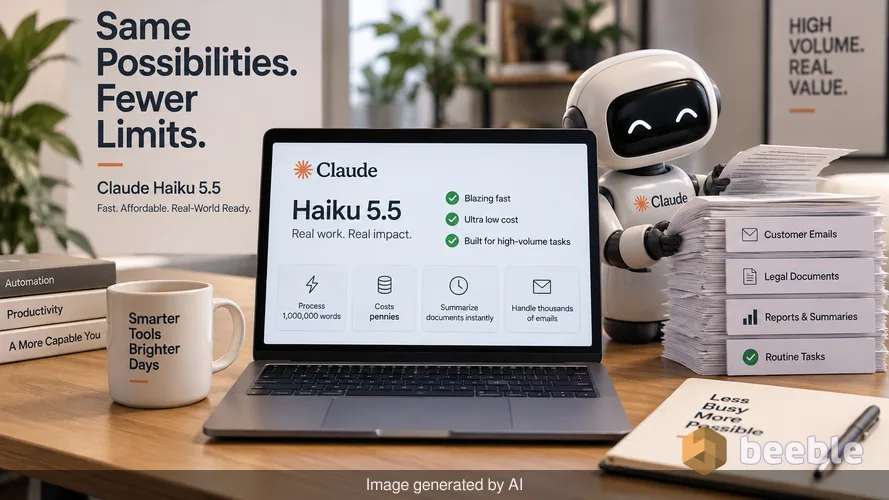
Have you noticed how your digital tools are getting smarter without getting more expensive? For the average user, the rise of artificial intelligence often feels like a race toward bigger, more complex machines that require massive power and even larger budgets. Anthropic just flipped that script. With the release of Claude Haiku 5.5, the company is not chasing a higher IQ for its software. Instead, it is focused on something much more practical for your daily life: making the technology nearly free and incredibly fast.
This release completes a trio of updates that began with Opus 5.5 and Sonnet 5.5 earlier this month. While those larger models act as the heavy lifters for complex coding and creative writing, Haiku 5.5 is more like a tireless intern. It is designed to handle the repetitive, high-volume tasks that keep a business running, from sorting through thousands of customer emails to summarizing long legal documents in the blink of an eye. The most striking part of this launch is the price tag, which has dropped so low that the cost of processing a million words is now measured in pennies.
The math of the digital tireless intern
To understand why this matters, we have to look at how these companies charge for their services. In the AI world, the currency is the token. A token is a small chunk of text, usually about three-quarters of a word. When a developer builds an app using Claude, they pay for every token the AI reads and every token it writes.
Historically, these costs were a major barrier for small businesses. The previous version, Haiku 4.5, cost $1 per million input tokens. Haiku 5.5 costs just $0.10. That is a 90% price cut for the majority of requests. Anthropic estimates the average saving for a typical business is roughly 75%. This is the digital equivalent of a gasoline price drop from $4.00 a gallon to $1.00. Suddenly, tasks that were too expensive to automate become financially viable.
| Model Version | Input Cost (per 1M tokens) | Output Cost (per 1M tokens) | Best Use Case |
|---|---|---|---|
| Claude Haiku 4.5 | $1.00 | $5.00 | Basic automation |
| Claude Haiku 5.5 | $0.10 | $0.50 | High-speed support |
| Claude Sonnet 5.5 | $3.00 | $15.00 | Complex coding |
| GPT-6 Luna | $0.10 | $0.50 | Direct competitor |
Where speed meets accuracy in the real world
Behind the jargon of model weights and architecture, Haiku 5.5 is a response to a very human problem: waiting. If you are chatting with a customer support bot, a five-second delay feels like an eternity. Anthropic built this model to respond almost instantly. In our initial testing, a simple logic question received a response so fast it appeared before the screen could finish scrolling.
However, speed has a ceiling. During that same test, the model gave a confident but incorrect answer to a basic logic puzzle. This is a crucial reminder for anyone using these tools. A faster intern is not always a smarter one. Haiku 5.5 is perfect for summarizing a 50-page PDF because it is excellent at extracting facts, but you should not ask it to solve a complex architectural math problem without double-checking the result. It is a tool for volume, not necessarily for deep philosophical debate.
Looking at the big picture, this speed makes it possible for the AI to operate a web browser on your behalf. Imagine telling your computer to find the cheapest flight to Tokyo, book a hotel within two miles of the city center, and add the itinerary to your calendar. Haiku 5.5 has the raw speed necessary to click through websites and fill out forms in real time, a task that would be sluggish and frustrating on a larger, slower model.
Benchmarks that actually matter for your workflow
Anthropic shared several performance scores that compare Haiku 5.5 to its main rival, OpenAI's GPT-6 Luna. One of the most relevant tests is OSWorld 2.1. This test measures how well an AI can navigate a standard computer operating system to finish multi-step tasks. Haiku 5.5 scored a 72.4% success rate. For comparison, GPT-6 Luna scored 48.9%.
In another test called Terminal-Bench 4.0, which asks the AI to solve professional technical problems by typing commands into a computer terminal, Haiku 5.5 solved 39.2% of tasks correctly on the first try. Its predecessor, Haiku 4.5, scored 0% on this same test. While it still trails the more powerful Sonnet 5.5 model, which scored 70.6%, the jump from zero to nearly 40% represents a massive leap in capability for a model this small.
On the market side, these numbers suggest that the gap between cheap AI and expensive AI is closing. You no longer need the most expensive model to handle professional-grade work. This shift is disruptive for the industry because it forces competitors to either lower their prices or significantly improve their performance to justify a higher cost.
The price of efficiency in a volatile market
Anthropic is also changing how it handles data that the model has already seen. They have halved the price of cache-reading for their mid-tier model, Sonnet 5.5. When an AI reads a long document once, it can remember that data for future questions if the developer uses a feature called prompt caching. The price for this is now $0.10 per million tokens.
This move is a direct attack on the high costs of running AI at scale. By making it cheaper to reuse data, Anthropic is encouraging developers to build more complex apps that can remember your preferences and history without breaking the bank. From a consumer standpoint, this means your apps will likely become more personalized and context-aware over the next few months.
Adjusting the effort dial for better results
One of the most interesting additions to Haiku 5.5 is a new feature called the adjustable effort setting. Think of this as a digital thermostat for the AI's brain. If you are doing a simple task, you can turn the effort down to save money and get faster answers. If you need the AI to think a little harder about a specific problem, you can turn the effort up.
This is the first time Anthropic has included this setting in its smallest model. It gives users more control over the trade-off between cost and quality. Historically, you had to choose between a cheap model and a smart model. Now, you can use the same model and simply tell it how much energy to spend on a specific question. This flexibility is foundational for developers who need to manage tight budgets while still providing high-quality service to their users.
What this means for your monthly subscription
Anthropic is not just focusing on developers who write code. They are also adding value for their regular subscribers. This week, users on the Max and Team plans will start receiving monthly API credits. A Max 5x subscriber gets $100 in credits, while Team plans can get up to $500 to share across their organization.
Essentially, Anthropic is giving you the tools to build your own custom AI assistants for free as part of your existing subscription. If you have ever wanted to build a custom bot that only searches your own personal notes or helps you manage your specific hobby, these credits make it much easier to start. It is a clear move to keep users inside the Anthropic ecosystem as competition from OpenAI and Google remains fierce.
The bottom line for your digital habits
The arrival of Haiku 5.5 marks the end of the first era of expensive AI. We are moving into a period where the intelligence itself is becoming a commodity, much like electricity or internet bandwidth. You will soon stop thinking about AI as a separate tool you visit on a website and start seeing it as an invisible layer inside every app you own.
What this means for you is a world where your software is more responsive and less expensive to use. However, the logic errors found in early testing prove that we cannot yet outsource our critical thinking. The best way to use Haiku 5.5 is to treat it as a high-speed filter for information. Let it do the heavy lifting of reading and sorting, but keep your hand on the wheel when it comes to the final decision. Observe how many of your daily apps start adding features like automatic summaries or instant support chats over the next few months. Those are the tangible results of this price war.
Sources:
Anthropic Official Press Release: Introducing Claude Haiku 5.5
Anthropic Developer Documentation: Model Pricing and Specifications
OSWorld 2.1 Benchmark Results
Terminal-Bench 4.0 Performance Data



See you on the other side.
Our end-to-end encrypted email and cloud storage solution provides the most powerful means of secure data exchange, ensuring the safety and privacy of your data.
/ Create a free account
