


Why Meta is playing catch-up in the AI race while winning the price war

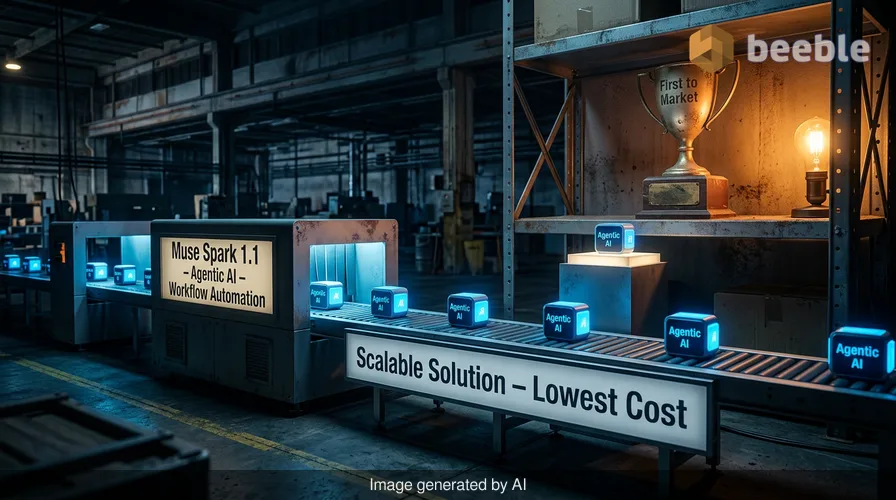
The prevailing narrative in Silicon Valley suggests that being first to market is the only way to win. If you are not leading the pack, you are effectively invisible. OpenAI and Anthropic have dominated the AI coding space for months, leaving Meta to look like a distant third. But the launch of Muse Spark 1.1 on Thursday suggests a different reality. Meta is not trying to be the first to invent the wheel. Instead, it is trying to be the company that manufactures the wheel so cheaply and reliably that everyone else has to change their business model to survive.
Looking at the big picture, the AI industry is moving away from simple chatbots that answer questions. We are entering the era of the tireless intern. This is what the industry calls agentic AI. Unlike previous models that simply suggested a line of code, Muse Spark 1.1 is designed to handle entire workflows. It can identify a bug, plan a fix, test the solution across multiple digital environments, and deploy the update without human intervention. While its competitors have similar tools, Meta is betting that the market cares less about who arrived first and more about who offers the most scalable solution at the lowest cost.
The mechanics of the agentic coding shift
To understand why Muse Spark 1.1 matters, we have to look under the hood at how developers actually work. Coding is rarely about writing a single brilliant function. It is a grinding process of migration, debugging, and system orchestration. Historically, these tasks consumed thousands of human hours. Meta designed Spark 1.1 to act as a system administrator rather than just a typewriter. The model handles multistep reasoning, which means it can remember the goal of a project through ten different steps of a complex process.
In everyday life, this is the difference between a GPS that gives you a single turn and a self-driving car that navigates the entire city. Muse Spark 1.1 can manage digital workflows across external apps and services. If a company needs to move its entire database from an old server to a new cloud provider, the model plans the migration and executes the code transfers. This type of automation is a foundational requirement for modern enterprises that are drowning in technical debt. Meta is positioning Spark as the practical choice for these systemic overhauls.
Counting the pennies in the intelligence economy
On the market side, the most disruptive aspect of this release is the price tag. AI intelligence is becoming a commodity, similar to how electricity or bandwidth transitioned from luxury goods to basic utilities. Meta is charging $1.25 per million input tokens and $4.25 per million output tokens. For the average user, these numbers feel abstract. For a large corporation running millions of automated tasks an hour, these fractions of a cent determine the feasibility of a project.
| Model | Input Price (per 1M tokens) | Output Price (per 1M tokens) | Primary Focus |
|---|---|---|---|
| Muse Spark 1.1 | $1.25 | $4.25 | Agentic tasks, system migration |
| GPT-5.6 Luna | $1.15 | $3.95 | General reasoning, large context |
| Claude Haiku 4.5 | $1.20 | $4.10 | Speed, efficient logic |
Practically speaking, Meta is priced slightly higher than its immediate rivals. This is a curious move for a company usually known for aggressive discounting. However, the value proposition lies in the agentic performance. Meta claims Spark 1.1 is more efficient at tool use and computer use than the cheaper alternatives. If Spark completes a task in three steps that takes GPT-5.6 Luna five steps, the slightly higher price per token actually results in a lower total bill. This efficiency is the tangible metric that corporate CTOs monitor.
A rare signal from the top
Mark Zuckerberg does not spend much time on social media these days. His last post on X was in July 2023. The fact that he broke a three-year silence to announce Muse Spark 1.1 indicates how high the stakes are for Meta. Zuckerberg called the model a strong agentic and coding tool at a low price. This public endorsement suggests that Meta is no longer treating AI as a research project. It is now a core product that the CEO is willing to put his personal reputation behind.
This move also highlights a shifting strategy within Meta. For years, the company focused on social networking and the metaverse. Now, it is clear that AI is the invisible backbone of their entire ecosystem. Zuckerberg’s mention of computer use is particularly relevant. This refers to the AI's ability to see a screen and click buttons like a human would. It is a step toward a world where the AI does not just write code for a website but actually navigates the web to perform tasks for you.
The broader battle for the developer's desktop
This week has been exceptionally volatile for the AI sector. Tuesday saw the release of Muse Image, Meta's new visual generator. Thursday was a double-header with both Muse Spark 1.1 and OpenAI’s GPT-5.6 family hitting the market. Even SpaceXAI joined the fray with a new Grok update. This concentration of releases shows that the industry is in a state of unprecedented competition. Every company is trying to lock developers into their specific ecosystem before the market stabilizes.
From a consumer standpoint, this competition is a win. When giant corporations fight for dominance, they do so by making their tools more user-friendly and cheaper. The software you use every day will become more resilient because the people building it have access to better debugging tools. If your favorite banking app has fewer crashes next year, it might be because a model like Muse Spark 1.1 found a systemic error that a human programmer missed. The intelligence is becoming decentralized and embedded in every layer of our digital lives.
What this means for your digital future
Ultimately, the release of Muse Spark 1.1 is a reminder that the AI revolution is moving into its industrial phase. We are past the era of digital novelties and conversational toys. The focus has shifted to industrial-grade tools that can handle the heavy lifting of modern software development. For the average user, the impact is indirect but profound. You will not necessarily interact with Spark 1.1 directly, but you will experience the results through faster app updates and more reliable digital services.
Behind the jargon of tokens and agentic workflows is a simple reality. Meta is betting that the future of AI belongs to the models that can actually do work. It is not enough to be a smart conversationalist. An AI must be a capable laborer. As Meta continues to release more models, the cost of building complex software will continue to fall. This will likely lead to a surge in niche, specialized apps that were previously too expensive to develop and maintain.
Practically speaking, you should observe how the apps on your phone change over the next six months. You will likely see more features that connect different services together automatically. This is the result of agentic models making it easier for different pieces of software to talk to each other. The digital world is becoming more interconnected, and Muse Spark 1.1 is one of the primary tools driving that integration. Whether Meta is late to the party or just arriving at the right time with the right price, they have successfully forced every other player in the industry to look over their shoulder.
Sources:
- Meta AI Research Blog: Muse Spark 1.1 Release Notes
- Reuters Tech Analysis: AI Token Pricing Comparison Report
- Meta Newsroom: CEO Mark Zuckerberg Public Statement on X
- OpenAI Product Update: GPT-5.6 Luna Specifications



See you on the other side.
Our end-to-end encrypted email and cloud storage solution provides the most powerful means of secure data exchange, ensuring the safety and privacy of your data.
/ Create a free account
