


Why Nigeria is taking on the global tech giants over your morning news

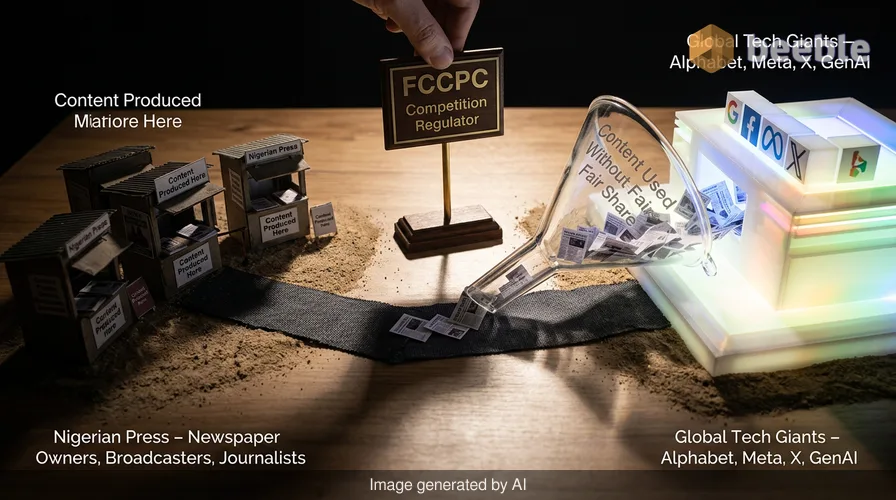
When you scroll through your social media feed or ask an artificial intelligence a question, the answer often comes from the hard work of a journalist you never meet. You see a headline, read a summary, or get a quick fact without ever leaving the platform you are on. In the digital economy, this convenience for you creates a massive financial gap for the people who actually report the news. Nigerian President Bola Tinubu recently directed the national competition regulator to investigate whether this relationship has become fundamentally unfair.
The Federal Competition and Consumer Protection Commission is now looking into Alphabet, Meta, X, and various generative artificial intelligence platforms. This inquiry follows a formal complaint by the Nigerian Press Organisation. This group includes newspaper owners, broadcasters, and journalists who argue that tech giants use their content to make money without providing a fair share of the revenue. The investigation is a significant moment for the Nigerian legal system as it tries to balance the power between local businesses and global tech corporations.
The law as a shield for local creators
To understand this investigation, we must look at the concept of market dominance. In simple terms, market dominance happens when a company is so large and powerful that it no longer has to worry about what its competitors do. In a healthy market, companies compete for your attention and your money. In the digital news world, the Nigerian Press Organisation argues that a few companies control the roads that lead to information. These companies act as gatekeepers. If a newspaper is not on Google or Facebook, it basically does not exist for millions of readers.
The FCCPC is using the Federal Competition and Consumer Protection Act as a shield to protect the local news industry from being crushed by these gatekeepers. The regulator is not saying these tech companies are definitely guilty of a crime. Instead, it is examining whether these firms use their size to force unfair terms on Nigerian media houses. When a large platform extracts news content without authorization, it deprives the original creator of advertising revenue. This creates a systemic problem where the people who do the work cannot afford to keep doing it.
Why artificial intelligence is part of the problem
Artificial intelligence introduces a new layer to this dispute. Generative AI models need massive amounts of data to learn how to speak and reason like humans. This data often includes decades of archived news articles and broadcast transcripts. Tech companies use this material to train their AI, which then summarizes the news for users.
The legal question here is whether this use of content is authorized or if it constitutes a breach of copyright. Copyright is a legal right that gives the creator of an original work exclusive control over how that work is used. If a tech firm uses a journalist's work to build a product that eventually replaces that journalist, the law may require compensation. The FCCPC investigation focuses on whether these AI platforms are extracting value from Nigerian intellectual property without a license or payment. This is not a minor technicality; it is a question of who owns the fruits of journalistic labor.
Global precedents for news compensation
Nigeria is not the first country to confront this issue. Several other nations have already built a paved road for news publishers to negotiate with tech giants. The table below illustrates how different jurisdictions handled similar disputes.
| Country | Regulatory Action | Outcome for Publishers |
|---|---|---|
| Australia | News Media Bargaining Code | Platforms pay millions to local newsrooms. |
| Canada | Online News Act | Google agreed to an annual payment of $100 million. |
| France | Antitrust Fines | Google was fined €500 million for negotiation failures. |
| South Africa | Market Inquiry | Secured a media support package worth 688 million rand. |
| Nigeria | FCCPC Investigation | Investigation is ongoing as of July 2026. |
In Australia, the government created a system where tech companies must negotiate in good faith with news outlets. If they cannot agree on a price, an arbitrator decides. An arbitrator is an independent person who makes a binding decision to settle a dispute. This framework forced companies like Meta and Google to sign deals that moved millions of dollars back into local journalism. Nigeria is watching these examples closely to see if a similar framework can work within its own jurisdiction.
The invisible cost to the everyday reader
It is easy to think that this is just a fight between big corporations. However, the outcome affects every Nigerian who uses the internet. If local newspapers cannot make money, they eventually close. When local newsrooms disappear, there is no one left to report on your local government, your neighborhood schools, or your community events. The loss of local news creates a vacuum that is often filled by misinformation or unverified rumors.
From a regulatory standpoint, the FCCPC wants to ensure that the Nigerian media ecosystem remains diverse and competitive. If one or two global companies control all the profit from news, the variety of voices in the country shrinks. This is why the investigation includes allegations of anti-competitive conduct. The goal is to ensure that the digital economy is equitable for all participants, not just the ones with the largest servers.
How the investigation will proceed
The FCCPC stated that this inquiry is a fair process. All affected parties, including Meta and Alphabet, have an opportunity to present their side of the story. The commission is looking for evidence of unauthorized extraction of content and the use of journalistic material for AI training. They are also looking for boilerplate clauses in digital contracts that might unfairly limit the rights of Nigerian publishers. A boilerplate clause is standard language used in contracts that people often sign without reading.
If the commission finds evidence of wrongdoing, it has the power to impose fines or order these companies to change how they operate in Nigeria. This could lead to a mandatory bargaining system similar to the one in Australia. For the average consumer, this might mean that the way you see news on your phone changes, but it also means the people who write that news are more likely to get paid for their work.
Practical steps for news consumers
While the government and tech giants battle it out in the regulatory arena, you can take steps to protect your access to quality information. The law works best when citizens are informed and active.
- Go directly to the source: Instead of relying on social media summaries, visit the websites of Nigerian newspapers or download their apps.
- Understand your data rights: Be aware that your interactions with news content on social media contribute to the data used by these platforms.
- Support local journalism: If you value a particular news outlet, consider a subscription or a donation to ensure they have the resources to keep reporting.
- Monitor the FCCPC findings: Keep an eye on official announcements from the Federal Competition and Consumer Protection Commission regarding new digital regulations.
- Report unfair practices: If you notice a platform is blocking access to local news or engaging in suspicious behavior, you can file a consumer complaint with the FCCPC.
Ultimately, the investigation is about more than just money. It is about the future of truth and information in the digital age. By ensuring that tech giants play by the rules, Nigeria is attempting to build a sustainable environment where both innovation and journalism can exist.
Sources
- Federal Competition and Consumer Protection Act (FCCPA), 2018.
- Nigerian Press Organisation (NPO) official complaints and statements.
- FCCPC Media Release on Digital Platform Inquiry, July 2026.
- Australian News Media and Digital Platforms Mandatory Bargaining Code.
- South Africa Competition Commission Media and Digital Platforms Market Inquiry (MDPMI) Report.
Disclaimer
This article is for informational and educational purposes only. It is not intended to be, and should not be taken as, formal legal advice. Laws and regulations regarding digital content and competition are complex and change frequently. If you are a publisher or a business owner dealing with copyright or competition issues, please consult with a qualified attorney in your jurisdiction to discuss your specific situation.



See you on the other side.
Our end-to-end encrypted email and cloud storage solution provides the most powerful means of secure data exchange, ensuring the safety and privacy of your data.
/ Create a free account
