


Why OpenAI’s New Drug-Hunting AI Is a Breakthrough You Can’t Touch

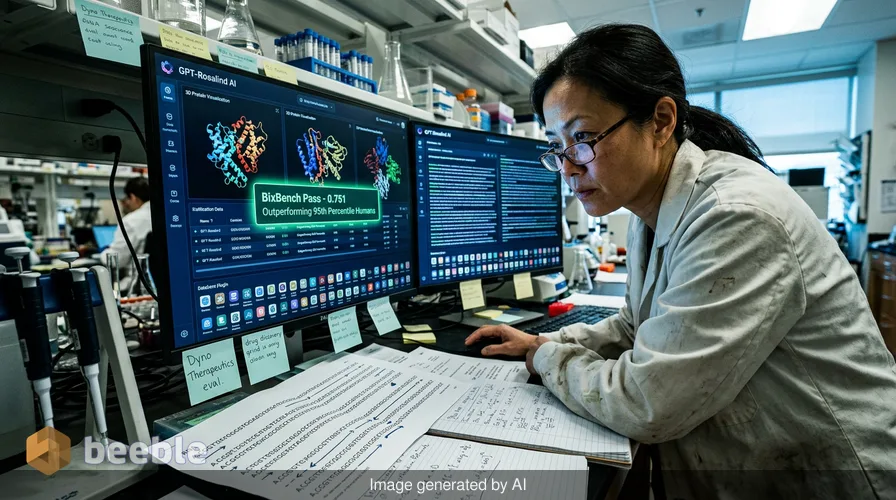
OpenAI has just launched a new AI model that could fundamentally change how we treat disease, but there is a catch: you almost certainly cannot use it. Named GPT-Rosalind, this specialized model is the first in what OpenAI calls its Life Sciences series. It is a direct tribute to Rosalind Franklin, the British chemist whose work was essential to discovering the structure of DNA but who was famously sidelined during her lifetime.
Unlike the general-purpose ChatGPT that helps you write emails or plan vacations, GPT-Rosalind is a domain-specific reasoning engine. It is built to navigate the dense, high-stakes world of biology, genomics, and protein engineering. For the average user, this might seem like just another tech announcement, but the implications for the medicine in your cabinet—and how long it takes to get there—are profound.
The 15-Year Grind: Why Drug Discovery Is Broken
To understand why GPT-Rosalind matters, we have to look at the current state of heavy industry in the lab. Historically, getting a new drug from a scientist’s "eureka" moment to a pharmacy shelf in the United States takes between 10 and 15 years. It is a marathon where most runners never finish; only about one in ten drug candidates that enter clinical trials actually make it to market.
Most of that time isn't spent in flashes of brilliance. It is lost in the "grind": parsing through thousands of academic papers, querying fragmented databases, and manually designing the chemical reagents needed for experiments. In everyday life, this is the equivalent of trying to build a house, but having to write the instruction manual and manufacture every single nail yourself before you can even start on the foundation. GPT-Rosalind is designed to be the tireless intern that handles the manual labor, allowing scientists to focus on the architecture of the cure.
Under the Hood: Benchmarks and Better Hypotheses
OpenAI isn't just making bold claims; they’ve brought the data to back it up. On BixBench, a benchmark that tests how well AI can handle real-world bioinformatics tasks, GPT-Rosalind logged a 0.751 pass rate. This is currently the top score for any model with published results, beating out generalist models like GPT-5.4 and even competitors like Google’s Gemini 3.1 Pro.
In a particularly striking test conducted with Dyno Therapeutics, the model was asked to predict the function of RNA sequences it had never seen before. GPT-Rosalind’s performance was better than 95% of human experts in prediction and reached the 84th percentile in generating new sequences.
| Benchmark | GPT-Rosalind Score | GPT-5.4 (Generalist) | Gemini 3.1 Pro |
|---|---|---|---|
| BixBench (Bioinformatics) | 0.751 | 0.732 | 0.550 |
| LABBench2 (Lab Tasks) | Top Performer | Outperformed on 6/11 tasks | N/A |
| RNA Prediction | 95th Percentile | N/A | N/A |
What this means is that the model isn't just "smarter" in a general sense—it is more precise. It understands the specific grammar of biology. While GPT-5.4 might be a master of all trades, GPT-Rosalind is the specialist surgeon.
The Gated Garden: Why Access Is Restricted
If this tool is so revolutionary, why is it locked away? Currently, GPT-Rosalind is only available as a research preview for qualified enterprise customers in the U.S., such as Amgen, Moderna, and Thermo Fisher Scientific.
There is a systemic reason for this gatekeeping: biosecurity. An international coalition of over 100 scientists has recently warned that AI models trained on deep biological data could be misused to design dangerous pathogens or biological weapons. OpenAI’s restricted rollout is a direct response to these concerns. To get access, an organization must undergo a rigorous safety review and prove their research provides a clear public benefit.
For the average user, this creates a strange paradox. You are living in an era where the most advanced tools for human health are being built, yet they are more decentralized and opaque than the consumer apps we use every day. You won't find a "Rosalind" button in your ChatGPT sidebar anytime soon.
The Ecosystem: More Than Just a Chatbot
OpenAI is also releasing a free Life Sciences research plugin for Codex, which connects to over 50 scientific databases. This allows researchers to look up protein structures and genomics pipelines directly. It is part of a broader push into the scientific workspace that began with the launch of Prism in January—a LaTeX-native environment for writing papers.
Looking at the big picture, we are seeing a shift from general AI to "vertical AI." Just as we have specialized software for architects or accountants, we are now seeing the emergence of a digital backbone for the life sciences. OpenAI isn't just building a chatbot; they are building a laboratory operating system.
What This Means for You
While you can't log in to GPT-Rosalind to self-diagnose a cough, its existence will eventually ripple down to your local pharmacy.
- Faster Cures for Rare Diseases: Small labs working on niche diseases often lack the budget for massive research teams. If an AI can shave two years off their early-stage research, drugs that were once financially "impossible" might become viable.
- Lower Healthcare Costs (Eventually): A significant portion of drug pricing is driven by the high failure rate of R&D. If AI helps scientists pick "winners" more accurately, the systemic cost of bringing a drug to market could drop.
- The Zero-to-One Moment: To date, no drug fully discovered by AI has cleared Phase 3 clinical trials. We are still waiting for that first tangible victory. GPT-Rosalind is a bet that by speeding up the "grind," we will reach that milestone much sooner.
Ultimately, GPT-Rosalind represents a shift in how we view AI. It is moving away from being a digital toy and toward becoming a foundational tool for human survival. You might not be the one typing the prompts, but you will certainly be the one benefiting from the answers. It is worth watching this space closely—not for the hype, but for the quiet, compounding progress happening behind the locked doors of the world’s most advanced labs.



See you on the other side.
Our end-to-end encrypted email and cloud storage solution provides the most powerful means of secure data exchange, ensuring the safety and privacy of your data.
/ Create a free account
