


Why the alien intruders in Hope signify a shift in the global blockbuster formula

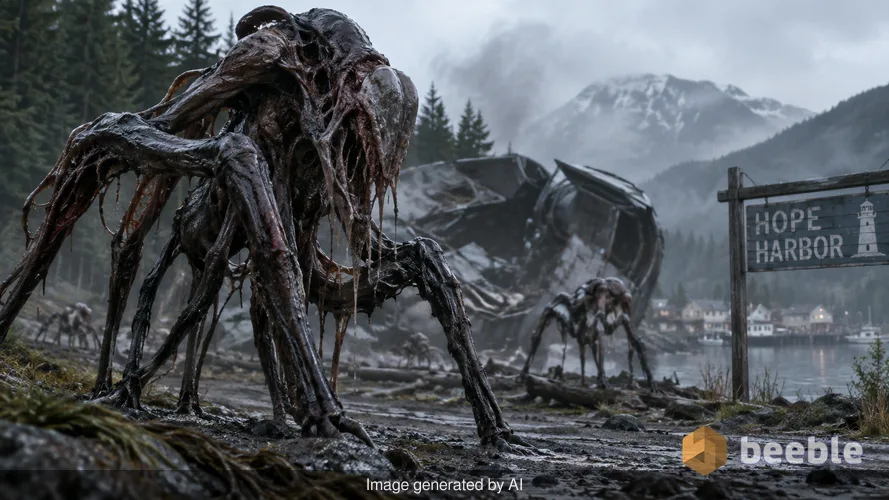
There is a specific, prickly sensation that occurs when a creature on screen refuses to fit into a recognizable biological category. It is the feeling of looking at something that is not just dangerous, but fundamentally wrong. In the new sci-fi epic Hope, the extraterrestrial intruders that crash-land near the hamlet of Hope Harbor evoke this exact reaction. Parallax Studios, the team behind the concept art for these entities, created forms that are malformed and unsettling. These designs do not follow the sleek, symmetrical aesthetics of typical Hollywood invaders. Instead, they look like nature in a state of high-octane rebellion.
Behind the scenes, this visual choice is a calculated move to break the sterile patterns of modern science fiction. Audiences are tired of the smooth, gray CGI blobs that have populated big-budget films for the last decade. The creatures in Hope are messy and tactile. They are intruders in the most literal sense, disrupting the quiet stillness of the forest and the mountain sides with a presence that feels heavy and wet. This visceral design philosophy is the first sign that Hope is not interested in being a standard popcorn flick. It is interested in the friction between the extraordinary and the mundane.
The tactical reverse of narrative structure
Narratively speaking, Hope is a bold experiment in how an audience consumes a mystery. The film begins with a lengthy climax, then unspools a mystery in reverse before it reaches a final peak. This structure mimics the way we experience real-life trauma or sudden change. First comes the impact, and only then do we have the breathing room to ask how we got there. By starting at the highest possible stakes, the film forces the audience to live in the immediate aftermath of the alien arrival. There is no slow burn here. There is only the frantic attempt by the chief of police and his sergeant to contain a situation that is already out of control.
In everyday terms, this mirrors the way modern news cycles function. We see the explosion on our social media feeds first, and the context arrives in fragmented pieces over the following hours. Na Hong-jin, the director, leverages this contemporary anxiety to keep the pace relentless. The film is a gonzo sensory assault that uses the claustrophobic main streets of a small town to make the stakes feel intimate. Even though the forces are larger than the town itself, the focus remains on the hunters and the local law enforcement. This choice keeps the scale human even when the visuals are cosmic.
A massive domestic footprint for non-English cinema
Zooming out to the industry level, the release of Hope is a landmark event for the American theatrical market. The film opened in approximately 1,500 theaters across the U.S. on September 9. This is the widest domestic theatrical release for a Korean-language film since Parasite won the Academy Award for Best Picture. This expansion is a data-backed signal that the so-called subtitle barrier has finally crumbled. American audiences no longer see non-English films as niche arthouse products. They see them as competitive blockbusters that are worth a trip to the multiplex.
This shift is part of a larger trend where global IP is becoming more liquid. The cast of Hope is a mixture of Korean superstars like Hwang Jung-min and Zo In-sung, and Western actors such as Alicia Vikander, Michael Fassbender, and Taylor Russell. This ensemble is a bridge between different cinematic traditions. It proves that a film does not need to be a mono-cultural product to succeed on a massive scale. The production is a hybrid that brings together the high-tension filmmaking of the Korean New Wave with the star power of Hollywood mainstays.
The clash between nature and cultural paranoia
At its core, the film is a riveting clash with nature. The choice of a forest setting outside a hamlet is a classic trope, yet Hope uses the environment as a weapon. The action-comedy-thriller saga relies on low-to-the-ground vehicular chases and horseback sequences. These choices ground the high-concept sci-fi elements in physical reality. When a character is on a horse chasing an otherworldly creature through a thicket of trees, the danger feels immediate because the physics are recognizable. The film avoids the floaty, weightless action that often plagues films with heavy digital effects.
Paradoxically, the malformed creature designs work to bring cultural paranoia to the surface. We live in an era where we are constantly told to be afraid of the unseen or the unknown. Hope takes that abstract fear and gives it a physical, frightening shape. The motley group of hunters who join the police force are not superheroes. They are ordinary people who are ill-equipped for an invasion. This lack of preparation is what makes the struggle resonant for a modern audience. We are all living in a world that feels increasingly unpredictable, and watching characters scramble to survive mirrors our own collective uncertainty.
Moving beyond the cinematic universe model
From a creator's standpoint, Hope is a rejection of the fragmented franchise model. While other studios try to build sprawling digital cities of interconnected sequels and spin-offs, this film is a self-contained explosion. It has a beginning, a middle, and an end, even if they are not in the order we expect. The story does not exist to set up a sequel. It exists to provide a complete, immersive experience for the person sitting in the theater seat. This return to the standalone blockbuster is a breath of fresh air for viewers who feel overwhelmed by the homework required to follow a modern franchise.
Historically, the most successful sci-fi films are those that use aliens to tell us something about ourselves. Hope follows this tradition by focusing on the response of a small community. The police chief and his gun-toting sergeant are the anchors in a storm of extraterrestrial chaos. By keeping the camera close to their faces and their horses, the director ensures that the spectacle never overshadows the human drama. The aliens are the catalyst, but the heart of the movie is the resilience of a small town under siege.
Taking the lead in a new era of global media
The success of Hope suggests that the next generation of blockbusters will not come from a single city or a single language. The film is a product of a globalized entertainment industry where quality and originality are the primary currencies. As audiences continue to reclaim conscious choice over their digital leisure, films that offer a unique sensory experience will always stand out. Hope is a reminder that cinema is most powerful when it is a little bit strange, a little bit malformed, and completely uncompromising in its vision.
Sources:
- Box Office Mojo: Domestic release data for Korean films (2019-2026).
- Parallax Studios: Official concept art press release for Hope.
- Variety: Exclusive interview with Na Hong-jin regarding the production of Hope.
- The Hollywood Reporter: Cast announcement and international distribution report.
Food for thought
- Why are we increasingly drawn to non-linear storytelling in an era of instant information?
- How does the presence of physical, tactile monsters change our emotional response compared to digital ones?
- Is the wide release of Hope a sign that the domestic market is finally catching up to global tastes?
- Can a standalone film still compete in an industry dominated by the cinematic universe model?



See you on the other side.
Our end-to-end encrypted email and cloud storage solution provides the most powerful means of secure data exchange, ensuring the safety and privacy of your data.
/ Create a free account
