


Why the biggest AI models are actually getting smaller in practice

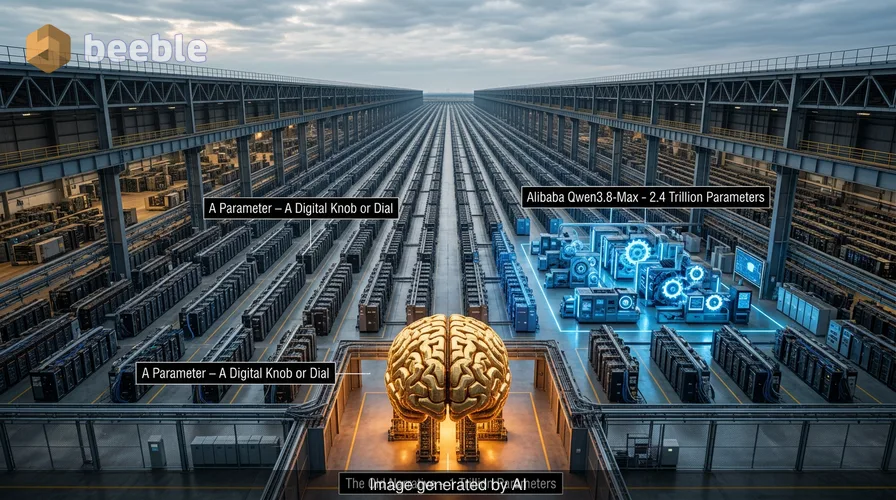
A common narrative in Silicon Valley and Beijing is that artificial intelligence follows a simple rule of physics: more is better. If a model with one billion parameters is smart, a model with one trillion parameters must be a genius. Alibaba recently challenged this assumption by unveiling Qwen3.8-Max. While the raw numbers are staggering, the real innovation is not the size of the digital brain, but how little of it the system actually uses at any given moment.
Parameters are the digital knobs and dials that a model adjusts during its training phase. They are the settings that allow the software to recognize the difference between a legal contract and a grocery list. Alibaba's new model has 2.4 trillion of these settings. This puts it in direct competition with Moonshot AI, another Chinese firm that recently launched a 2.8 trillion parameter system called Kimi K3. For the average user, these figures feel abstract. To put it another way, if a standard smartphone app is a single tool, these models are entire industrial warehouses filled with specialized machinery.
The numbers game behind massive models
In the current AI arms race, parameter count is often used as a proxy for raw intelligence. Companies publish these figures to gain traction among developers and investors. However, a higher number is not a guarantee of superior performance. A model with 2.4 trillion parameters requires an immense amount of electricity and specialized chips to run. If every request from a user forced the entire system to wake up, the cost of asking an AI to summarize a recipe would be higher than the price of the ingredients.
Alibaba is targeting a specific segment of the market with this release. By keeping the model open-weight, they allow developers to download and run the system on their own hardware. This is a different path than the one taken by OpenAI or Google, who keep their largest models behind closed doors. For a software engineer in a mid-sized firm, an open-weight model provides a tangible level of control and transparency that closed systems lack.
Efficiency through the mixture of experts method
Under the hood, Qwen3.8-Max uses a design known as mixture-of-experts. Instead of being one monolithic block of intelligence, the model is more like a large corporation with dozens of specialized departments. When you ask the AI a question about Python code, the system does not activate the parts of its brain that understand French poetry or ancient history.
Only 95 billion parameters are active at any single time. This is less than 4% of the total model size. This design is a practical response to the soaring costs of data centers. It allows the system to remain scalable without requiring a dedicated power plant for every server rack. For the consumer, this means faster response times. You are not waiting for a 2.4 trillion parameter beast to lumber into action; you are getting a quick answer from a streamlined specialist.
The meaning of the million token context window
Both the Alibaba and Moonshot models handle up to 1 million tokens at once. In the world of AI, tokens are the basic units of language. A million tokens is roughly equivalent to several thick novels or a massive software codebase. Looking at the big picture, this context window is the digital equivalent of a person's short-term memory.
| Feature | Alibaba Qwen3.8-Max | Moonshot Kimi K3 |
|---|---|---|
| Total Parameters | 2.4 Trillion | 2.8 Trillion |
| Active Parameters | 95 Billion | Unknown |
| Context Window | 1 Million Tokens | 1 Million Tokens |
| Primary Design | Mixture-of-Experts | Mixture-of-Experts |
| Access Model | Open-weight | Proprietary/API |
For a lawyer, this means the AI can read an entire stack of case files in one go and find a specific contradiction. For a developer, it means the AI can look at a whole application instead of just a single file. Alibaba claimed the model completed a full software engineering project in 16 days. This is an emerging trend where AI acts as a tireless intern that never sleeps and remembers every line of code it has ever seen.
Performance on the global stage
Benchmarking these systems is a volatile process. On Arena.AI, a platform where humans rank AI responses blindly, Qwen3.8-Max became the highest-ranking Chinese text model. It still sits behind the top offerings from Anthropic, such as Claude Fable 5. However, the gap is closing rapidly. In the specific area of visual analysis, which involves understanding images and videos, the Alibaba model reached the second spot globally.
This shift is foundational for the next generation of gadgets. If a model can understand visual data with high accuracy, it becomes much more useful in heavy industry and robotics. A system that can watch a factory floor and identify a safety hazard in real-time is more than just a chatbot. It is a systemic upgrade to how businesses monitor their physical operations.
What this means for your digital life
From a consumer standpoint, the arrival of Qwen3.8-Max signals that high-end AI is becoming a commodity. When massive models are released as open-weights, the cost of using them tends to drop across the entire industry. You might not interact with Alibaba’s model directly, but the apps you use every day will likely use its architecture or its competition to lower their subscription prices.
There is also the question of privacy and localization. Because this model is open-weight, a company can run it on their private servers without sending data to the cloud. This reduces the risk of sensitive information leaking to a third party. For the average person, this could lead to more "on-device" AI that works without an internet connection, keeping your personal data on your phone or laptop.
The bottom line on industrial AI
The sheer scale of 2.4 trillion parameters is impressive, but the clever use of only 95 billion of them is the real victory. The industry is moving away from raw power and toward streamlined efficiency. As these models become more decentralized, the invisible backbone of modern software will become faster and less expensive to maintain.
Ultimately, you should look past the marketing hype of parameter counts. The true value lies in how these systems handle complex tasks without burning through a company's entire hardware budget. Observe your digital habits over the next few months. You will likely notice that your AI tools are becoming better at handling long documents and complex instructions. This is not because the computers got bigger, but because the software learned how to be selective about which parts of its brain to use.
Sources
- Alibaba Cloud official technical announcement (August 2026)
- Arena.AI (LMSYS) global leaderboard data
- Moonshot AI product specifications for Kimi K3
- Alibaba Cloud Model Studio platform documentation



See you on the other side.
Our end-to-end encrypted email and cloud storage solution provides the most powerful means of secure data exchange, ensuring the safety and privacy of your data.
/ Create a free account
