


Why the Biggest Winner in the AI Race Isn't Actually Building an AI Model

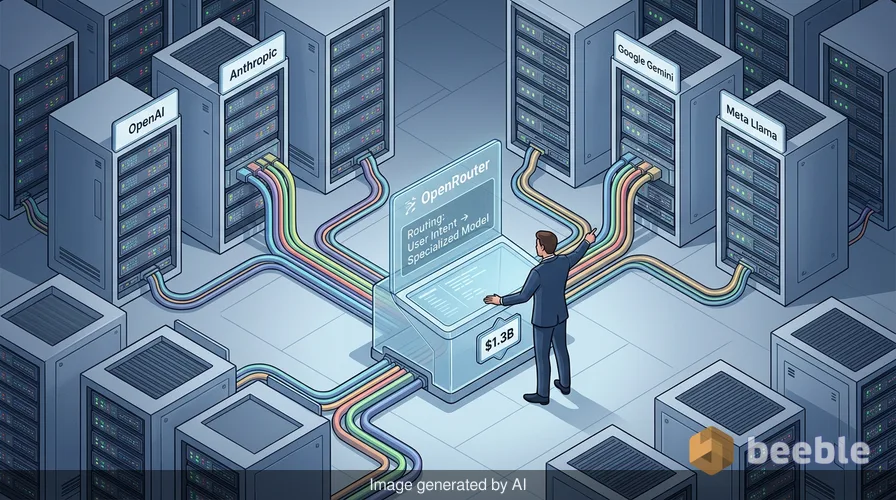
For the past two years, the public narrative surrounding artificial intelligence has felt like a heavyweight boxing match. In one corner, you have the household names like OpenAI and Google, and in the other, aggressive challengers like Anthropic and Meta. We have been told to expect a 'winner-take-all' scenario where one single, god-like model eventually becomes the brain behind every app on your phone and every spreadsheet at your office.
While that narrative makes for great headlines, the actual market reality is shifting in a completely different direction. On May 26, 2026, we received the clearest signal yet that the future of AI isn't about one dominant mind, but about a massive, interconnected network of specialized ones. OpenRouter, a startup that doesn't actually build its own AI models, has seen its valuation rocket to approximately $1.3 billion.
By securing $113 million in a Series B round led by CapitalG—the growth venture arm of Google’s parent company, Alphabet—OpenRouter has proven that the real money isn't just in the 'brains' themselves, but in the digital switchboard that connects them.
The Universal Switchboard of the AI Era
To understand why a company that simply 'routes' traffic is suddenly worth over a billion dollars, we have to look under the hood of how businesses actually use AI. In the early days of the boom, a company might have signed an exclusive deal to use one specific model for everything. However, as the technology matured, developers realized that using a massive, expensive model to summarize a simple email is like hiring a rocket scientist to help with long division. It is overkill, and it is expensive.
OpenRouter acts as a foundational gateway. It provides a single point of entry to over 400 different AI models. Instead of a developer having to set up separate accounts, billing cycles, and technical connections for OpenAI, Google’s Gemini, and Anthropic’s Claude, they just connect to OpenRouter.
Essentially, OpenRouter is a universal travel adapter for the digital world. No matter which 'country' (or model provider) you are trying to visit, you only need one plug. This streamlined approach has allowed the startup to scale at an unprecedented rate, growing from processing 5 trillion tokens per week to 25 trillion in just six months.
Understanding the Token Economy
Behind the jargon of the AI industry lies a very simple unit of measurement: the token. For the average user, you can think of a token as a small building block of language—roughly equivalent to four characters or three-quarters of a word. When an AI 'thinks,' it processes these blocks.
OpenRouter is now processing 100 trillion of these blocks every month. To put that into a more relatable perspective, that is roughly the equivalent of every person on Earth reading a full-length novel every few weeks, all routed through one single startup’s infrastructure.
This volume is a tangible indicator of a massive industry shift. We are moving away from the 'training' phase—where companies spent billions just to teach AI how to speak—and into the 'inference' phase. Inference is simply a fancy word for 'using the AI to do actual work.' As AI shifts from being a lab experiment to a tireless intern that helps us write code, book travel, and analyze medical data, the demand for a reliable, cheap, and fast way to access those brains is skyrocketing.
The Death of Vendor Lock-In
Looking at the big picture, OpenRouter’s success highlights a deep-seated fear in the corporate world: vendor lock-in. Historically, companies have been burned by becoming too dependent on a single software provider. If you build your entire business on one company's ecosystem, you are at the mercy of their price hikes, service outages, and shifting terms of service.
In the AI world, this risk is even higher. Models that are world-class today might be obsolete in three months. By using a gateway like OpenRouter, a business can swap out its underlying AI 'engine' in a matter of seconds. If a new, cheaper model from a startup in France or China suddenly outperforms the big players, a company can switch without rewriting a single line of their own software code.
This decentralized approach makes the AI industry more resilient. It ensures that no single company can hold the keys to the kingdom. For the consumer, this competition is excellent news because it forces model makers to keep prices low and performance high to avoid being 'swapped out' by the gateway.
From Chatbots to Autonomous Agents
Curiously, the surge in OpenRouter’s popularity also tracks with the rise of AI 'agents.' Most of us are familiar with the basic chatbot—you ask a question, it gives an answer. But the next frontier is agentic AI: systems that can actually go out and perform multi-step tasks on your behalf.
Imagine an agent tasked with planning a 10-day trip to Japan. It might use a highly sophisticated, expensive model to plan the itinerary, a cheaper, faster model to check flight prices, and a third, specialized model to translate hotel booking policies from Japanese to English.
An agent like this needs to talk to multiple models simultaneously to be efficient. OpenRouter provides the robust infrastructure that makes this multi-model communication possible. Without a central hub, building these types of complex, autonomous assistants would be a logistical nightmare for developers.
What This Means for Your Daily Life
From a consumer standpoint, you might never interact with OpenRouter directly, but you will certainly feel its impact. Here is how this billion-dollar valuation trickles down to your smartphone and your wallet:
| Impact Area | How it Changes Your Experience |
|---|---|
| Cost of Services | AI-powered features in your favorite apps will likely stay free or cheap because developers can constantly switch to the lowest-cost model provider. |
| App Reliability | If one major AI provider (like OpenAI) goes down, your favorite apps can automatically switch to a backup model via the gateway, meaning less downtime for you. |
| Specialized Quality | Instead of one 'average' AI trying to do everything, apps will use different 'brains' for different tasks, leading to better medical advice, more accurate coding, and more creative writing. |
| Privacy and Choice | You may soon see 'model pickers' in apps, allowing you to choose an open-source, privacy-focused model for personal tasks and a high-performance model for work. |
Looking Ahead: The Multi-Model Reality
Ultimately, the fact that Alphabet’s CapitalG is leading this round is perhaps the most telling detail of all. Even Google, which owns one of the world’s most powerful AI models (Gemini), recognizes that the future is not a monopoly. By investing in the leading aggregator, Google is acknowledging that they are part of an ecosystem, not the sole owners of it.
As we move forward, the 'AI model' itself is becoming an invisible, transparent commodity—much like the electricity that powers your house. You don't necessarily care whether your power comes from wind, solar, or hydro, as long as the lights stay on and the bill is reasonable.
Practically speaking, we should stop asking which AI model will 'win' the race. OpenRouter’s meteoric rise suggests that the real winner is the infrastructure that allows all of them to compete. For the average user, the takeaway is clear: don't get too attached to any one chatbot. The digital world is becoming a shifting, modular landscape where the best tool for the job might change by next Tuesday.
Rather than waiting for one all-powerful AI to change your life, start observing how many different 'intelligences' are already working behind the scenes in your digital habits. The multi-model future isn't a distant prediction; it is currently being routed through a $1.3 billion gateway.
Sources:
- Alphabet/CapitalG Official Investment Announcement (May 2026)
- The New York Times: OpenRouter Valuation Analysis
- PitchBook Data: Venture Capital Trends in AI Inference (Q2 2026)
- OpenRouter Public Usage Statistics and Documentation



See you on the other side.
Our end-to-end encrypted email and cloud storage solution provides the most powerful means of secure data exchange, ensuring the safety and privacy of your data.
/ Create a free account
