


Why the Company Behind TikTok is Rewriting the Rules of the Microchip Market

Every time you open TikTok and find yourself spiraling down a rabbit hole of perfectly curated videos, a silent, lightning-fast calculation is happening thousands of miles away. A signal travels from your thumb to a server farm, where a complex algorithm decides exactly which slice of digital life will keep you watching for another ten seconds. Historically, that decision-making process relied on standardized parts—hardware bought from the same catalogs used by everyone from local banks to government agencies. But as we move into the mid-2020s, that model is breaking.
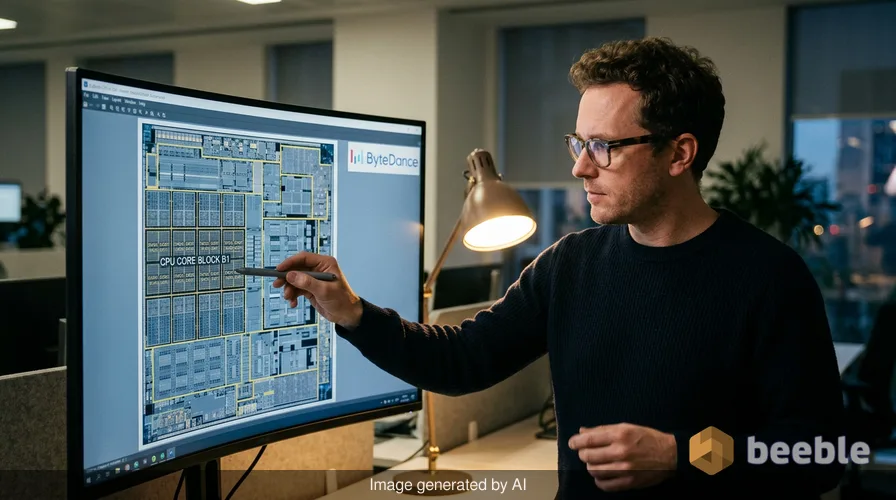
Looking at the big picture, the journey of a single TikTok recommendation starts not with code, but with silicon. ByteDance, the parent company of TikTok and the Chinese equivalent Douyin, is now tracing that journey all the way back to the drawing board. By developing its own custom central processing units (CPUs), ByteDance is attempting to move from being a mere consumer of technology to a foundational architect of it. This isn't just a corporate vanity project; it is a calculated response to a world where microchips have become the digital crude oil—essential, volatile, and increasingly difficult to secure.
The Great Decoupling: Why Off-the-Shelf Chips No Longer Cut It
For decades, the tech industry followed a simple script: Intel or AMD designed the CPUs, and software companies like ByteDance wrote the code to run on them. This arrangement worked because general-purpose chips were "good enough" for almost everything. However, the AI revolution has fundamentally altered this systemic balance. We have reached a point where generic hardware acts like a one-size-fits-all suit—it technically covers the body, but it’s baggy in the wrong places and tight where you need movement.
Under the hood, ByteDance’s move is driven by the sheer scale of its operations. When you are serving content to billions of people, even a 1% increase in hardware efficiency translates to hundreds of millions of dollars saved in electricity and cooling costs. The current market for high-end chips is also incredibly resilient to price drops. Because of the insatiable demand for AI, companies like Nvidia can command premium prices, leaving software giants in a vulnerable position. By designing their own CPUs, ByteDance is attempting to bypass the "Nvidia tax" and the supply chain bottlenecks that have plagued the industry since the early 2020s.
Beyond the Chatbot: The Rise of the Agentic AI Intern
To understand why a company famous for short-form video needs custom CPUs, we have to look at how AI has evolved. In the early days of the AI boom, the focus was almost entirely on "training"—feeding massive amounts of data into a model so it could learn. This is a job for Graphics Processing Units (GPUs), which are essentially the heavy lifters of the math world.
Conversely, we are now in the era of "inference." This is when the AI is actually put to work. If training is like a student studying for an exam, inference is the student actually taking the test in real-time. But the tasks are becoming more complex. We aren't just talking about chatbots anymore; we are moving toward agentic AI.
Think of an agentic AI as a tireless intern. It doesn't just answer your question; it takes a series of steps to solve a problem. If you ask a 2026-era AI to "organize a dinner party," it has to check your calendar, search for recipes, compare grocery prices, and perhaps even send out invites. These tasks require sophisticated logic, branching paths, and constant communication between different parts of a system. This is where the CPU shines. While a GPU is great at crunching numbers, a custom CPU acts as the refined executive assistant, managing the flow of information and making sure the agent stays on track. ByteDance’s new chips are being built specifically to handle these "managerial" tasks for AI, ensuring that your digital assistant doesn't lag when things get complicated.
The Arithmetic of Autonomy: Why Custom Silicon Saves Billions
On the market side, the decision to build hardware is a play for long-term stability. The semiconductor industry is notoriously cyclical, swinging between periods of glut and painful scarcity. For a company that relies entirely on cloud infrastructure, being at the mercy of a third-party manufacturer's roadmap is a significant risk.
| Feature | General-Purpose CPUs (Intel/AMD) | ByteDance Custom CPUs |
|---|---|---|
| Core Focus | Versatility for all software types | Optimized for AI inference/agentic tasks |
| Power Efficiency | Moderate (includes legacy support) | High (streamlined for specific workloads) |
| Cost Structure | High per-unit markup from vendors | High R&D upfront; low per-unit cost at scale |
| Supply Chain | Subject to market availability | Internal priority and control |
For the average user, this might seem like dry balance-sheet talk. However, consider the "So What?" filter. When ByteDance reduces its operational overhead by using streamlined, in-house silicon, it gains a competitive edge. It can offer more complex features—like real-time video translation or hyper-realistic AR filters—without needing to charge users more or clutter the interface with even more aggressive advertising. This vertical integration is the same strategy Apple used with its M-series chips, which transformed Macbooks from hot, loud machines into silent, all-day powerhouses. ByteDance is looking for that same unprecedented jump in performance-per-watt.
Geopolitics and the Foundry Bottleneck
We cannot ignore the elephant in the room: the shifting landscape of global trade. ByteDance operates in a complex geopolitical web. Access to the highest-end Western chips has become increasingly opaque due to export restrictions and national security concerns. By developing their own designs, they are building a degree of self-reliance.
Curiously, designing a chip is only half the battle. You still need someone to bake the silicon. Even with a perfect design, ByteDance must rely on foundries like TSMC or Samsung to actually manufacture the physical hardware. This means they are still interconnected with the global supply chain, but they are no longer just buying a finished product off a shelf. They are bringing their own proprietary recipe to the kitchen. This shift from consumer to creator allows them to bake in specific security and efficiency features that are proprietary to their ecosystem, making their software and hardware work in a hand-in-hand fashion that competitors using generic parts simply cannot match.
How This Changes the App in Your Pocket
From a consumer standpoint, what does this actually look like in everyday life? For a long time, the bottleneck for mobile apps was your phone's processor. Today, the bottleneck is the server's ability to think and respond.
As ByteDance rolls out its custom chips, the primary tangible benefit will be latency—or rather, the lack of it. Imagine talking to an AI persona on a social platform and having it respond with the cadence and emotional nuance of a real person, without the awkward three-second "thinking" pause. This is only possible if the server-side hardware is robust enough to process your voice, understand the context, and generate a response in milliseconds.
Furthermore, specialized CPUs allow for better privacy handling. If a chip is designed with specific "secure enclaves" for AI processing, more of your data can be handled in a decentralized way, or at least in a more transparently managed environment. It makes the overarching system more resilient to crashes and more intuitive to use.
Practical Foresight
The bottom line is that the era of "software companies" is ending; we are entering the era of the "compute company." Whether it's Amazon, Google, or now ByteDance, the giants of the internet have realized that to control the experience, they must control the atoms as well as the bits.
As a user, you should start observing the subtle shifts in your digital habits. Are the AI-driven features in your favorite apps becoming more proactive? Is the battery on your device lasting longer even as you use more complex tools? These are the footprints of custom silicon at work. We are moving away from a world where we all use the same digital tools and toward one where our experiences are powered by invisible, highly-specialized engines. The next time an app seems to anticipate your needs with eerie accuracy, remember: it’s not just the code. It’s the custom-built brain in a data center halfway around the world, finally catching up to the speed of your thoughts.
Sources:
- ByteDance Technical Infrastructure Overview (May 2026)
- Semiconductor Industry Association: Market Trends Report
- SemiAnalysis: The Shift Toward Inference-Optimized Silicon
- Bloomberg Tech: Geopolitics of the 2026 Chip Supply Chain



See you on the other side.
Our end-to-end encrypted email and cloud storage solution provides the most powerful means of secure data exchange, ensuring the safety and privacy of your data.
/ Create a free account
