


Why the fastest AI on the market is no longer the most expensive one

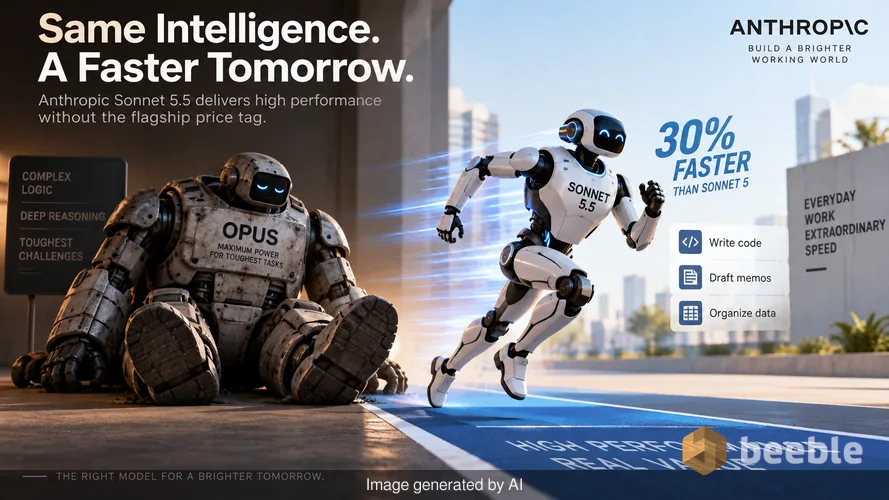
Have you ever wondered why your expensive flagship smartphone sometimes feels clunkier than the brand-new budget model your friend just bought? In the world of technology, the newest mid-range release often carries the benefits of refined engineering that the older, heavy-duty giants lack. This phenomenon has now arrived in the artificial intelligence sector. Anthropic just released Sonnet 5.5, a model that occupies the middle ground in its lineup but moves with a speed that makes the flagship versions look stationary. This update changes the math for businesses and everyday users who want high performance without the high price tag of a top-tier system.
Anthropic describes Sonnet 5.5 as a streamlined work partner. It targets the people who spend their days writing code, drafting endless office memos, or organizing chaotic data spreadsheets. While the company’s Opus model remains the heavy lifter for the most complex logic puzzles, Sonnet 5.5 is now the agile athlete of the family. The lab claims this version is 30 percent faster than the previous Sonnet 5, which arrived only three months ago. In the fast-moving tech world, a three-month cycle for a major performance jump is a sign of a very volatile and competitive market.
The mechanics of a faster digital intern
To understand why speed matters in AI, think of the model as a tireless intern. If you ask an intern to summarize a 50-page report, you do not just care about the accuracy. You care about how long you have to wait before you can use that summary in your next meeting. Sonnet 5.5 reduces that wait time significantly. Anthropic achieved this by slowing down the rate of token burn. In simple terms, a token is a chunk of text that the AI processes. If the model burns through tokens more slowly and efficiently, the cost to the user drops while the output speed rises.
Practically speaking, this change affects how much you pay at the end of the month. Most AI services charge based on how much the model has to think or read. When a model is 30 percent faster and uses fewer resources to deliver the same result, it becomes a scalable tool for small businesses that previously found AI too expensive for daily operations. This is the digital equivalent of a car that goes faster while using less gasoline. It is a rare combination that usually indicates a breakthrough in how the software is organized under the hood.
Why agility beats brute force in coding
One of the most curious details in the release notes is how Sonnet 5.5 compares to the flagship Opus 5.5 model. In certain tests, specifically agentic coding, the mid-tier Sonnet actually performs better than its more powerful sibling. This seems counterintuitive. You would expect the most expensive model to be the best at everything. However, the reason lies in the way modern software is built.
Agentic coding involves an AI spawning multiple smaller agents to handle different parts of a project simultaneously. One agent might write the logic, while another checks for security flaws, and a third writes the user interface. Because Sonnet 5.5 is so efficient, it can run many of these agents at once without hitting the cost or memory limits that slow down the larger Opus model. For a developer, this means the AI can build complex applications in chunks rather than trying to process the entire project as one giant, slow block of text. This agility makes it a more practical choice for building the apps and websites we use every day.
| Feature | Sonnet 5 | Sonnet 5.5 |
|---|---|---|
| Processing Speed | Standard | 30% Increase |
| Resource Efficiency | Baseline | Lower token burn rate |
| Coding Performance | Specialized | Superior agentic agility |
| Safety Protocol | Standard | Advanced cyber safeguards |
| Target Audience | Early adopters | Office power users |
New safeguards for a more capable tool
As AI models become faster and smarter, they also become more capable of doing things they should not do. Anthropic has recognized that Sonnet 5.5 has reached a level of cyber capability that was previously reserved for its most powerful models. The company states that this version has cyber skills comparable to Opus 5. This includes the ability to understand complex code structures that could be used for both building and breaking security systems.
Because of these emerging capabilities, Anthropic has applied the same strict cyber safeguards to Sonnet 5.5 that it uses for its top-end Fable and Opus models. These safeguards are the digital guardrails that prevent the AI from being used to create malware or find vulnerabilities in sensitive infrastructure. From a consumer standpoint, this is a positive development. It means the tools we use for basic office work are built with the same security rigor as the systems used by major corporations and government agencies.
The broader war for your digital desktop
Looking at the big picture, this release is a direct response to a flurry of activity from other major players. Just last week, OpenAI updated its mid-tier Sol and budget-friendly Luna models to be more competitive. Meta also entered the fray with a new model designed for smart glasses, showing that the battle for AI dominance is moving from the computer screen to our wearable hardware.
Historically, these tech wars lead to a period where features become cheaper and more accessible very quickly. We are currently in that phase. The release of Sonnet 5.5, followed by the promised arrival of a new, even smaller Haiku model, suggests that the industry is moving away from the idea of one giant, all-knowing brain. Instead, we are seeing a decentralized approach where different models handle different tasks based on their size and speed. You might use the tiny Haiku to sort your emails, the fast Sonnet to write your reports, and the heavy Opus to analyze your company's annual budget.
What this means for your daily workflow
For the average user, the arrival of Sonnet 5.5 is not just another tech headline. It is a tangible change in how much work you can get done in an hour. If you use AI to help with your job, you will likely notice that the responses feel more immediate. The lag between asking a question and getting a useful answer is disappearing.
This speed also makes the AI feel more like a collaborator and less like a search engine. When a tool reacts in real-time, you are more likely to stay in your creative flow rather than getting distracted while waiting for a loading bar. It is a streamlined experience that treats your time as a valuable resource. Essentially, Anthropic is betting that users value their time and their budget more than they value the raw, theoretical power of a model that takes too long to respond.
On the market side, this release puts pressure on other companies to lower their prices. If a mid-tier model can outperform a flagship in practical tasks like coding, the definition of a premium product has to change. We are seeing a foundational shift in how intelligence is priced. It is no longer a luxury good for data scientists. It is becoming a utility, like electricity or internet access, where the goal is to provide the most power for the lowest possible cost.
A pragmatic look at the AI transition
Ultimately, the release of Sonnet 5.5 is a sign of a maturing industry. The early hype focused on what AI could theoretically do in the future. Now, the focus is on what AI can actually do for a worker on a Tuesday afternoon. The improvements in speed and cost are the kind of practical updates that matter in the real world. They move AI out of the realm of science fiction and into the realm of everyday office equipment.
You should observe your own digital habits over the next few weeks. If you find yourself reaching for these tools more often because they are faster, you are experiencing the result of this industrial competition. The digital crude oil of our era is no longer just data. It is the speed at which that data can be turned into something useful. As these models get faster and cheaper, the barrier between a good idea and a finished project continues to shrink.
Sources: Anthropic technical documentation, September 2026; industry benchmarks on agentic coding performance; competitive analysis of OpenAI Sol and Luna release cycles.



See you on the other side.
Our end-to-end encrypted email and cloud storage solution provides the most powerful means of secure data exchange, ensuring the safety and privacy of your data.
/ Create a free account
