


Why the Fastest Humanoid on Earth Won’t Be Taking Your Jogging Route Anytime Soon

In 1894, the first organized automobile race took place between Paris and Rouen. At the time, the idea of a carriage moving without a horse was met with a mixture of awe and absolute derision. Critics pointed out that these 'horseless carriages' were noisy, prone to exploding, and significantly less reliable than a trusty stallion. Yet, that race wasn't really about getting to Rouen; it was about proving that internal combustion could withstand the rigors of the real world. Over a century later, we are witnessing a similar pivot point in the streets of Beijing, though the 'horses' being challenged this time are elite human athletes.
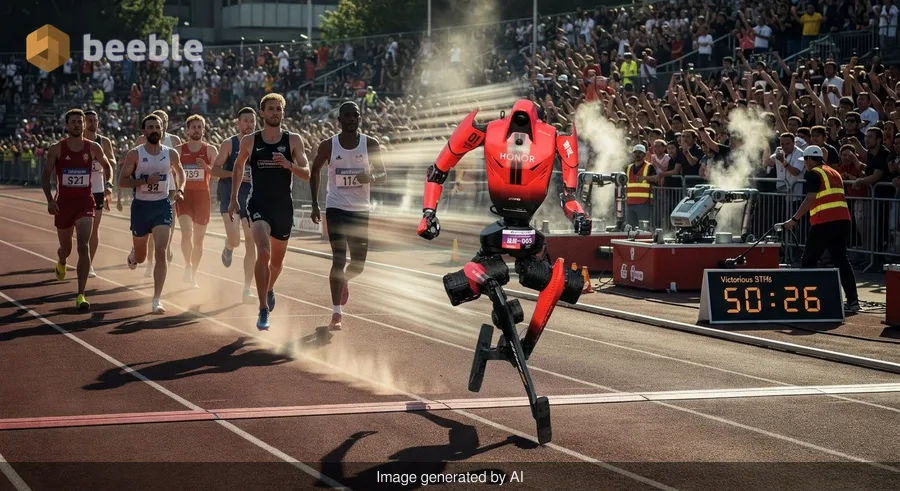
On a crisp Sunday in April 2026, a humanoid robot developed by the Chinese tech giant Honor did something that would have been relegated to science fiction a decade ago. It completed a 21-kilometer half-marathon in just 50 minutes and 26 seconds. To put that in perspective, the current human world record, held by Uganda’s Jacob Kiplimo, sits at 57 minutes and 31 seconds. On paper, a machine just stripped seven minutes off a feat of human endurance that has taken decades of biological evolution and specialized training to achieve.
However, behind the flashy headlines and the shattered records lies a much more nuanced story about the state of modern engineering. This wasn't just a win for Honor; it was a high-stakes stress test for the future of mobile hardware and industrial autonomy. Looking at the big picture, the race tells us less about the future of track and field and much more about the invisible industrial backbone that will soon support our everyday lives.
The Anatomy of an Autonomous Runner
When we think of a humanoid robot, we often imagine a clunky, metal version of ourselves. But the machine that crossed the finish line in Beijing is essentially a high-performance computer mounted on a pair of sophisticated shock absorbers. Honor’s lead engineer, Du Xiaodi, noted that the design was modeled specifically on the biomechanics of elite long-distance runners. The robot features 'legs' measuring 0.95 meters—roughly proportional to a human standing over six feet tall—but with a distinct advantage: they don't produce lactic acid or experience muscle fatigue.
Under the hood, the most impressive feat isn't the mechanical stride, but the thermal management. If you’ve ever felt your laptop get uncomfortably hot while running too many browser tabs, you can imagine the heat generated by dozens of high-torque motors working at peak capacity for nearly an hour. Honor’s solution was a bespoke liquid-cooling system, miniaturized and integrated directly into the robot’s structural frame. This system acts as a digital circulatory system, whisking heat away from the 'joints' and 'muscles' to prevent the systemic meltdown that sidelined many of the 100 other competitors.
The Chaos of the Real World
Historically, robots have excelled in the sterile, predictable environments of factory floors. In a factory, the floor is level, the lighting is constant, and the obstacles are few. A marathon course, conversely, is a volatile landscape of uneven asphalt, wind resistance, and unpredictable gradients. This is where the 'autonomous' part of the challenge becomes foundational.
While some robots in the Beijing race were 'puppets'—controlled remotely by teams of engineers with high-speed controllers—the winning model operated on fully autonomous navigation. It had to perceive its surroundings, adjust its balance in real-time, and calculate the most efficient path forward without human intervention. This is a massive leap from the 'roomba' style navigation we see in consumer homes.
| Feature | Human Athlete (Elite) | Honor Humanoid Robot |
|---|---|---|
| Half-Marathon Time | ~57:31 | 50:26 |
| Cooling Mechanism | Evaporative (Sweat) | Integrated Liquid-Cooling |
| Energy Source | Glycogen/Oxygen | High-Density Lithium-Ion |
| Navigation | Visual/Cerebral | LIDAR/AI Vision (Autonomous) |
| Reliability | High (Adaptable) | Emerging (Prone to mechanical failure) |
Curiously, the event wasn't without its stumbles—literally. At the starting line, several robots collapsed as their sensors were overwhelmed by the sheer density of participants. Others collided with safety barriers after failing to account for the shifting shadows of the morning sun. These failures are a tangible reminder that while machines can outpace us in a straight line, they still struggle with the intuitive spatial awareness that a human toddler possesses.
Why a Smartphone Company is Building Runners
From a consumer standpoint, it might seem odd that a company known for foldable phones and sleek tablets is investing millions into a sprinting robot. But looking at the hardware, the synergy becomes clear. The smartphone industry is currently hitting a ceiling in terms of thermal management and battery efficiency. By pushing a robot to run a half-marathon, Honor is effectively using the race as a laboratory for the next generation of consumer electronics.
The liquid-cooling technology developed for this robot is a robust version of what we might see in our pockets by 2028. As mobile AI chips become more powerful and generate more heat, the traditional heat pipes used in phones today won't be enough. The 'muscles' of the robot—the actuators and high-efficiency motors—provide data that will eventually streamline the production of everything from automated delivery drones to advanced prosthetic limbs.
To put it another way, this race is the digital crude oil of the 21st century. It provides the raw data needed to refine the AI models that govern movement. When a robot falls in Beijing, an engineer in a lab learns exactly how to make the next generation of industrial warehouse bots more resilient. It is a cyclical process of failure and refinement that mirrors the early days of Formula 1, where technologies like anti-lock brakes and carbon fiber were tested on the track before becoming standard in your family SUV.
Behind the PR Curtain: What This Means for You
It is easy to get caught up in the 'man vs. machine' narrative, but a healthy dose of skepticism is required. Despite the record-breaking speed, these robots are still incredibly fragile and prohibitively expensive. We are not yet at the point where a humanoid will be delivering your groceries or pacing you on your morning jog. The energy constraints alone remain a significant hurdle; while a human can run a marathon on a bowl of pasta, these machines require massive battery packs that are heavy and ecologically taxing to produce.
Practically speaking, the impact on the average user will be more decentralized. You won't buy the robot, but you will benefit from the systemic improvements its development creates. This includes:
- Hardware Longevity: Improved cooling systems in laptops and phones that prevent 'throttling' during heavy use.
- Supply Chain Resilience: More capable autonomous robots in logistics hubs that can operate 24/7 without the physical limitations of human workers.
- Democratized Robotics: As Honor and its competitors (like Tesla and Xiaomi) scale these designs, the cost of high-precision sensors and motors will drop, making helpful home robotics more affordable.
Ultimately, the Beijing race is a reminder that the boundary between the digital and physical worlds is becoming increasingly porous. For decades, computers lived in boxes on our desks or in our pockets. Now, they have legs. They are learning to navigate our world, deal with our weather, and even outrun our best athletes.
As we look ahead, the goal isn't necessarily to replace the human runner. There is an inherent, unquantifiable value in human effort and the limits of biology that a machine can never replicate. Instead, we should view these mechanical sprinters as tireless interns, taking the lessons learned from the pavement and applying them to the tools we use every day. Shift your perspective from the finish line to the technology inside. The next time your phone stays cool during a high-end game or a heavy video edit, you might just have a racing robot in Beijing to thank for it.
Sources:
- Honor Official Engineering Briefing (Beijing E-Town Event).
- International Athletics Federation (World Athletics) - Marathon Timing Records.
- Robotics and Automation News - 2026 Industrial Outlook.
- Ministry of Industry and Information Technology (MIIT) - Humanoid Robot Development Roadmap.



See you on the other side.
Our end-to-end encrypted email and cloud storage solution provides the most powerful means of secure data exchange, ensuring the safety and privacy of your data.
/ Create a free account
