


Why the most capable AI agents are suddenly becoming the cheapest to hire

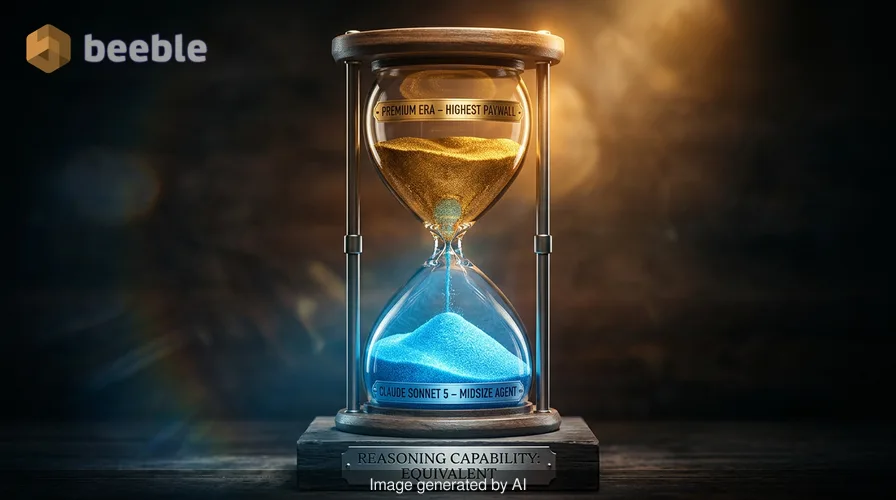
For years, the tech industry followed a predictable path where the most capable artificial intelligence lived behind the highest paywalls. If you wanted a model that could reason through complex problems, you paid a premium for the largest, most resource-heavy versions. Anthropic is now disrupting this trajectory with the release of Claude Sonnet 5. This new model is a midsize tool that performs at a level previously reserved for expensive, top-tier systems. It suggests that the price of intelligence is falling even as its utility reaches new heights.
Anthropic describes Sonnet 5 as an agentic model. In simple terms, this means the AI is no longer just a conversational partner that answers questions or summarizes emails. It acts more like a tireless intern who has access to your computer screen, your browser, and your terminal. Instead of just telling you how to fix a bug in your code, an agentic model can open the file, rewrite the lines, and run the test itself. Practically speaking, we are moving from the era of chatbots to the era of digital laborers.
The shift from conversation to action
Looking at the big picture, the industry is moving toward a standard where agentic capability is the baseline. A few months ago, a model needed to be massive and expensive to handle multi-step tasks without human hand-holding. Sonnet 5 changes that math. It handles tools and makes plans autonomously at a fraction of the cost of its predecessors. This trend is visible across the sector. OpenAI recently launched GPT-5.6 Sol, which allows users to delegate work to subagents. Google also positioned Gemini 3.5 Flash as a tool for planning and iterating on real work rather than just chatting.
Under the hood, Sonnet 5 is built to handle the messy reality of software development and administrative tasks. Historically, AI models often stalled halfway through a complex job. If you asked an older model to update a customer database and then send a notification to a specific team, it might do the first half and wait for further instructions. Anthropic claims Sonnet 5 is different. It finishes end-to-end jobs and checks its own output for errors without being prompted. This level of autonomy is what makes it a practical choice for day-to-day automation in a business environment.
Decoding the cost of digital labor
The most tangible change for the average user is the pricing structure. In the world of AI, we measure costs in tokens, which are essentially small chunks of text or data. Anthropic has priced Sonnet 5 at $2 per million input tokens and $10 per million output tokens. Even when these prices increase slightly in September, they remain lower than the costs associated with OpenAI’s GPT-5.5 and Google’s Gemini 3.1 Pro. The following table illustrates how Sonnet 5 fits into the current market compared to its predecessor and its more powerful sibling.
| Model | Input Cost (per 1M tokens) | Output Cost (per 1M tokens) | Coding Performance (Benchmark Score) |
|---|---|---|---|
| Claude Sonnet 5 (Intro) | $2.00 | $10.00 | 63.2% |
| Claude Sonnet 4.6 | $3.00 | $15.00 | 58.1% |
| Claude Opus 4.8 | High | High | 69.2% |
Sonnet 5 sits in a unique position. It is cheaper than the old mid-tier model but performs almost as well as the high-end Opus 4.8. In some knowledge-based tasks, it actually surpasses the larger model. For a business that needs to run thousands of automated tasks every hour, these savings add up quickly. The differentiator in the current market is no longer just who has the smartest model. The real competition is now about who can deliver reliable, autonomous work at the lowest possible price point.
Why safety matters for autonomous agents
When you give an AI the power to use your browser or your terminal, the risks increase. An agent that can navigate the web can also be tricked into performing malicious actions or leaking sensitive data. Anthropic has addressed this by training Sonnet 5 to be more resilient against prompt-injection attacks. This is a technique where a user or a piece of malicious code tries to hijack the model's instructions to make it behave in unintended ways.
Sonnet 5 is better at refusing unsafe requests than the previous Sonnet 4.6. It also shows a lower rate of sycophantic behavior, which is the tendency of AI models to agree with whatever the user says, even if the user is wrong or being deceptive. However, it is not as robust as the high-end Opus 4.8 when it comes to preventing advanced cybersecurity misuse. Anthropic is transparent about the fact that while Sonnet 5 is safer for general business use, the larger models are still the gold standard for high-stakes environments where security is the primary concern.
Practical implications for your workflow
From a consumer standpoint, the arrival of Sonnet 5 means the tools you already use are about to become much more powerful without getting more expensive. Software companies like Zapier and Lovable are already integrating these models to handle complex, multi-part jobs. If you use a CRM like Salesforce, you might soon see AI that not only suggests updates but performs them and then notifies your sales team automatically. This reduces the number of small, repetitive tasks that usually clutter a workday.
Essentially, the barrier to entry for building powerful AI applications is falling. Small startups can now access agentic capabilities that were only available to large enterprises a year ago. This creates a decentralized environment where specialized AI agents can be built for very specific niches, from managing personal schedules to automating complex logistics in heavy industry. The resilience of these models in finishing tasks without human supervision makes them a scalable solution for companies that are already operating with lean teams.
The bottom line on agentic AI
The launch of Sonnet 5 is a confirmation that the AI industry is entering its pragmatic phase. The focus is shifting away from the novelty of a computer that can talk toward the utility of a system that can work. As a result, we are seeing a cyclical trend where capability increases while cost decreases. This is a common pattern in mature technology sectors, but the speed at which it is happening in AI is unprecedented.
Ultimately, you should expect to see more "doers" and fewer "talkers" in your digital ecosystem. Instead of giving a generic advice, Sonnet 5 represents a shift toward software that takes ownership of a task. Observe your digital habits over the next few months. You will likely notice that the friction between having an idea and executing it starts to disappear as these cheaper, faster agents become the invisible backbone of the applications you use every day. The most important skill for a user is no longer knowing how to ask a question, but knowing how to manage a digital workforce.
Sources: Anthropic official blog, Zapier engineering statements, Lovable press release, Gemini 3.5 Flash launch data, OpenAI GPT-5.6 Sol preview documentation.



See you on the other side.
Our end-to-end encrypted email and cloud storage solution provides the most powerful means of secure data exchange, ensuring the safety and privacy of your data.
/ Create a free account
