


Why the Most Important Meeting Between Trump and Xi Won't Be About the Chips in Your Phone

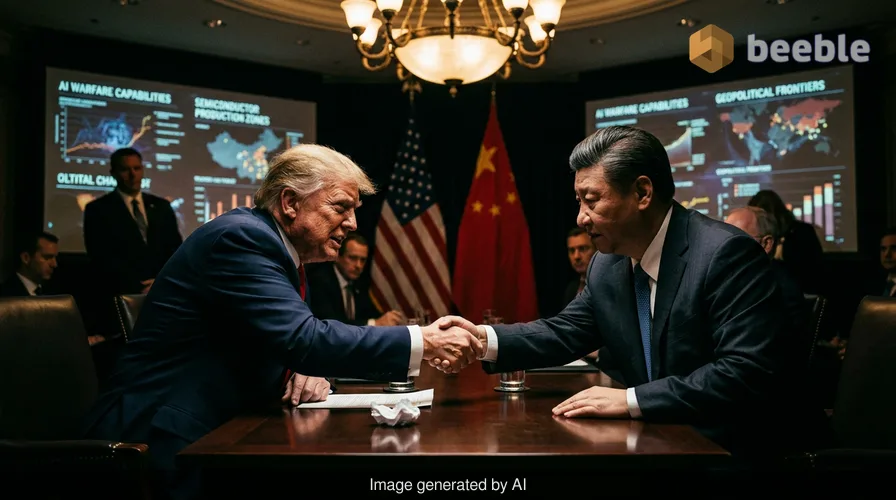
Most observers assume that any high-stakes meeting between the United States and China will inevitably descend into a haggling session over semiconductors—the digital crude oil of the modern world. While it is easy to focus on whether the next generation of iPhones will face tariffs or if Nvidia can sell its latest processors to Beijing, the reality of the 2026 summit in Beijing suggests a much more volatile shift. As President Donald Trump sits down with Xi Jinping, the conversation is moving away from consumer gadgets and toward a far more disruptive frontier: the role of artificial intelligence in global warfare.
While a breakthrough deal on chips seems unlikely, the presence of tech titans like Elon Musk and Tim Cook on the guest list signals that Silicon Valley has moved from the sidelines to the center of the negotiating table. This isn't just a trade talk; it is a recalibration of how two superpowers will coexist in an era where software, not just hardware, determines national survival.
The Shadow Diplomats of Silicon Valley
Looking at the big picture, the composition of the American delegation reveals a fascinating shift in how US policy is currently being crafted. Traditionally, diplomatic missions are populated by career bureaucrats and seasoned geopolitical strategists. However, the Trump administration has increasingly relied on tech executives to act as informal ambassadors. The presence of Apple’s CEO Tim Cook and Tesla’s Elon Musk suggests that the interests of Big Tech are now inextricably linked with national security.
Curiously, Jensen Huang, the head of Nvidia, is notably absent. This omission is telling. It highlights a growing realization that the "chip war" may have reached a stalemate. China has signaled that it is no longer interested in begging for American silicon; instead, it is aggressively subsidizing its own domestic producers like Huawei and Alibaba. In everyday life, this means the global supply chain is bifurcating. We are moving toward a world where Eastern and Western tech ecosystems operate on entirely different foundational architectures.
For the average user, this shadow diplomacy means that the devices in your pocket are no longer just consumer products—they are bargaining chips in a larger game of sovereign leverage. When Elon Musk discusses Tesla’s expansion in China, he isn't just talking about cars; he is talking about the massive datasets and physical AI systems that both nations view as essential to their future dominance.
AI as the New Digital General
Under the hood of this summit is a grim new reality: the emergence of AI-enabled warfare. For the past year, we have seen localized conflicts in regions like Gaza and Iran serve as testing grounds for algorithmic combat. These aren't the killer robots of science fiction, but rather sophisticated software systems capable of identifying targets, predicting troop movements, and launching autonomous drone swarms with minimal human intervention.
In simple terms, AI has become a tireless intern for the military—processing millions of data points from satellites and sensors in seconds. This speed creates a "use it or lose it" dilemma for commanders. If your opponent is using an algorithm to make decisions in milliseconds, you cannot afford to wait for a human colonel to sign off on a counter-move. David Leslie of The Alan Turing Institute notes that the US and China have already begun tentative talks about these risks, particularly regarding the nightmare scenario of AI having any control over nuclear launch sequences.
What this means is that the tech race is no longer just about who can make the fastest smartphone. It is about which nation can build a more resilient algorithmic shield. The fear is that an AI-driven escalation could happen so fast that human diplomats wouldn't have time to pick up the phone and de-escalate.
The Mythos of Cybersecurity
Beyond the battlefield, the summit is haunted by the specter of "frontier AI" models that could collapse national infrastructures without firing a single shot. Recently, the AI firm Anthropic released its "Mythos" model to a select group of cybersecurity firms but withheld it from the public. Why? Because the model is so effective at finding vulnerabilities in software that it poses an unprecedented risk to the power grids, banking systems, and communication networks of entire nations.
Historically, the US has accused China of intellectual property theft and copying American AI models. Conversely, Beijing views American dominance in software as a tool for Western hegemony. This mutual distrust has led to what some call "Techlash 2.0." Behind the jargon, this is a systemic effort by both nations to build a sovereign firewall around their most sensitive data.
From a consumer standpoint, this focus on high-level cybersecurity might seem distant, but it trickles down. It results in more rigid regulations on how data can be moved across borders and could eventually lead to a more opaque internet experience where certain apps or services are simply banned in the name of "national resilience."
The Rare Earth Lever and Economic Interdependency
Despite the talk of a "New Cold War," the two countries remain bound by a complex web of materials. While the US leads in the design of the world's most sophisticated AI, China controls the raw ingredients needed to build the hardware. China’s dominance in rare earth minerals—metals like cerium and lanthanum—is the invisible backbone of the entire tech industry.
Practically speaking, the US is in a weaker position than it was a decade ago. Years of depleting military stockpiles and offshoring manufacturing have left the American industrial base vulnerable. If China were to throttle the export of these minerals, the transition to green energy and the production of advanced military hardware would grind to a halt.
This creates a paradoxical situation: both sides want to be independent, but neither can afford a total divorce. While Marco Rubio and the national security wing of the Trump administration push for hard "red lines" on chip exports, the commercial reality is that the US needs Chinese materials just as much as China once needed American chips.
Behind the Curtain: China’s Domestic Ambition
One of the most striking developments leading up to this summit is the rise of DeepSeek and other Chinese AI firms. For years, the narrative was that China was merely a copycat. That story is no longer accurate. Chinese AI models are now claiming to be cheaper and more efficient than ChatGPT, often performing just as well in coding and mathematics.
Beijing has a mandate to achieve a 70% AI penetration rate in key industries by 2027. This isn't just about high-tech labs; it’s about putting AI into factories, shipping ports, and schools. To put it another way, while the US focuses on the "capital-heavy" side of AI—massive data centers and expensive chips—China is focusing on the "physical AI" side, integrating intelligence into robotics and heavy industry.
Ultimately, this means that even if Trump were to offer a deal to ease chip restrictions, China might not take it. As Jacob Gunter from the MERICS think tank points out, Beijing has reached a point where it would rather suffer short-term pain to ensure long-term domestic self-sufficiency. They have seen how easily the US can turn off the tap, and they are determined to never be in that position again.
The Bottom Line for the Everyday User
As these two giants negotiate, the ripple effects will reach your living room and your workplace. We are entering an era of "high-trust" technology, where the origin of your hardware and software matters more than its price tag.
What this means for you:
- Hardware Costs: As supply chains split, expect the "efficiency dividend" of the last 30 years to disappear. Hardware will likely become more expensive as companies move manufacturing away from China to more costly "friendly" nations.
- Privacy and Sovereignty: Your digital habits are increasingly becoming a matter of national interest. The platforms you use may face more scrutiny regarding where their data is stored and who has access to the underlying algorithms.
- The AI Job Market: The race for AI penetration in China will likely spark a similar push in the West to remain competitive. This means the "tired intern" (AI) will be showing up in your office sooner than you might think, regardless of your industry.
Ultimately, the Beijing summit is a reminder that we are moving past the age of globalized tech harmony. The future is one of guarded cooperation and systemic rivalry. As a consumer, the best strategy is to observe your digital habits through the lens of this shifting landscape—understanding that the gadget in your hand is the product of a geopolitical struggle that is only just beginning to heat up.
Sources:
- The Alan Turing Institute: Ethics and Innovation Reports
- Stanford Institute for Human-Centered Artificial Intelligence (HAI): 2026 AI Index
- MERICS (Mercator Institute for China Studies): Industrial Policy Briefings
- Anthropic Corporate Communications: Mythos Model Safety Disclosure



See you on the other side.
Our end-to-end encrypted email and cloud storage solution provides the most powerful means of secure data exchange, ensuring the safety and privacy of your data.
/ Create a free account
