


Why the newest version of Claude is twice as smart but twice as expensive

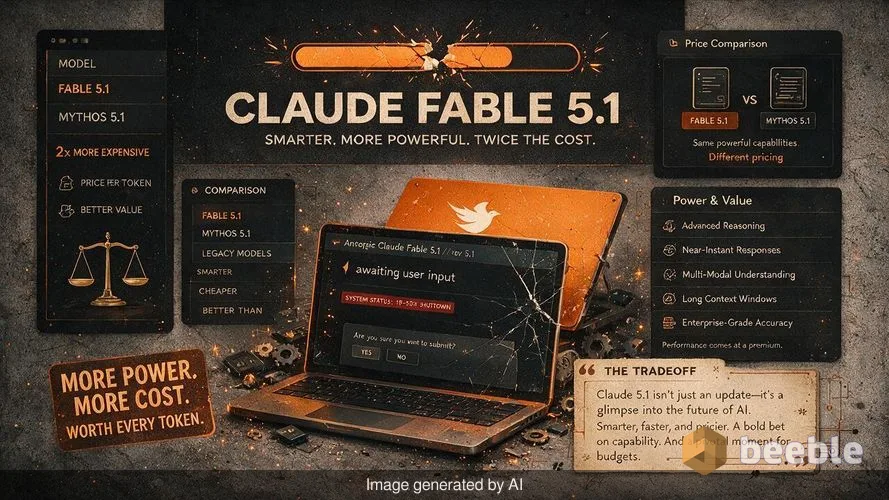
Most people assume a software update is like a phone update where you get more features for the same price. Anthropic just broke that cycle with the release of Claude Fable 5.1. While the model is vastly more capable than its predecessor, it sits in a strange place in the market. It costs twice as much to run as the model Anthropic released just two months ago, and it requires users to think harder about their budget before they click the submit button.
Anthropic released Claude Fable 5.1 and its sibling Mythos 5.1 this Tuesday. This is the first major update to the high-end Mythos line since the original Fable 5 launched in June. The release follows a chaotic three-month period for the company. During this time, Anthropic faced an 18-day export-control shutdown and a pricing dispute that left many users wondering which model they should actually use.
The math behind the brainpower jump
To understand why this update matters, you have to look at how these models are tested. Anthropic uses a test called Terminal-Bench-Science 0.1. This benchmark measures whether an AI agent can perform scientific research tasks inside a computer terminal. It is essentially a test of whether the AI can act as a tireless intern who knows how to navigate a lab computer without human help.
Fable 5.1 scored 52.6% on this test. For comparison, the previous version, Fable 5, only managed 24.7%. The mid-range flagship model, Opus 5, scored 29.0%. In plain English, the new model is more than twice as good at complex scientific reasoning as the one it replaced. This level of improvement in three months is unusual for the industry, where gains are usually measured in single digits.
On a separate test for coding—Terminal-Bench 4.0—the model showed similar progress. Fable 5.1 completed 55.8% of tasks correctly. This is a significant jump from Fable 5's 42.0% and sits comfortably ahead of Opus 5's 52.3%. The data shows that for people who use AI to write, run, and debug code, Fable 5.1 is now the top choice in Anthropic’s lineup.
| Model Name | Science Benchmark Score | Coding Benchmark Score | Input Price (per 1M tokens) | Output Price (per 1M tokens) |
|---|---|---|---|---|
| Claude Fable 5.1 | 52.6% | 55.8% | $10 | $50 |
| Claude Fable 5 | 24.7% | 42.0% | $10 | $50 |
| Claude Opus 5 | 29.0% | 52.3% | $5 | $25 |
The hidden cost of high-level reasoning
While the performance jump is impressive, the pricing creates a dilemma for the everyday user. In July, Anthropic released Opus 5. That model was a massive hit because it was better than the old Fable 5 but cost exactly half as much. For a few weeks, it seemed like the high-end "Fable" tier was dead because the cheaper model was simply better.
Fable 5.1 changes that by reclaiming the performance crown, but it keeps the original high price of $10 per million input tokens and $50 per million output tokens. Tokens are the digital crude oil that powers AI. They are the small chunks of data the model processes, roughly equal to 750 words. If you are a developer running thousands of requests an hour, paying $10 versus $5 is the difference between a profitable month and a loss.
Anthropic is trying to soften this blow with a new feature called reasoning effort. Instead of running the model at full power for every task, users can turn a metaphorical dial. The company claims that running Fable 5.1 at a low or medium effort level provides better results than the old Fable 5 but at a lower cost. However, for users who need the model to solve problems that other AI cannot touch, they will have to pay the full premium rate.
Managing the data cache
There is one area where the new model is objectively cheaper for everyone. Anthropic has cut the cost of cache reads by 75%. In the world of AI architecture, caching is like keeping a book open on a specific page so you do not have to look it up again. If you ask an AI to analyze the same 500-page document ten times in an hour, caching saves the AI from re-reading the whole thing every time.
For typical work, this cuts costs by about 25%. For highly agentic workloads—where an AI performs dozens of small steps in a row to finish a project—the savings reach up to 45%. This makes the $10 price tag more bearable for power users, but it does not change the fact that the entry price for a single question remains high.
Access to the new model is also tiered in a way that might frustrate standard subscribers. If you have a Claude Pro plan or a standard Team seat, Fable 5.1 is not included in your flat monthly fee. You have to buy usage credits separately, similar to how a prepaid phone works. Only those on the expensive Max plans or premium Enterprise seats get the model included as part of their subscription, and even then, it only covers up to 50% of their weekly usage limits.
Why the filters matter
Anthropic also released Mythos 5.1 alongside Fable 5.1. The company describes these as the same underlying model with different safety filters. Fable 5.1 is the version the general public uses. It has strict safeguards to prevent it from helping with dangerous activities.
Mythos 5.1 is different. It is restricted to vetted professionals in cybersecurity and life sciences. These experts need the AI to understand how viruses work or how hackers break into systems so they can build better defenses. Because Mythos 5.1 has lighter filters, it actually scored higher on coding tests—60.9% compared to Fable 5.1’s 55.8%. This gap exists because the standard safety filters sometimes mistake legitimate coding tasks for malicious ones and block the AI from finishing them.
What this means for your workflow
If you use AI for basic tasks like summarizing emails or writing cover letters, you should probably ignore Fable 5.1. The Opus 5 model remains the better value for everyday work. It is fast, cheap, and more than capable for common writing tasks. Using Fable 5.1 for an email summary is like hiring a rocket scientist to help you with your fourth-grade math homework.
However, if you are a software engineer or a researcher, the math shifts. The ability to complete scientific research tasks at a 52% success rate is a foundational change. It means the AI is moving from being a simple text generator to a functional agent that can handle multi-step processes. For these users, the high price is a practical trade-off for the time they save.
Looking at the big picture, Fable 5.1 shows that the AI industry is splitting into two paths. One path is focused on making AI as cheap as possible for the masses. The other path, which Fable 5.1 represents, is pushing the ceiling of what computers can do, regardless of the cost. As a consumer, you now have to decide if you are paying for a basic tool or a high-performance engine. Observe your own usage habits over the next week. If you find yourself asking the AI to do the same task three times before it gets it right, the premium price of a smarter model might actually save you money in the long run.
Sources:
Anthropic Official Technical Announcement (September 2026)
Terminal-Bench Science 0.1 Performance Report
Anthropic API Pricing Schedule
Cyber and Life Sciences Verification Program Documentation



See you on the other side.
Our end-to-end encrypted email and cloud storage solution provides the most powerful means of secure data exchange, ensuring the safety and privacy of your data.
/ Create a free account
