


Why the smartest AI for your company is the one that stays in the building

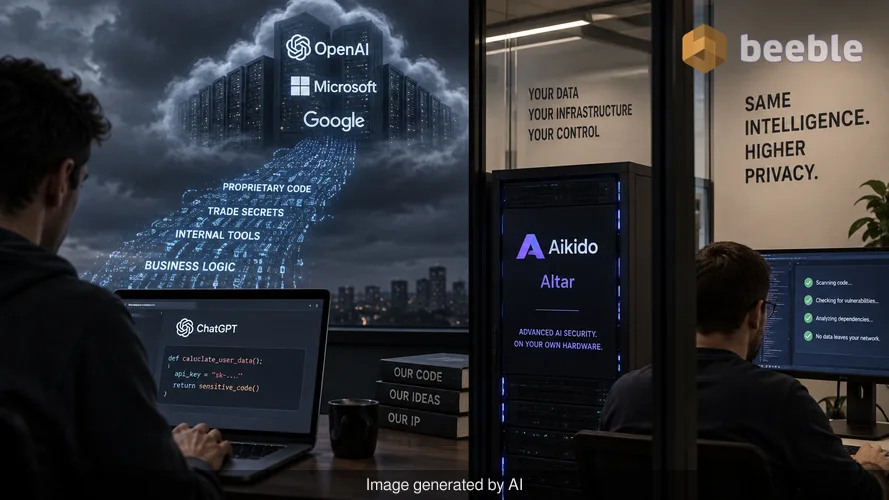
While the prevailing narrative suggests that the most powerful artificial intelligence must live in the cloud, the reality for modern software companies is much more dangerous. For years, the tech industry has operated on the assumption that convenience outweighs privacy. Developers frequently paste sensitive code into tools like ChatGPT or GitHub Copilot to find bugs, unknowingly sending their intellectual property to external servers where it is stored and analyzed. This habit turns a company's proprietary secrets into digital crude oil that fuels the engines of big tech competitors.
Belgium's Aikido is now challenging this status quo. The cybersecurity firm recently released Altar, an open-weight AI model built specifically to stay inside a company's own four walls. By allowing businesses to run advanced security checks on their own hardware, Aikido addresses a growing anxiety among executives: the fear that AI, our most productive new intern, is secretly leaking the floor plans of the office to the public. This shift marks a significant departure from the trend of centralizing intelligence in a few massive data centers.
How Aikido shrunk a giant brain into a local tool
AI models are often heavy, bloated, and hungry for expensive computing power. To make a model that runs locally without a room full of specialized servers, developers must engage in a process similar to vacuum-sealing a suitcase. Aikido based Altar on GLM-5.3, a model from Z.AI, and then compressed it to fit onto standard corporate hardware. This compression does not just save space. It makes the model faster and cheaper to operate for the average enterprise.
In technical terms, Altar is an open-weight model. This means that while the exact training data and secret sauce remain with the creators, the final mathematical structure is available for anyone to download and run. Unlike the black-box models found in Silicon Valley, an open-weight model allows a security team to see exactly how the AI handles their data. Think of it as the difference between sending your car to a mystery mechanic behind a curtain and having a set of professional tools in your own garage. The tools are yours, they stay on your property, and no one else gets to see what is under your hood.
Europe finds its footing in the global AI race
Aikido reached a valuation of $1 billion earlier this year, a milestone that places it in the rare category of European unicorns. This rise is not just a success story for Belgian venture capital. It represents a broader movement toward digital sovereignty in Europe. For a long time, European firms have been consumers of American and Chinese technology, often at the expense of their own data privacy regulations.
The demand for local tools is surging because the stakes have changed. Cybercriminals now use their own AI models to scan for vulnerabilities at a scale that humans cannot match. If a company uses a cloud-based AI to fix a bug, there is a small but real risk that the bug report itself could be intercepted or leaked. For a European firm, especially one operating under strict GDPR rules, that risk is a systemic threat to the business. Aikido is positioning itself as the guardian that keeps the data at home, which is a powerful sales pitch in a region that prizes privacy over almost everything else.
Why your bank does not trust the open internet
Banks are historically the most conservative users of new technology for a reason. A single leaked line of code in a banking app can lead to millions in losses and a total collapse of consumer trust. Belfius, a major Belgian bank, is already using Aikido’s solutions. For a financial institution, the idea of sending source code to a third-party AI provider is a non-starter.
When a bank uses Altar, the AI acts as a tireless intern who reads every line of code to check for errors. Because this intern lives on the bank's own servers, the sensitive logic of how they move money or protect accounts never touches the public internet. This creates a transparent environment where the bank can innovate without worrying about a slow leak in their security tire. The use of Altar by such high-stakes organizations suggests that local AI is moving from a niche preference to a foundational requirement for heavy industry and finance.
The hardware reality of running AI at home
Practically speaking, moving away from the cloud is not free. The reason the cloud became popular is that it offloads the need for expensive graphics cards and massive cooling systems to someone else. Running a model like Altar requires a tangible investment in local hardware. While the model is compressed, it still needs modern processors to function at a speed that is useful for a developer team.
However, the math is beginning to shift. The cost of a cloud AI subscription for a team of 500 developers can be hundreds of thousands of dollars per year. Conversely, a one-time investment in a few high-end servers can pay for itself in eighteen months. When you add the cost of a potential data breach—which now averages over $4 million globally—the local approach looks less like an expensive luxury and more like a prudent insurance policy. For the average user at a smaller firm, this might mean that AI tools become slightly slower but infinitely safer.
Privacy is a competitive advantage
Looking at the big picture, the launch of Altar is a sign that the AI honeymoon phase is ending. The initial excitement of "what can AI do?" is being replaced by the pragmatic question of "what is AI doing with my data?" We are entering a cyclical phase where decentralization becomes the new standard. As AI becomes the invisible backbone of modern life, the companies that control their own intelligence will be the ones that remain resilient in the face of volatile global markets.
For the everyday consumer, this trend is good news. Even if you never see the code inside your banking app, the fact that your bank is using local AI means your personal data is one step further away from a catastrophic leak. It means that the software you use every day is being checked for holes by a machine that doesn't talk to the outside world. This shift toward local, open-weight models is a necessary correction to the "move fast and break things" era of the early 2020s.
Ultimately, the rise of Aikido and its Altar model shows that you do not have to choose between cutting-edge technology and total privacy. The most disruptive thing a tech company can do today is give its customers the tools to ignore the cloud entirely. Observe your own digital habits and ask how much of your information is sitting on a server you don't own. The answer might make a local AI model seem like the most logical tool in your kit.
Sources:
- Aikido official press release, September 2026.
- Z.AI Technical Documentation on GLM-5.3 Model Architecture.
- Belfius Bank Annual Security Strategy Report.
- European Cyber Security Organization (ECSO) Market Analysis.



See you on the other side.
Our end-to-end encrypted email and cloud storage solution provides the most powerful means of secure data exchange, ensuring the safety and privacy of your data.
/ Create a free account
