


Why the World’s Biggest Retailer Refuses to Chase Every New AI Trend

For the last few years, the corporate world has been caught in a fever dream. If a company doesn't mention "AI" at least a dozen times during an earnings call, investors start treating it like a rotary phone in a smartphone era. We have seen a relentless race to integrate the newest, largest, and most expensive language models into everything from spreadsheets to smart fridges. However, while the rest of the industry is tripping over itself to be first, Amazon is taking a remarkably different path.
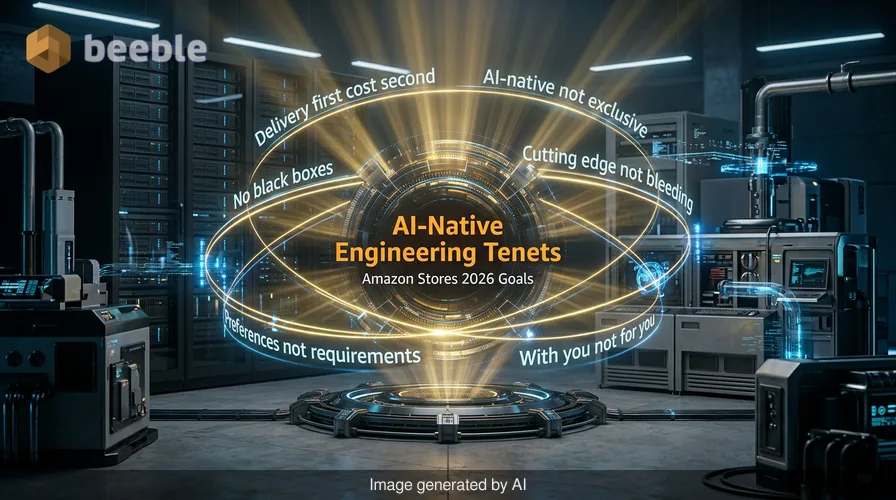
Recently, internal documents from Amazon’s "Stores" division—the massive engine behind its retail business—leaked, revealing six core tenets for how the company builds with artificial intelligence. At first glance, these rules might seem like standard corporate jargon. But looking at the big picture, they represent a radical departure from the "move fast and break things" mentality that usually defines Silicon Valley.
Amazon is choosing to be pragmatic rather than performative. By adopting a "cutting edge, but not bleeding edge" philosophy, the retail giant is signaling that it cares more about whether a tool works than whether it is trendy. To put it another way, Amazon is treating AI like a sophisticated power tool: it is incredibly useful for heavy lifting, but you don't use a chainsaw to butter your toast just because it’s the most powerful tool in the shed.
The "Build Now, Pay Later" Approach to Innovation
One of the most striking rules in the Amazon playbook is "Delivery first, cost second." In the world of high finance and tight margins, this sounds almost irresponsible. Usually, engineering teams are haunted by the "compute cost"—the digital electricity bill generated every time an AI thinks.
Behind the jargon, what this means is that Amazon is prioritizing the user experience over immediate profitability. They want their engineers to build solutions that actually solve customer problems first, without being paralyzed by the price tag of the server space. Essentially, they are betting that if they create something truly disruptive and useful, they can figure out how to make it cheaper and more streamlined later. Historically, this is how Amazon conquered the cloud computing market with AWS; they built the infrastructure first and worried about the granular economics once the system was robust.
Why AI Isn't Always the Answer
Perhaps the most refreshing tenet is the admission that "AI-native is not AI-exclusive." We are currently living through a period of "AI-washing," where every software update is rebranded as "AI-powered" even if it’s just a slightly better search filter. Amazon is explicitly telling its teams to stop forcing the technology where it doesn't belong.
For the average user, this is a win. We have all experienced the frustration of a "smart" chatbot that can’t perform a simple task that a standard menu of buttons could have handled in seconds. Amazon’s stance is foundational: use the best tool for the job. Sometimes that is a massive, trillion-parameter language model, and sometimes it is just a very good piece of traditional code. This systemic approach prevents the "bloatware" effect, where apps become slower and more confusing because they are trying to be more "intelligent" than they need to be.
Avoiding the "Bleeding Edge" Trap
In the tech world, being on the "bleeding edge" means using the absolute newest version of a technology. The problem with the bleeding edge is that, as the name suggests, you often get cut. New AI models are frequently volatile, prone to "hallucinations," or susceptible to sudden performance drops.
Amazon’s internal guidelines state they will not try to keep pace with every incremental update in AI technology. Instead, they will remain resilient by retaining the flexibility to switch models only when the benefits clearly outweigh the costs. Curiously, this means Amazon might intentionally use a "slower" or "older" AI model if it is more reliable. From a consumer standpoint, this translates to consistency. You want your package tracking and product recommendations to work every single time, not to be a guinea pig for an experimental algorithm that might break on a Tuesday afternoon.
The End of the "Black Box"
One of the biggest criticisms of modern AI is that it is often a "black box"—even the programmers who built it don't always know why it made a specific decision. This lack of transparency is a major hurdle for trust, especially in a business that handles millions of credit card transactions and personal data points.
Amazon’s final tenet, "No black boxes," is a firm line in the sand. They are willing to forego better performance or lower costs if a solution isn't auditable and traceable. In everyday life, this is the difference between an AI denying your insurance claim "just because" and a system that can provide a clear, human-understandable reason for its actions. By insisting on traceability, Amazon is attempting to build a more transparent architecture that can be held accountable when things go wrong.
What This Means for You
So, what does this shift in strategy actually mean for the person clicking "Buy Now"? It suggests a move away from the era of "gimmick AI" and toward an era of "invisible AI."
| Feature | The Hype Approach (Bleeding Edge) | The Amazon Approach (Pragmatic) |
|---|---|---|
| Reliability | High risk of bugs and errors. | Prioritizes stable, proven tech. |
| Cost | High, often passed to the consumer. | High initially, then aggressively optimized. |
| Functionality | AI for the sake of AI. | AI only when it’s the best tool. |
| Transparency | "Trust the algorithm." | "Show your work." |
Practically speaking, you might see fewer flashy, conversational interfaces that don’t actually help you shop, and more systemic improvements in the background. This could manifest as more accurate delivery windows during volatile weather, or a more intuitive way to find a specific item among millions of listings without having to know the exact brand name.
Looking Ahead: The 2026 Horizon
As we look toward the ambitious goals Amazon has set for 2026, it is clear they are viewing AI as an interconnected part of their full development lifecycle, not just a coat of paint applied at the end. They aren't trying to build a digital god; they are trying to build a more efficient warehouse, a faster delivery network, and a more streamlined shopping experience.
Ultimately, Amazon's approach reminds us that the most successful technology is often the kind you don't notice. When your refrigerator stays cold, you don't care about the thermodynamics; you just care that your milk isn't sour. By focusing on the "cutting edge" rather than the "bleeding edge," Amazon is betting that consumers value a package that arrives on time more than a chatbot that can write poetry about their order history.
As a consumer, it’s worth observing your own digital habits. Are the "AI" features you use daily actually saving you time, or are they just new ways to perform old tasks? The next time you interact with a major platform, look under the hood. The most impressive innovation might not be the one that talks to you, but the one that makes the entire world behind the screen work a little bit better.
Sources:
- Amazon Internal Engineering Memos, Stores Division (April 2026).
- Statements from Montana MacLachlan, Amazon Spokesperson.
- Business Insider Tech Analysis Report on "AI-Native Engineering Tenets."
- Market Research: The State of Enterprise AI Adoption (Q1 2026).



See you on the other side.
Our end-to-end encrypted email and cloud storage solution provides the most powerful means of secure data exchange, ensuring the safety and privacy of your data.
/ Create a free account
