


Why the world's most efficient AI model is currently a legal nightmare

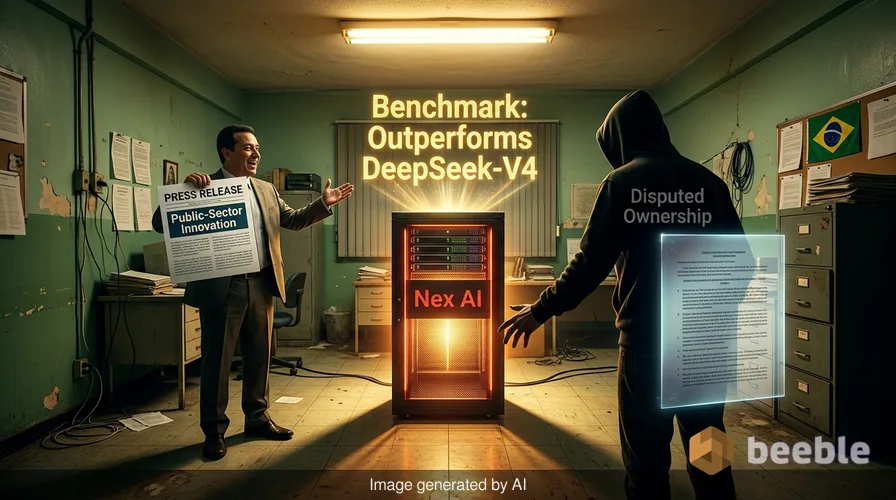
While the world usually looks to Silicon Valley or Beijing for the next big breakthrough in artificial intelligence, a surprising contender emerged from the municipal offices of Rio de Janeiro. The city recently announced Nex, an AI model that allegedly outperformed DeepSeek-V4 in several key performance metrics. On paper, this is a triumph for public-sector innovation. It suggests that a city government can compete with multi-billion dollar tech giants using a fraction of the budget. However, the story behind the software is far messier than the official press releases suggest. Behind the benchmarks lies a bitter dispute over ownership, intellectual property, and whether the city actually has the right to the code it claims to have built.
The myth of the miracle model
Rio de Janeiro's claim caught the tech world off guard because DeepSeek is the current gold standard for efficiency. DeepSeek, a Chinese firm, is famous for building models that offer high performance without requiring the massive electricity and hardware costs associated with companies like OpenAI or Google. When Rio announced that its own model, Nex-1-70B, was faster and more accurate than DeepSeek-V4, it was like a local bicycle shop claiming to have built a faster engine than Ferrari. The city pitched this as a victory for the people of Rio, promising that the model would soon power everything from school tutoring to city planning.
Looking at the big picture, the efficiency of Nex is its most disruptive quality. It is a 70-billion parameter model, which is large but manageable. Think of parameters as the number of tiny switches inside the AI's brain. More switches usually mean a smarter model, but they also mean you need more expensive microchips to run it. Nex managed to pack more intelligence into fewer switches, making it a scalable solution for organizations that cannot afford a warehouse full of servers. This efficiency makes it an attractive tool for other cities and smaller businesses. But as the technical data began to circulate, so did allegations that the foundations of this model were not entirely the city's to give away.
How a city outpaced the giants of Beijing
To understand how Nex works, you have to look at how modern AI is trained. Most developers do not start from scratch. Instead, they take an existing open-source model and refine it through a process called fine-tuning. This is similar to buying a generic store-bought cake and adding specialized frosting and decorations to make it a wedding cake. Rio de Janeiro claims its team performed a specialized type of training that optimized the model for the Portuguese language and specific administrative tasks. This made Nex a tireless intern that understood the local context better than any model trained in California or China.
On the market side, this was a bold move. By beating DeepSeek, Rio signaled that it was no longer just a consumer of global technology. It was now a producer. The city government even spoke about exporting the technology to other Lusophone countries. For the average user in Brazil, this meant a future where local government services are faster and more intuitive. Instead of navigating a confusing website to pay a fine or request a permit, a citizen could simply chat with Nex. The model promised to be a foundational layer for a new, streamlined digital bureaucracy. But the excitement cooled when the lead architect of the project went public with a different version of events.
The architect who says his work was stolen
Arthur Guez, the former chief of staff for Rio’s digital transformation, claims that Nex was not a product of city resources alone. Guez and his team argue that the core work behind the model was developed using their own private infrastructure and intellectual property before it was ever integrated into the city's projects. According to Guez, the city effectively seized the project and rebranded it as a municipal achievement without compensating the creators or acknowledging their ownership rights. This has turned a technical milestone into a volatile legal battle.
This dispute highlights a systemic problem in the world of public-private partnerships. When a government official works on a project, the line between "official work" and "personal innovation" is often opaque. The city of Rio maintains that because the development happened under its umbrella and utilized public visibility, the result is public property. Conversely, Guez asserts that the specific techniques and data used to make Nex so efficient were his own. This conflict creates a significant risk for the future of the model. If a court decides that the city does not own the code, Nex could be pulled from the market, leaving the users who rely on it in the dark.
Why this matters for the average user
From a consumer standpoint, you might wonder why an ownership dispute in Brazil matters to someone using AI in London or New York. The answer lies in the transparency of the tools we use every day. We are currently in a cycle where AI models are increasingly integrated into our lives. We use them to write emails, plan trips, and manage our finances. If these models are built on contested ground, the stability of our digital tools is at risk. A legal injunction could shut down an AI service overnight, much like a slow leak in a tire that eventually leads to a flat at the worst possible time.
There is also the question of trust. For the average user, the appeal of a model like Nex is that it is supposed to be more transparent than a corporate model from a company like Microsoft. We expect government-led tech to be a public good. If the development process is shrouded in accusations of intellectual property theft, that trust evaporates. It suggests that even in the supposedly open-source world of AI, the same old power struggles of big industry are at play. This dispute makes the model less resilient because developers are hesitant to build on top of software that might be illegal to use in six months.
The hidden cost of public tech
Historically, the most successful industrial developments have had clear rules about who owns what. When those rules are broken, innovation stalls. The Nex situation is a warning for other municipalities attempting to build their own tech stacks. While it is tempting to claim a win for the public sector, cutting corners on legal ownership creates a fragile product. The bottom line is that Nex might be technically superior to DeepSeek, but technical superiority is worthless if you cannot legally use the software. This is not just a Brazilian problem. As more cities try to build their own "sovereign AI" to avoid relying on big tech, these ownership disputes will become more common.
Essentially, the world is watching Rio to see how this settles. If Guez wins his case, it will force governments to be much more careful about how they collaborate with private developers. If the city wins, it might set a precedent where any innovation created by a public employee is automatically seized by the state, regardless of previous agreements. Neither outcome is particularly user-friendly. It creates a landscape where the people actually writing the code—the digital weavers of our modern world—are caught between aggressive governments and protective private interests.
How to protect your digital habits
Practically speaking, what this means is that you should be cautious about moving your entire workflow to a single, niche AI model, no matter how good the benchmarks look. The Nex dispute shows that the most efficient model is not always the most stable one. When choosing a tool for your personal or professional life, look for projects with clear, documented governance structures. Transparency is a feature, not just a buzzword. You want to know that the team behind your favorite app has a clear right to the code they are selling you.
Ultimately, you should observe how the apps you use are built. If a company or a government body cannot explain where its data came from or who owns its algorithms, that is a red flag. As AI becomes the invisible backbone of modern life, the legal foundations of that backbone must be as solid as the code itself. In the coming years, the winners in the AI space will not just be those with the smartest models. They will be the ones who can prove their work is their own, providing a stable platform for everyone else to build on.
Sources:
- Decrypt media reports on the Rio AI dispute
- Rio de Janeiro City Hall official technical documentation
- Arthur Guez public statements and legal filings
- DeepSeek official performance benchmarks



See you on the other side.
Our end-to-end encrypted email and cloud storage solution provides the most powerful means of secure data exchange, ensuring the safety and privacy of your data.
/ Create a free account
